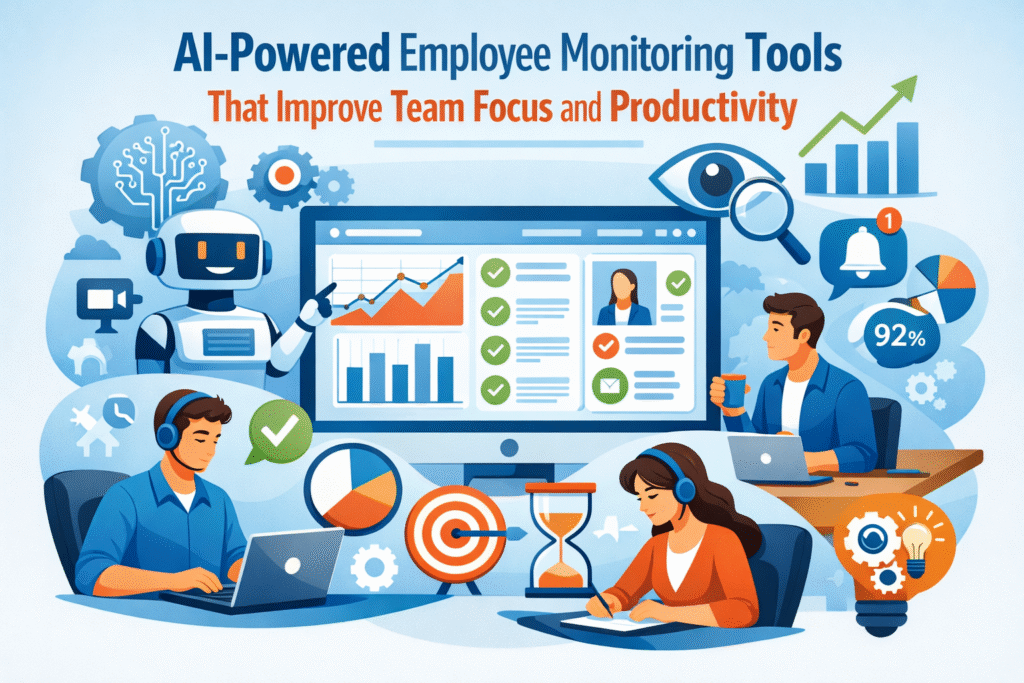
Modern organizations are reconsidering how productivity is measured, supported, and enhanced. Traditional time-tracking methods and manual supervision simply cannot keep pace with the speed and complexity of today’s work. With teams becoming more and more distributed and knowledge-driven, AI-powered productivity tools and AI productivity software for teams are taking over to provide a more intelligent, human, centric way of staying focused and productive.
The change is not simply about automation; it’s about getting insights. Managers are now less interested in the number of hours someone has worked and more interested in how work is done efficiently. Interruptions, disjointed communication, constant context switching, and an inability to observe actual work habits are making it harder to maintain productivity.
Here, the discussion shifts to AI-enabled workforce productivity software.
Instead of reactive watching, AI-powered productivity management enables active observation of work patterns that anticipate team slowdowns, while providing guidance on where to focus on the right things without micromanagement.
AI-powered workforce productivity software solutions use machine learning and behavioural analysis to understand how work is done within teams. An AI-driven work productivity platform doesn’t just count hours or take screenshots; it also analyzes workflows, tool usage, focused work time, and output models to highlight key insights.
Unlike traditional surveillance software, which operates on static rules and reports, AI-powered platforms continuously learn. They use automation to learn from patterns across roles, teams, and projects, thereby significantly reducing administrative work and removing guesswork.
The real value is in the interpretation. AI is not only a data collector; it also identifies the relationship between activities and outcomes. Leaders are now in a position to facilitate performance improvement without the need for constant check-ins or subjective evaluations.
Common Productivity Challenges in Modern Teams
Limited Visibility into Work Patterns
Most organisations are unsure how workflow actually works. A glance at employee productivity analytics software often shows that effort and output are not always aligned. Managers can only view completed tasks; they are unaware of the hidden inefficiencies that frequent app switching, meeting overload, or lack of focus slow teams down.
Lack of visibility into the situation as it unfolds makes productivity decisions reactive and, most of the time, based on assumptions rather than facts.
Productivity Gaps in Remote and Hybrid Work Models
The new norm of working from home has increased the need for productivity tools for remote teams. The lack of a set routine, time zone differences, and fewer informal communications can, almost unnoticed, lead to declines in both concentration and responsibility. It is particularly difficult for hybrid teams to manage the different productivity expectations that in-office and remote employees face.
AI-assisted data can support equitable decision-making by providing standardized, measurable insights for all locations.
Manual Reporting and Biased Performance Evaluation
Manual productivity tracking is not only laborious but also prone to bias. Performance evaluations often reflect visibility rather than impact, leading people to feel disconnected and frustrated. When reliable data are unavailable, managers struggle to make sound, winning decisions that support both performance and well-being, guided by fairness, timing, and compatibility.
How AI-Powered Employee Monitoring Instruments Facilitate Productivity?
Intelligent Work Activity Tracking
Intelligent work productivity tools for teams combine AI-powered employee productivity tracking with analysis of work processes, application usage, and concentration patterns. Through intelligent work activity insights, teams can see clearly where their time goes minus the unwarranted surveillance.
The highlight is on patterns rather than individuals. Using AI to identify productivity rhythms, peak focus hours, and common interruptions helps teams adjust their work methods rather than limiting behaviour through a system of rules.
Data-Driven Productivity Analytics
Using the latest employee productivity analytics software, a leader sees a visual summary of the situation, showing changes over time. These revelations would provide a foundation for better decisions on human resources, operations, and technical innovation.
Beyond guessing why deadlines slip or workloads feel uneven, managers can now base their actions on actual data.
Focus Optimization and Distraction Reduction
AI, for one, is an expert at uncovering hidden inefficiencies that reduce productivity. By identifying meetings that are too frequent, too many tools, or too scattered schedules, AI helps teams organize their workdays more intentionally and preserve time for deep work—the most precious and least available resource in today’s organizations.
AI tools for hybrid workforce productivity aim to provide flexibility without sacrificing accountability. For productivity tools for remote teams, real-time visibility enables managers to focus on results rather than on the activity level.
AI builds trust when implemented transparently. Employees understand how the metrics are used, and managers become more confident in the absence of constant oversight. Achieving this equilibrium is essential to maintaining performance in distributed environments.
According to a 2024 Gartner report, 75% of companies that use AI-driven workforce analytics report accelerated decision-making and improved team productivity.
- A mature AI-driven work productivity platform typically includes AI-based activity analysis, smart alerts, and productivity scoring that adapts to different roles.
- Context-aware productivity scoring, with benchmarks that adapt by job function, team, and task complexity instead of neutral “one-size-fits-all” scoring systems.
- Smart notifications and recommendations to detect threats to productivity, work overload, or inefficiencies in the system before they become problems!
- Relevance-first insights – designed so that teams and leaders can focus on meaningful information instead of getting lost in raw activity logs.
- Predictive analytics and forecasting enable leaders to anticipate when they may face increased risk of burnout, reduced productivity, or constrained resources.
- Seamless integration with task management software ensures insights align directly with real work, not isolated metrics.
Advantages of Implementing AI-Driven Productivity Software for Your Team
Organizations adopting AI productivity software for teams often see improvements that go beyond output:
- More defined priorities and better focus, because AI identifies where work delivers the most value and where it is scattered.
- More even workloads to help teams keep hidden overload at bay and use capacity strategically across roles.
- Objective, data-driven performance insights reduce bias from visibility-based or subjective assessments.
- Early recognition of burnout indicators enables proactive, rather than reactive, intervention when productivity declines.
- Better employee experience, fewer last-minute escalations, clearer expectations and more consistent support.
- Stronger leadership confidence: resource, timeline, and performance decisions are supported by real data.
A 2025 McKinsey study found that companies using AI for workforce optimisation achieved 20–30% productivity gains in knowledge-based roles.
AI productivity tools realize their full potential only when they are seamlessly integrated into current work routines. Linking the data to a project management tool is a good way to keep daily work aligned with the strategic objectives. Once a connection to the project management software is established, it is easier to proactively manage timelines and meet milestones.
By integrating with team collaboration software, productivity insights can be used to improve communication without adding complexity. What is achieved is a cohesive overview of the work, conducive to large-scale performance.
Ethical implementation is key. Productivity monitoring should be about coaching, not spying. Thoughts are tracked; why it matters and how data is used foster trust and acceptance.
Best practices include anonymised insights where feasible, role-based benchmarks, and employee access to their own data. When AI is presented as a support system rather than a control tool, it strengthens culture rather than undermining it.
- Scalability for mid-market and enterprise expansion to ensure the platform keeps pace as the team, projects, and data volumes grow.
- Depth and accuracy of insights, with an emphasis on actionable, not shallow, activity-based tracking.
- Integrates easily, allowing the platform to be naturally embedded within current systems and workflows without disrupting work.
- Good support for remote or hybrid teams, providing predictable visibility and accountability regardless of location.
- Transparency, ethics-based design to build trust, built with clear metrics, explainable insights, and employee-centric deployment.
- Focus on alignment with employee experience: productivity gains should not make employees work harder; they should support their well-being, not just their output targets.
Conclusion: AI for Smarter Productivity, Not Employee Surveillance
The future of work is all about smarter systems, not tighter control. AI-powered productivity tools and AI-powered workforce productivity software allow companies to raise focus, fairness, and performance without the need for micromanagement.
Instead of shifting the focus from watching to understanding, AI changes the meaning of productivity from a checked activity to a shared outcome. WeekMate is an example of this approach: smart features that enable teams to be more effective rather than work longer hours.
As data-driven focus turns into the new productivity norm, those organisations that adopt ethical, AI-led productivity management will be the ones to succeed in the ever more complicated work environment.
FAQs
1. Do AI-powered employee monitoring tools equal employee surveillance?
No. Advanced AI-powered productivity tools primarily focus on identifying work patterns, not on monitoring individuals. They focus on analyzing aspects such as the time devoted to concentration, equity of the workload, and efficiency of the work process rather than storing private content or micromanaging. When used ethically, these tools can support both performance improvement and employee well-being.
2. How do AI productivity tools enable remote and hybrid teams to work while keeping trust?
AI productivity software for teams fosters trust-building transparency through objective, role-based insights rather than through frequent employee check-ins. By focusing on what teams have accomplished and the patterns of their work, rather than their mere presence, teams become clear and accountable without losing their autonomy, which is very important for remote and hybrid work models.
3. What type of information do AI-powered workforce productivity platforms reveal?
An AI-powered workplace productivity platform provides a wide range of insights, including changes in concentration levels, how work is shared, peak efficiency times, collaboration patterns, and early signs of exhaustion. Such findings give managers the freedom to make decisions on matters such as staffing, the duration of different stages, and the overall approach, reducing their dependence on guesswork.
4. How quickly can organizations realise benefits from AI productivity software?
Typically, mid-market and enterprise customers gain significant insights within the first couple of weeks. As the system gets familiar with the team’s behavior over a period of time, the precision and worth of the recommendations on productivity will get fine-tuned, thus paving the way for data-driven decisions to be made more rapidly and for the benefits in productivity to be maintained.