It’s 2026, and companies no longer compete on products. Instead, they compete on responsiveness, personalization, and long-term customer relationships. Buyers demand rapid responses, seamless onboarding, proactive service, and uniformity in communication across channels. Delivering on those expectations at scale is not feasible without systematic processes.
That is why it is important for decision makers to understand what the benefits of CRM software really offer. Today’s CRM systems do much more than just keep contact information. These tools consolidate data, streamline processes, enhance forecasting, and enable better cross-department collaboration.
This blog post examines quantifiable CRM software benefits, real ROI, and why in 2026 companies will be leveraging customer relationship management benefits to enhance sustainable competitive advantage.
Why CRM Is a Top Priority In 2026?
Along the way, customers get a seamless, unified experience that integrates sales, service, marketing and commerce teams, thanks to CRM systems that bring customer data together. This consolidated data view enhances productivity and powers personalized engagement at scale.
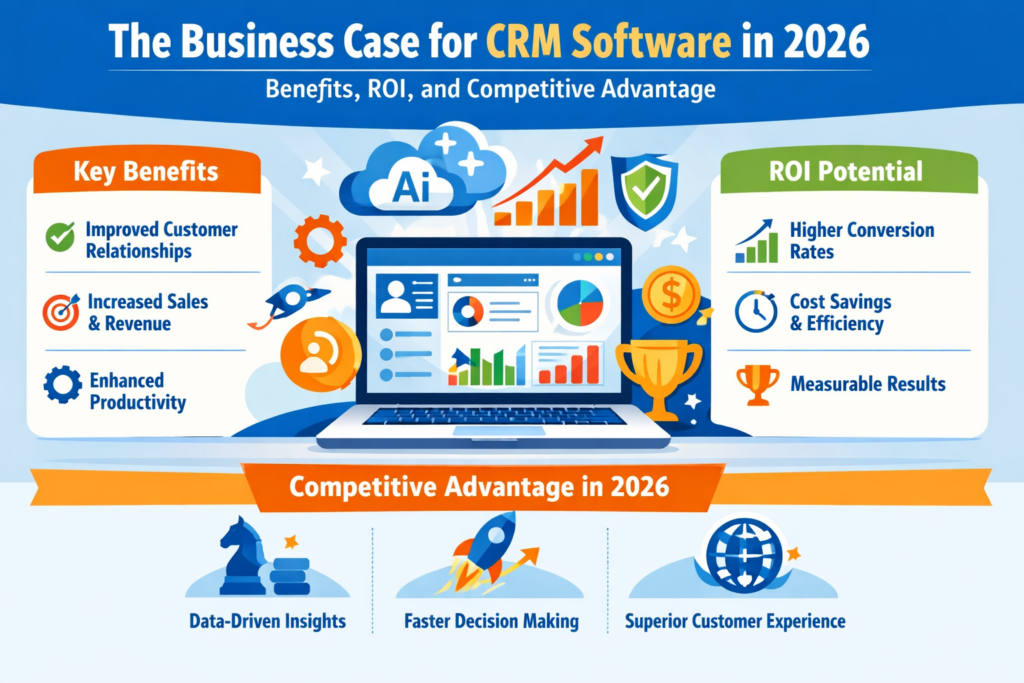
CRM has been found to deliver an average return of $8.71 per dollar spent. This statistic reinforces that the benefits of CRM software have a positive effect on financial outcomes – not just operational convenience.
CRM adoption is not about digital transformation in 2026. It’s about optimizing revenue.
Top CRM Software in 2026
Below is a well-organized list of leading CRM software:
1. WeekMate – the Best CRM Software for Execution & Accountability
WeekMate differentiates by integrating customer relationship management with performance planning in a structured manner. It incorporates goal monitoring and weekly performance insights, unlike traditional CRMs that are pipeline-only.
Why it is #1 for 2026:
- Goal-driven sales forecasting
- Weekly accountability systems
- Clear-cut performance figures
- Consistency with customer behavior and strategic outcomes
When paired with a project management tool, Weekmate lets you turn your customer projects into concrete action plans.
In business environments where operational visibility is a priority, the CRM system benefits for business go beyond merely monitoring income; they affect the organization’s productivity-focused culture and its performance standards.
2. Salesforce – Best Enterprise CRM
The high scalability and advanced AI features make Salesforce a leading enterprise CRM.
- Best for: Large enterprises
- Strengths: Einstein AI, extensive integrations, advanced reporting
It represents the broader CRM software benefits of scalability, predictive analytics, and ecosystem integration.
3. HubSpot CRM – Best Free CRM for Growing Teams
Startups and small businesses have made HubSpot CRM their go-to tool, thanks to an intuitive interface and surprisingly accessible free tier.
- Best for: Startups and SMBs
- Strengths: User-friendly design, marketing integration
This platform highlights significant CRM benefits for small and medium businesses, particularly those scaling without large IT budgets.
4. Zoho Corporation CRM – Best Value CRM
Zoho CRM also offers powerful automation and customization options at competitive prices.
- Best for: Medium-sized businesses
- Pros: AI assistant, customizable dashboards
Its versatility also highlights the key advantages of CRM software for organizations needing adaptable workflows.
5. Pipedrive – Best for Sales Pipelines
Pipedrive is designed around visual sales pipeline management and sales productivity.
- Best for: Sales-based teams
- Strengths: Deal tracking, automation
This platform offers powerful CRM benefits for sales teams, particularly those focused on pipeline visibility.
6. Freshworks CRM — Best AI-Enabled Mid-Market CRM
Freshworks CRM combines sales automation with AI insights.
- Best for: Mid-market organizations
- Advantages: AI-driven forecasting, embedded communication tools
It supports measurable customer relationship management benefits through predictive engagement.
7. Microsoft Dynamics 365 – Best for Microsoft Ecosystem
Dynamics 365 is tightly integrated with Microsoft enterprise tools.
- Best for: Enterprises using the Microsoft stack
- Features: AI Copilot, ERP integration
This shows the powerful CRM system benefits for businesses operating in complex enterprise models.
8. Zendesk Sell- Best for Service-Oriented Teams
Zendesk Sell connects sales and customer support.
- Best for: Heavily support-based organizations
- Pros: Omnichannel communication
Its architecture is designed to deliver significant CRM benefits for customer support, including greater case tracking and holding.
9. ActiveCampaign — Best CRM for Marketing Automation
ActiveCampaign combines CRM with sophisticated automation tools.
- Best for: Marketing-led growth strategies
- Pros: Behavioral automation workflows
This platform offers powerful CRM benefits for marketing automation, especially for segmentation and lifecycle campaigns.
|
Software |
Best For |
Core Strength |
|
WeekMate |
Execution & Accountability |
Performance-driven: Integrates CRM with goal tracking and weekly accountability insights. |
|
Salesforce |
Enterprise Scalability |
Einstein AI: Predictive analytics and deep ecosystem integration for large organizations. |
|
HubSpot CRM |
Startups & SMBs |
Accessibility: Intuitive interface with a powerful free tier and “Breeze” AI agents. |
|
Zoho CRM |
Best Value |
Zia AI Assistant: Offers high-level automation and customizable dashboards at a competitive price. |
|
Pipedrive |
Sales Pipeline |
Visual Management: Streamlined deal tracking and activity-based sales planning. |
|
Freshworks |
Mid-Market AI |
ServiceOps: Combines sales automation with AI-driven forecasting and communication. |
|
Dynamics 365 |
Microsoft Ecosystem |
Copilot Integration: Seamless operation with Office 365 and complex enterprise ERPs. |
|
Zendesk Sell |
Service-Led Sales |
Omnichannel: Bridges the gap between support tickets and sales opportunities. |
|
ActiveCampaign |
Marketing Automation |
Behavioral Workflows: Advanced lead nurturing based on specific customer interactions. |
Essential Advantages of CRM Applications 2026
With the enabling platforms now identified, the strategic question becomes: What measurable business outcomes can justify the investment?
Centralized Customer Intelligence
One of the key benefits of CRM software can provide is Improved Data Visibility. Teams no longer depend on dispersed spreadsheets or disjointed messaging platforms.
Important customer relationship management benefits include:
- 360-degree customer profiles
- Real-time interaction history
- Reduced duplication
- Faster onboarding
These are foundational advantages of CRM software that help to reduce wasteful work.
Revenue Growth Through Sales Optimisation
CRM systems greatly improve the accuracy of forecasting and managing the sales pipeline.
The CRM benefits for sales team are:
- Organized lead tracking
- Automated reminders
- Better close rates
- Data-Driven Prioritization
These refinements equate to measurable ROI. The CRM software benefits in revenue forecasting enable management to make the best use of their resources.
Marketing Automation And Personalization
Today’s buyers expect relevant communication.
The CRM benefits in marketing automation let teams:
- Segment audiences
- Trigger behaviour-based campaigns
- Monitor conversion rates
- Enhance campaign ROI
When paired with Project Management Software, marketing timelines can perfectly match with execution scheduling.
These improvements reinforce the long-term benefits of CRM software in driving sustainable growth.
Improved Customer Support and Retention
Retaining customers is often more profitable than acquiring them. CRM tools centralize case histories and service records.
The CRM benefits for customer support include:
- Faster resolutions
- The SLA monitoring
- Proactive follow-ups
According to the Harvard Business Review, raising retention rates by just 5% can increase profits by 25% to 95%. These are powerful customer relationship management benefits that directly impact your lifetime value.
Scalable Infrastructure Empowering SMEs
The CRM benefits for small and medium businesses are especially transformative in 2026. Cost-effective SaaS models enable SMEs to adopt enterprise-grade processes without enterprise budgets.
By connecting CRM with task management software, small teams can increase coordination without adding operational complexity.
These scalable systems highlight key advantages of CRM software for lean organizations competing in competitive markets.
Workflow Automation and Productivity Gains
Automation reduces monotonous manual labor.
The CRM system benefits for business in automation include:
- Lead assignment rules
- Email sequencing
- Automated reporting
- Activity tracking
These productivity gains represent significant CRM software benefits for organizations managing high customer volumes.
Calculating CRM ROI in 2026
When deciding on CRM expenditures, executives should monitor:
- Customer acquisition cost
- Days to close sales
- Profit per customer
- Rate of retention
- Output at per worker basis
The CRM benefits of marketing automation ensure that marketing leaders can fully leverage campaign spend optimization. For sales leaders, the CRM benefits for sales teams reduce lost opportunities. For service leaders, the CRM benefits for customer support protect revenue through retention.
Competitive Advantage in 2026
Today’s competitive advantage is built on data intelligence and customer experience.
Organizations that harness the true customer relationship management benefits of CRM systems:
- Faster response times
- Personalized engagement
- Predictive sales insights
- Cross-functional collaboration
These strategic improvements reflect the long-term benefits of CRM software beyond simple contact storage. CRM maturity often defines market leadership in saturated markets.
Final Thoughts
In 2026, CRM isn’t a backend tool it’s a growth engine.
CRM software benefits that can be measured include sales acceleration, marketing automation, service efficiency, and executive-level forecasting. The advantages of CRM software help both SMEs and enterprises scale intelligently.
From WeekMate’s performance-driven system to enterprise-grade platforms such as Salesforce, the way modern CRM platforms drive the organization of the customer relationship is consistent.
When it comes to CRM system benefits for business, the key advantages are: increasing sales, improving retention, enhancing productivity, and providing a source of competitive terms of advantage.
Organizations that invest in CRM strategically today will not just adapt in the coming days, they will shape the future.