Small and medium enterprises constitute the majority of India’s economy, but they face human resource management challenges as they expand. What starts as informal process management by the founder or an individual manager quickly becomes unmanageable when the team size exceeds 20-30 employees. Founders are trying to prioritise, recruit, run payroll, handle compliance filings, and answer employee questions while just trying to keep the business afloat.
This shift poses new HR challenges for small businesses. Manual processes are labor-intensive and error-prone, which introduces the risk of non-compliance that can harm business growth and reputation. The HR workload in small businesses increases, and one of two things happens: either the process slows down, or employees become dissatisfied.
Thankfully, cloud-based HRMS software offers a viable, adaptable solution. With these systems, routine work is automated and data are centralized, allowing small companies to elevate their HR function in a cost-effective and timely manner. In this article, we will review the top small business HR management challenges, the operational and financial impacts on business profitability, and how the latest HR systems can provide targeted relief.
Overview of HR Management for Small Business and SMEs
In big corporations, HR is a department with a talent acquisition team, a compensation team, a compliance team, and an employee relations team. By comparison, in most SMEs, HR duties are delegated to owners, operations managers, or administrators who work part-time and have little or no formal training or specialised tools.
Such a configuration often means that HR management issues in SMEs are underestimated until trouble blows up. Due to small staff and tight budgets, common HR problems in small companies like erratic record-keeping and reactive compliance have a habit of quietly piling up, leaving them vulnerable during audits, employee disputes, or periods of rapid growth.
The Hidden Costs of Doing Your Own HR in Small Business
Using spreadsheets, paper files, and email to perform HR functions incurs high hidden costs. The problems with manual HR management also steal time: payroll itself can be three or more days of manual work at month’s end. Managing employee records manually increases the risk of duplicate entries, stale information, and even data loss due to hardware failures or misfiling.
This is other than wasting time. Deductions or statutory filing mistakes can invite penalties, whereas late payslips or leave approvals lead to loss of employee trust. Over time, this translates into employee churn, lower employee productivity, and less focus on strategic business initiatives.
What are the Key HR Management Challenges Faced by Small Businesses?
1. Manual Management of Employee Records
Employee data joining letters, salary revisions, performance reviews, personal documents is stored in different folders across drives and spreadsheets. Accessing past records for appraisals or separations is error-prone and time-intensive.
This challenge ranks among the most persistent common HR problems in small companies, leading to inconsistencies that affect payroll accuracy, compliance reporting, and employee experience.
2. Compliance Challenges in HR for SME
Indian SMEs have to comply with a myriad of regulations, such as Provident Fund (PF), Employees’ State Insurance (ESI), Tax Deducted at Source (TDS), Professional Tax, gratuity, bonus, and certain state-level labour regulations. Manually monitoring due dates, calculations for contributions, and filing returns is error-prone and time-consuming.
The HR compliance challenges for SMEs face leave them vulnerable to financial penalties, legal notices, and harm to their reputation especially when scrutinized during audits or inspections.
3. The Challenge of Payroll Management in Small Businesses
Manual payroll processing has to calculate not only wages and salaries but also allowances, overtime, deductions, incentives, and taxes applicable to each employee. Variations such as late joiners, partial months, or variable pay further increase the complexity and the likelihood of errors.
Payroll management challenges in small businesses are common and can lead to late paychecks, inaccurate pay stubs, employee complaints, and a general lack of trust, all of which can disrupt business operations.
4. Issues of Employee Sign-in/out and Leave Management
Attendance management via registers, WhatsApp, or individual biometric machines can lead to discrepancies, particularly in hybrid or remote environments. Leave applications typically do not go through formal approval processes, leading to disputes over balances and entitlements.
Employee attendance and leave management issues lead to payroll errors, affect workforce planning, and compromise peace of mind.
5. Increasing HR Workloads With Very Little Resources
As the number of people you manage grows, so do your HR duties: recruiting, onboarding, enforcing policies, monitoring performance, conducting exit interviews, and handling grievances, all without additional resources.
An increasing HR workload in small businesses causes those responsible for completing these functions to burn out, service quality to decline, and strategic HR activities, such as talent development, to be overlooked.
6. Challenges Scaling HR Processes
What worked when your team needed only three people doesn’t work for nine people. Ad-hoc methodologies are harder to standardize, making it difficult to achieve uniformity across departments/branches.
Difficulties in scaling HR operations and digital HR management challenges limit expansion potential and increase operational risk during growth phases.
For an early adopters’ perspective on the benefits, see our related article: Why Small Businesses Need HR Management Software.
Why Traditional Approaches No Longer Work at Scale?
Spreadsheets and other disconnected tools lack the necessary framework to accommodate growing complexity. More employees mean more variables such as different leave policies, multi-state regulations, and varying payroll schedules. Digital HR management challenges multiply, increasing the risk of non-compliance, inaccurate data, and process failures.
How Cloud-Based HRMS Software Solves These Issues?
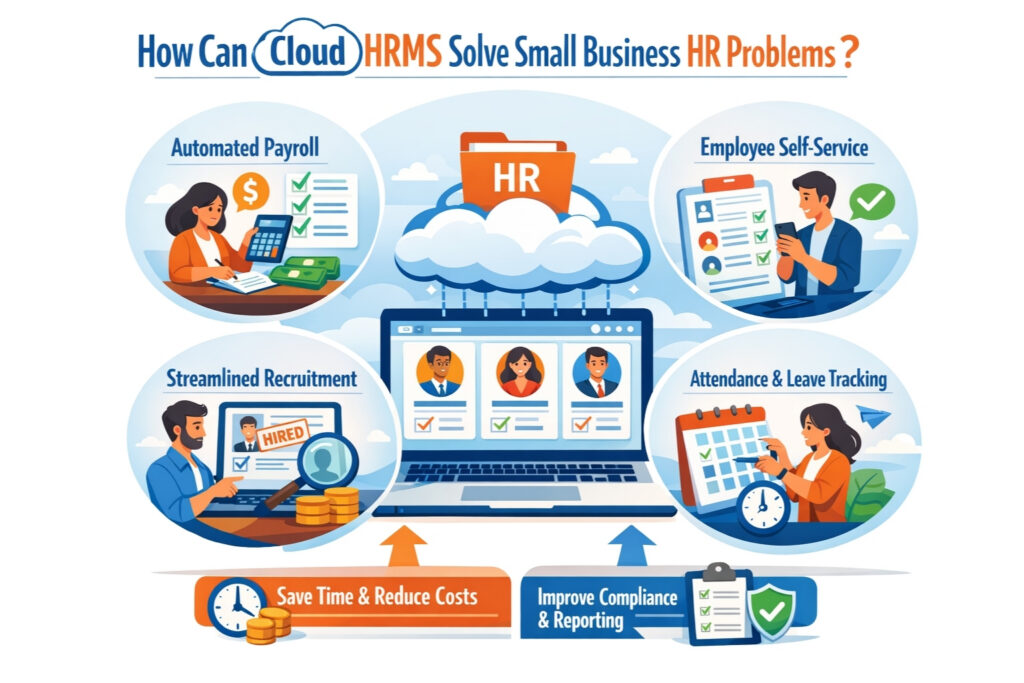
Today’s cloud-based HRMS software turns HR from a reactive, administrative drag into a streamlined, strategic function.
Centralized Employee Records
All employee data is stored in a single secure repository, along with version history, search capabilities, and role-based access. This removes redundancies and yields clean, accurate data throughout both processes.
Automated Payroll, Attendance, and Leave Control
Workflows enable these modules to automatically calculate payroll using live attendance and authorized leave. Self-service platforms like WeekMate empower employees to access their payslips, submit requests, and check their balances, making life easier for administrators.
Simplified Compliance Management
Statutory adherence, automated reminders, and pre-configured reports enable compliance with cycle filings, during audit, and on time. Regulatory changes are reflected in system updates, allowing manual processing to be avoided.
Reduced Workload and Enhanced Efficiency
Automation frees HR staff to focus on recruiting, engaging, and developing talent rather than performing tedious, repetitive work. Reporting dashboards provide actionable insights that tell you what to do.
Scalable Operations for Growth
Cloud infrastructure is designed to support a growing workforce and expand across geographies without requiring infrastructure upgrades. Capabilities are designed for multi-location teams, remote access, and customizable workflows.
The table below are the comparison between manual processes and cloud HRMS:
| Aspect | Manual/Traditional Approach | Cloud-Based HRMS Approach |
| Data Storage | Scattered files and spreadsheets | Centralized, secure database |
| Payroll Processing | Manual calculations, high error risk | Automated with statutory compliance |
| Compliance Tracking | Manual reminders, prone to oversights | Automated alerts and audit-ready reports |
| Attendance & Leave | Inconsistent tracking, frequent disputes | Real-time integration and self-service |
| Scalability | Limited; breaks beyond 30–50 employees | Seamless growth with no infrastructure cost |
| Monthly Time Savings | Minimal | 20–40+ hours per administrator |
Key Things to Consider for Cloud HRMS Software Selection
- Prioritize intuitive interfaces to ensure quick adoption by non-technical users
- Ensure strong support for Indian statutory regulations (PF, ESI, TDS, Professional Tax, gratuity, bonus, etc.)
- Consider modular integration, such as payroll, work schedule, leave management, and core HR modules
- Evaluate scalability to ensure the business can grow without the need for a giant system upgrade.
- Request mobile access for employees and managers who are out of the office.
- Ensure robust data security, such as encryption, regular back-ups, and pertinent compliance certifications
- Provide responsive support during Indian business hours.
How WeekMate HRMS Empowers Small Business HR functions?
- Solves small business-specific HR challenges with an easy-to-use, India-centric application
- Bring all your employee records under one roof, a centralized, secure, and accessible database
- Streamlines payroll processing with statutory compliance.
- enables real-time seamless attendance and leave monitoring
- Offers easy-to-use self-service (payslips, leave applications, working documents) for employees and managers who administrate teams
- It is scalable, specifically developed for SMEs, and designed to grow with you.
- Offers economical service and speed of delivery to reduce the chance of disruption
- Allows growing organizations to maintain control, ensure compliance, and support expansion without proportional increases in HR overhead
Conclusion: Transitioning from HR Chaos to Structured Control
WeekMate HRMS addresses the specific HR challenges outlined above for small businesses through a user-friendly, India-centric platform. Compliance regulations such as labor laws, the need to manually keep records, the risk of compliance breaches, payroll errors, pressure from doing too much work, and limits on growth: these are common problems, but they’re ones that can be solved.
SMEs achieve precision, efficiency, transparency, and strategic capacity after implementing cloud-based HRMS software. Proactive investments in contemporary HR solutions ensure the business achieves more predictable outcomes and positions it for scalable growth. WeekMate provides a trusted path to simplified HR, empowering leaders to focus on people and performance – not paperwork!
FAQs
1. What are the key challenges in HR for small businesses in India?
Manual operations, statutory compliance, payroll accuracy, attendance monitoring, and fatigue-related workload are symptoms of understaffing. Increasingly, small businesses are burdened by spreadsheets or combinations of tools, which heighten the risk of miscalculations and missed deadlines. A small HR team can be pulled in many directions when it comes to tracking employee records, monitoring leave , and staying compliant with the government.
2. How does cloud-based HRMS software lessen the HR load in small businesses?
It eliminates the repetition and tedium of tasks like approving leave, payroll, and reporting, and can save 20–40 hours per month. HR teams can now break out of the cycle of repetitive work and manual calculations by consolidating employee data and workflows into a single platform. Automation also increases precision, allowing HR managers to focus on staff engagement and strategy development.
3. Is WeekMate HRMS suitable for fewer than 20 users?
Yes, flexible pricing and essential features make it a great choice for startups and small teams. WeekMate offers payroll, attendance, and employee record management tools that small businesses can scale up or down as needed, without having to purchase a complex enterprise system. You can add more features as your team grows, no need to switch platforms.
4. Does cloud-based HRMS guarantee automatic compliance with Indian laws?
Trusted platforms like WeekMate come with built-in modules for PF, ESI, TDS, gratuity, etc., with auto-updates. So, businesses can rest easy knowing they’re keeping pace with regulatory changes without having to monitor policy updates daily . Automatic compliance calculations also mitigate the risk of fines that may occur from reporting errors and/or filing penalties.
5. What is the biggest benefit of digital HR management?
Increased accuracy, happier employees, reduced risk of non-compliance and more time to work on growing the business. Digital HR solutions accelerate communication, provide clear employee records, and generate on-the-fly reports to support decision-making. Eventually, this translates into an efficient workforce and organizational management.
6. Is employee data secure in Cloud HR software?
Leading solutions leverage encryption, regular backups, access controls, and compliance with data protection regulations. Modern HRMS solutions also include role-based permissions that restrict who can view specific information. This approach to layered security secures employee data while making it easily accessible to HR teams.
7. What is the average time to implement a solution like WeekMate HRMS?
Most small businesses are fully up and running within 1-4 weeks, depending on whether you need to move data. During this time, you import and set up employee records, payroll information, and attendance rules. As soon as it’s installed, you and your team can begin managing HR processes from a single digital platform.