
Going digital is not a future objective. Businesses must be working towards it now in order to be competitive, responsive, and customer-focused. Whether it is cloud computing or AI-enhanced decision-making, the most successful business ventures are reassessing their business models, value delivery, and innovation. At the core of this transformation lies a crucial yet rarely noticed process: IT Operations Management.
Policies and tools take the headlines, yet it is IT operations that help these strategies to work in production environments. They guarantee the reliability, scalability, and agility required to provide transformation across all levels. As organizations increasingly depend on digital platforms, demand for automated, sustainable, and scalable IT ecosystems is growing.
In this context, IT Operations Management is not just a support function; it is a strategic enabler of successful digital transformation.
What is Digital Transformation in Enterprise?
Enterprise Digital Transformation is the application of digital technology to all areas of an enterprise, fundamentally changing how you operate and deliver value to customers. It has stretched from basic digitization to comprehensive transformation, touching on culture, processes, and technology.
Key Drivers of Transformation
- Cloud adoption: Enterprises are shifting toward hybrid and multicloud environments to enhance flexibility and scalability.
- Data-Driven Decisions: Live analytics inform strategic decisions.
- Customer Experience Needs: Personalized, frictionless digital experiences have become the norm.
- Competitive innovation: You need rapid innovation cycles to stay ahead in the market.
According to a recent report, more than 70% of organizations have accelerated their digital agendas since 2023, highlighting the pressure to transform.
Technology teams not only contribute to business outcomes, but this has become the dominant driver of business outcomes, positioning IT operations as a critical enabler of transformation.
What is IT Operations Management?
IT Operations Management is the discipline responsible for managing an organization’s IT infrastructure. It is ensuring systems operate efficiently, securely, and consistently.
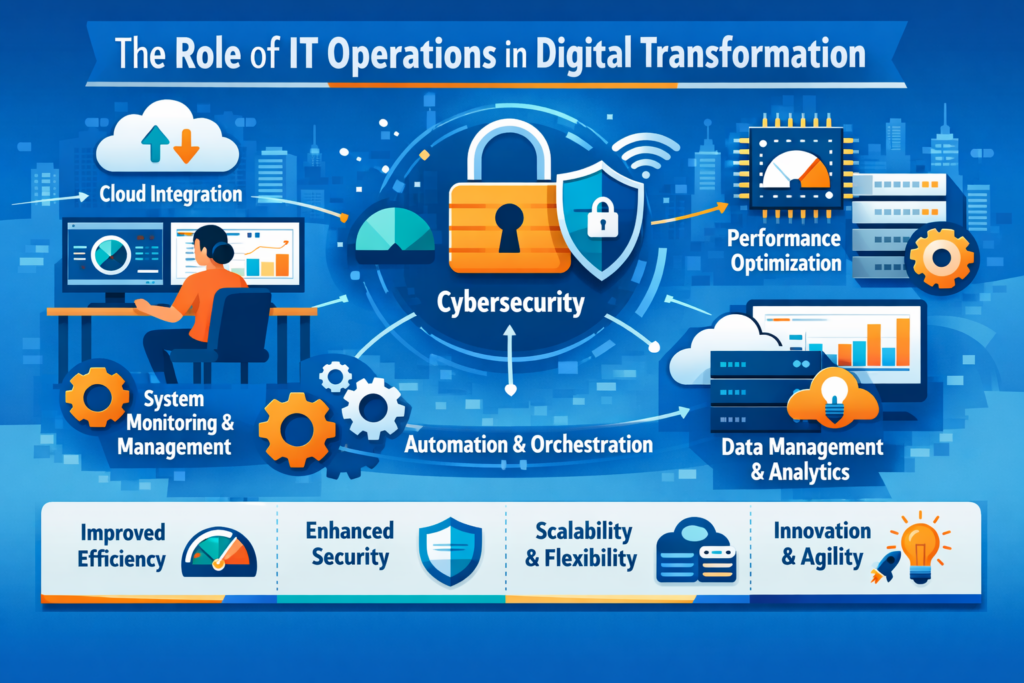
Core Components
- Infrastructure Monitoring: Servers, databases, and applications are monitored continuously
- Network Management: Delivering consistent connectivity and performance
- Incident Response: Detecting and remediating threats rapidly
- Performance Optimization: Speed, reliability and efficiency of the systems
Relationship with IT Service Management
In contrast to IT Service Management, which focuses on providing IT services to users, IT operations ensures the back-end systems that run these services are up and running. They combine to form an integrated structure that enhances user experience and system deliverability.
Why IT Operations is So Important in Your Digital Transformation Strategy?
A successful digital transformation strategy depends heavily on the efficiency and reliability of IT operations.
- Alignment with Business Goals: IT operations straddle balancing between business goals and how to technical execution
- Guaranteeing Availability: Digital services need to be up around the clock to satisfy users
- Enabling Innovation: Stable infrastructure gives teams the freedom to test and innovate
- Accelerated Deployment Cycles: Efficient operations facilitate faster deployment of new features and services
Without strong IT operations, even the most ambitious transformation strategies fail to deliver results.
Desirable Features Of Modern IT Operations
Automation and Intelligent Monitoring
It is integral to IT operations automation that organizations adopt a different approach to managing their IT environments. By eliminating manual handling, the automated process also enhances productivity.
- With AI monitoring, anomalies are detected before they become a problem
- Predictive maintenance reduces downtime
- Automated workflows decrease response time
Infrastructure As a Scalable Service
A growing company needs an infrastructure that can grow with it.
- Hybrid and multi-cloud operations provide flexibility
- Automation in IT Infrastructure delivers uniformity in separate environments
Security and Compliance
The expansion of digital ecosystems is bringing increased security risks.
- Protection of digital assets is paramount
- Governance models enforce adherence to industry standards
Benefits of IT Operations in Modern Businesses
The benefits of IT operations in modern businesses go far beyond just efficiency in technology.
| Benefit | Impact on Business |
| Improved Efficiency | Streamlined workflows and reduced manual effort |
| Reduced Downtime | Higher system availability and reliability |
| Faster Delivery | Quicker product and service launches |
| Better Customer Experience | Seamless digital interactions |
| Cost Optimization | Lower operational and maintenance costs |
How Automation is Transforming IT Operations?
There has been a dramatic increase in the importance of Automation in IT Infrastructure in recent times.
- Self-Healing Systems: Automatically identify and fix problems
- Automated Incident Management: Faster response and resolution
- Less manual work: teams can specialize in strategic work
- Continuous Operations: Run systems without interruption
Recent industry data shows that organizations that utilize automation in IT operations have achieved up to a 30 percent cost reduction and incident resolution times that are 40 percent faster.
IT Operations as a Source of Technology-Driven Innovation
Technology-driven innovation flourishes when IT operations are high-quality and responsive to the business’s needs.
- It’s compatible with DevOps and agile methodologies
- Shortens product development cycles
- Experiments without risk can be undertaken
- Uses data and analytics to get insights
By striking a balance between stable and flexible systems, IT operations enable high-functioning teams to innovate with confidence.
Implementing an Efficient Digital Transformation Strategy
To construct a winning Digital Transformation Strategy, businesses must execute a series of actions:
Evaluate IT Maturity
Know your current infrastructure and capability.
Upgrade Legacy Systems
Swap existing systems for more scalable alternatives.
Take an Automation-First Approach
Embed IT Operations Automation in the core business processes.
Map IT to Business KPIs
Be sure IT priorities are aligned with business needs.
Invest in Tools and Expertise
Pick platforms that allow for growth and scalability.
Take WeekMate’s tools for business owners seeking simplified workforce and operations management, for example. A useful resource is in this guide on workforce and operations efficiency.
Selecting The Right IT Operations Partner Or Solutions
Choosing an IT operations platform or partner is key.
What to Look For:
- Grow to scale with.
- Powerful automation features.
- Built-in security.
- Easily integrate with your systems.
A provider of IT Operations Management services can also enable organizations to focus on core business matters while still meeting the need for operational efficiency.
Reasons Why Enterprises Are Spending on IT Operations Automation
The incentives for implementing IT Operations Automation are largely the positive impact it can have on a business:
- Improved return on investment due to increased efficiency.
- Lower costs as a result of less work.
- Enhanced agility to make decisions more quickly.
- Edge in fast-moving markets.
Automation isn’t just a nice-to-have anymore; it’s essential to scale success.
Trends Future IT Operations and Digital Transformation
Enterprise digital transformation will be influenced over the coming years by these emerging trends:
- AIOps Adoption: Towards smarter IT operations leveraging AI.
- Autonomous Infrastructure: Self-managing infrastructure.
- Edge Computing Operations: Data Processing Near the Source.
- Hyper Automation: the integration of several automation technologies.
The trends indicate that the need for advanced IT operations is rising.
Final Thoughts
IT functions have moved past being a back-end mechanism to an innovation growth engine. With a solid background in IT operations management, businesses can proceed with their digital transformation strategy with confidence, making it reliable, scalable, and efficient throughout.
As organizations continue to adapt to enterprise digital transformation, the importance of automation, resiliency, and intelligent infrastructure is more critical than ever. Companies that invest in strong IT operations not only enhance performance but also realize long-term competitive benefits.
Platforms such as WeekMate are crucial for meeting contemporary operational requirements, enabling organizations to streamline operations, improve productivity, and align IT initiatives with business performance. The right tools and strategies can make a difference in the fast-changing digital world.
FAQs
1. What is IT Operations Management?
IT Operations Management is the process of managing an organization’s IT infrastructure and services to ensure computer systems run smoothly, securely, and efficiently. It addresses performance, uptime, and reliability.
2. How do IT operations enable digital transformation?
IT operations serve as the enabler of digital transformation, but that foundation must be scalable, stable, and responsive. This means organizations can introduce new technologies and innovations without disrupting anything.
3. What is IT Operations Automation?
IT Operations Automation is the use of technology to automate recurring processes, including monitoring, incident response, and system updates. It offers greater efficiency at lower cost and fewer human errors.
4. Why is automation important in IT infrastructure?
Automation provides faster, more accurate, and more consistent IT processes. It enables continuous operations, faster issue resolution, and allows the team to concentrate on strategic initiatives.
5. What are the benefits of IT operations to modern businesses?
IT operations enhance productivity, decrease downtime and accelerate service delivery. They also have a positive impact on customer experience and business cost optimization.
6. How is IT Service Management different than IT operations?
IT Service Management concerns the provision of IT services to end-users, while IT operations concerns the day-to-day running of the infrastructure that supports those services. They also collaborate for seamless performance.
7. What are the key trends that will drive IT operations into the future?
Leading trends are: AIOps, hyper automation, autonomous infrastructure, and edge computing. They are bringing greater intelligence, speed, and predictability to IT operations.