
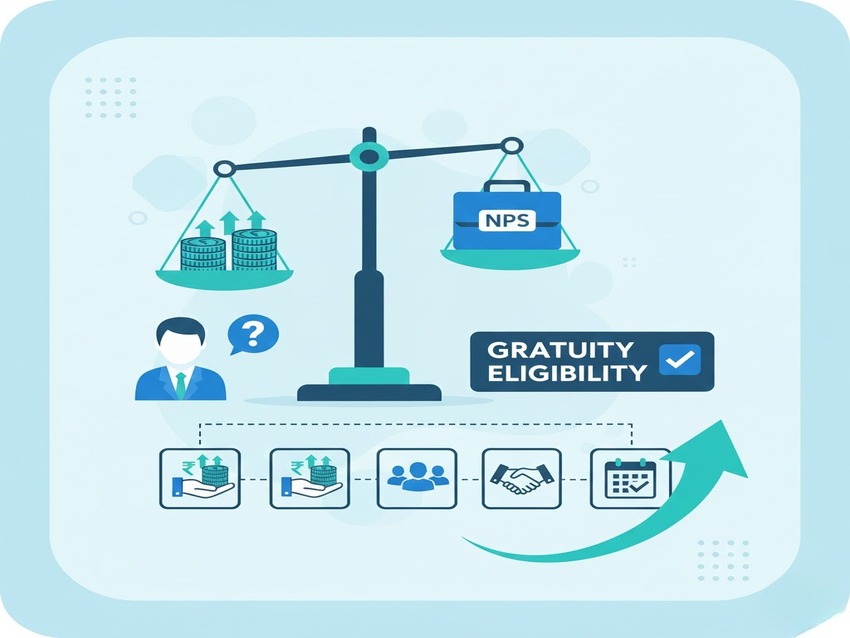

The government has finally clarified one of the most debated questions among Central Government employees under the National Pension System (NPS): Does an NPS employee receive gratuity if they resign?
In November 2025, the Department of Pension & Pensioners’ Welfare (DoPPW) released an important Office Memorandum (O.M. No. 2/8/2025-P&PW(F)/11164) that clearly defines when gratuity is payable, when it is not, and how resignation affects eligibility.
This Article explains the updated NPS gratuity rules in a structured, easy-to-read format.
What Is Gratuity for NPS Employees?
Central Government employees who joined service on or after January 1, 2004, are covered under the National Pension System (NPS). While they do not receive old-pension benefits, they do receive gratuity, governed by:
Central Civil Services (Payment of Gratuity under NPS) Rules, 2021
These rules define:
- Conditions for gratuity payment
- Events that qualify as “retirement”
- Forfeiture of service
- What is considered technical resignation
- Rules for absorption into PSUs or other government bodies
The 2025 circular resolves common misunderstandings about resignation.
Why the 2025 Clarification Was Issued
The government received repeated questions and RTI applications about:
- Is gratuity payable after resignation?
- Does five years of service guarantee gratuity?
- Does joining another department protect service?
- What is the difference between resignation and absorption?
To avoid inconsistent interpretations across ministries, DoPPW issued a structured clarification.
Eligibility for Gratuity Under NPS
According to Rule 22 of the CCS (Payment of Gratuity under NPS) Rules, 2021, an employee must meet two conditions:
Minimum Service Requirement
- Must complete at least 5 years of qualifying service.
Must Retire Under Specific Conditions
Gratuity is payable only if the employee retires under these circumstances:
- Superannuation (normal retirement at age 60)
- Invalidation/Disability retirement
- Compulsory or premature retirement under Rule 56 or Rule 12
- Special Voluntary Retirement Scheme (SVRS)
- Absorption in PSU/Autonomous Body (Rule 32)
Completing five years alone is not enough; the type of exit matters.
Gratuity Calculation Formula
Gratuity under NPS is calculated as:
One-fourth of last drawn emoluments × Completed six-monthly service periods (maximum 16.5 times emoluments)
| Component | Value |
| Last drawn emoluments | 50,000 |
| Service completed | 20 years (40 six-month periods) |
| Calculation | 0.25 × 50,000 × 40 |
| Gratuity | 5,00,000 |
The Most Important Rule: Resignation Forfeits Gratuity
This is the main highlight of the 2025 clarification.
If an NPS employee resigns, all past service is forfeited and gratuity is not payable.
This rule is based on Rule 17 of the CCS (Payment of Gratuity under NPS) Rules, 2021.
What forfeiture means:
- Employee loses all past qualifying service
- Gratuity becomes zero
- Years of service do not count
This applies even if an employee resigns after 10, 20 or 30 years of service.
Exceptions: When Resignation Does Not Cancel Gratuity
There are two important exceptions under Rule 17 and Rule 32.
Technical Resignation
Technical resignation is a special category of resignation that does not break service.
It applies when an employee resigns only to take up another government post with proper permission.
Conditions:
- Proper approval obtained
- New post is under central/state government
- Service counts at new organisation
Benefits:
- Past service preserved
- Gratuity eligibility continues
- Leave and service continuity protected
Resignation for Absorption (Rule 32)
If an employee resigns to join:
- PSU
- Statutory body
- Autonomous body
- Government-owned or government-financed organisation
and the government permits the move, it is treated as:
Deemed retirement
Result:
- Employee becomes eligible for gratuity
- Service until absorption is counted
- Forfeiture does not apply
When Gratuity Is Not Payable: Complete List
Gratuity is not payable when:
- Resignation is voluntary and normal
- Employee resigns to join a private company
- Employee resigns without permission
- Employee resigns for personal reasons
- Employee leaves service before completing 5 years
- Employee resigns to move abroad
- Resignation is not recognised as technical
- Service continuity is broken
Practical Examples for Clarity
Example 1: Normal Resignation After 10 Years
Reason: Personal reasons
Result: No gratuity (service forfeited)
Example 2: Resignation to Join Another Ministry
Reason: New central govt job through proper permission
Result: Technical resignation; gratuity preserved
Example 3: Joining PSU With Government Approval
Reason: Absorption under Rule 32
Result: Employee treated as retired; gratuity payable
Example 4: Resignation to Join Private Sector
Reason: Higher salary
Result: No gratuity
Example 5: Declared Surplus and Taking SVRS
Result: Gratuity payable under Rule 22
Death Gratuity for NPS Employees
Death gratuity is independent of resignation rules.
Key points:
- Payable even if service is less than 5 years
- Payable regardless of resignation conditions
- Nominees receive the benefit based on service slabs
Checklist Before Submitting Resignation
Employees should verify the following:
- Will this resignation qualify as technical resignation?
- Has proper permission been obtained?
- Is the new organisation eligible under Rule 32?
- Has the department confirmed continuity in writing?
- Am I prepared to lose gratuity if it is a normal resignation?
Many employees lose gratuity worth several lakhs due to improper submission of resignation.
Key Takeaways from the 2025 Gratuity Clarification
The major points to remember are:
- Gratuity is linked to retirement, not resignation.
- Resignation results in forfeiture of service, except in specific cases.
- Technical resignation preserves gratuity.
- Absorption in PSU is considered retirement.
- Completing 5 years alone does not guarantee gratuity.
- Employees should always obtain formal permission before leaving service.
FAQ Section
1. Do NPS employees get gratuity on resignation?
No. Normal resignation forfeits past service, and gratuity is not payable.
2. What is technical resignation?
A resignation submitted to take up another government post, with proper approval. It preserves gratuity eligibility.
3. Is gratuity paid after completing five years of service?
Only if the employee retires under eligible conditions. Resignation does not qualify.
4. Does joining a PSU allow gratuity payment?
Yes, if government approval is taken and the move is treated as absorption under Rule 32.
5. Will I get gratuity if I resign to join the private sector?
No. Service is forfeited and gratuity is not payable.
6. Does death gratuity require five years of service?
No. Death gratuity is payable regardless of length of service.
7. What happens if my department refuses technical resignation?
Your resignation becomes normal, service is forfeited, and gratuity is lost.
Conclusion
The 2025 DoPPW clarification provides much-needed transparency on gratuity eligibility for NPS government employees. The most important rule to understand is that resignation does not qualify for gratuity, except in cases of technical resignation or approved absorption.
Employees planning to change careers or switch jobs should carefully evaluate the nature of their resignation and secure proper permissions to avoid losing significant financial benefits. Understanding the rules can help protect years of service and ensure that gratuity is received when eligible