
What happens when a workplace policy silently considers unpaid overtime as “normal”?
What Is Statutory Compliance in HR?
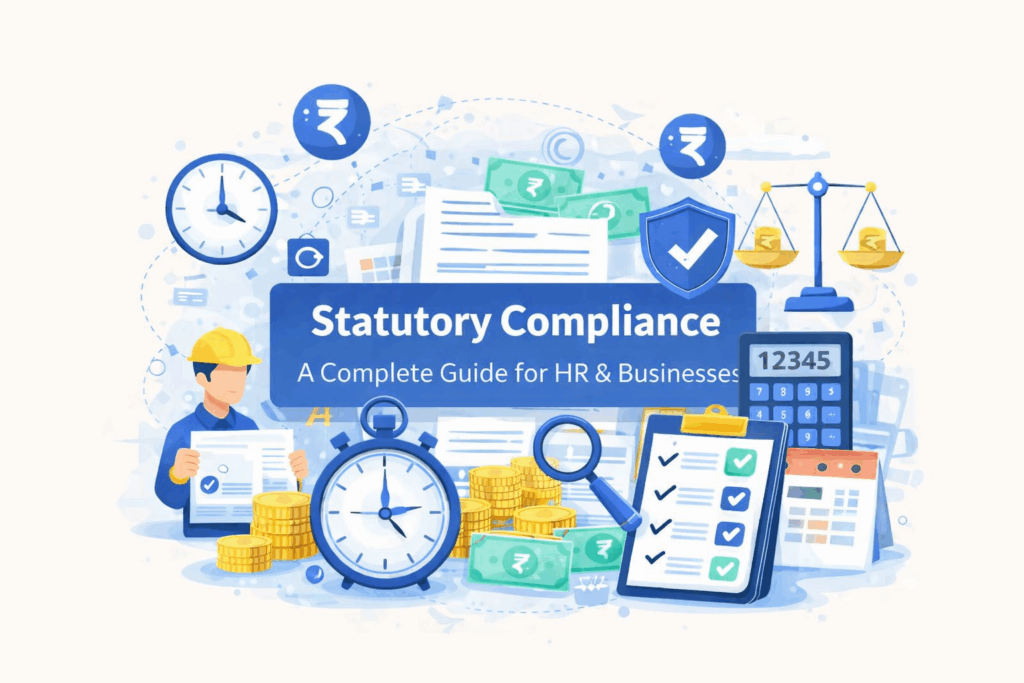
Statutory compliance in HR refers to adhering to labor laws, payroll regulations, employee benefits, and workplace safety laws mandated by government authorities.
Hidden Compliance Risks: When Workplace Policies Violate Labor Laws
An established Indian company once had a policy requiring employees in certain roles to work beyond standard hours without additional pay. It was called flexibility and commitment, and even appointment letters and policy manuals documented it. The organization looked superficially compliant. In reality, the practice conflicted with statutory compliance laws related to wages, working hours, and overtime key aspects of labour law compliance and employment law compliance.
Financial and Operational Risks of Non-Compliance
The problem was unnoticed internally for a long time. This changed when, during a routine labour inspection, the authorities pointed out the policy as a violation of statutory compliance requirements. The company had to make backdated overtime payments and was financially penalised. Employee trust declined, internal morale weakened, and the organization’s approach to HR legal compliance was questioned; these were among the consequences beyond the immediate cost.
This instance underscores why statutory compliance in HR should not be treated as a mere formality or a one-time exercise. If internal HR policies are not aligned with legal requirements for employers, they will notwithstand regulatory scrutiny or evolving employee expectations.
This blog explains the concept of statutory compliance, emphasizing its importance in HR, outlining the principal legal obligations businesses must fulfill, and showing how HR teams, with the right systems and tools, can navigate compliance efficiently.
Understanding Statutory Compliance in India
For startups, SMEs, and large organizations alike, statutory compliance for businesses is essential. Such compliance acts as a shield, protecting organizations from potential legal and financial risks, maintaining the integrity of payroll statutory regulations, and, at the same time, granting employee rights and regulations a stronger foothold in daily operations. The HR teams are at the forefront of this initiative, translating complex laws into actionable policies and ensuring uniform HR statutory compliance across the organization.
India’s rapidly expanding business ecosystem further underscores this obligation. At present, the country has more than 118,000 DPIIT-recognized startups, making it the world’s third-largest startup hub (Source: startupindia.gov).
As organizations grow at an unprecedented pace, compliance is no longer a choice. Robust statutory compliance enables business to remain legally safe, operationally stable, and ethically responsible to society. This manual provides a concise, up-to-date perspective on statutory compliance in India for 2025, including HR, payroll, labour laws, and governance, enabling organizations to expand with certainty and transparency.
What Is Statutory Compliance?
Statutory vs Non-Statutory Compliance
| Aspect | Statutory Compliance | Non-Statutory Compliance |
| Nature | Legally mandatory | Voluntary internal policies |
| Enforcement | Government authorities | Internal management |
| Penalty | Fines, lawsuits, legal action | Internal consequences |
| Examples | PF, ESI, Minimum Wage | Company code of conduct |
Statutory compliance is the legal framework that outlines the mandatory rules businesses must follow under central and state government regulations. These rules, among other things, are set to regulate employment conditions, wages, safety, taxation, and corporate conduct.
Statutory rules are legally enforceable, whereas non-statutory obligations, such as internal policies or voluntary codes, are not. Non-compliance can result in fines, lawsuits, licence cancellations, or even imprisonment.
Governments impose statutory regulations to protect public interest, ensure fair labour practices, and maintain economic stability. Examples are minimum wage laws, provident fund contributions, maternity benefits, and professional tax deductions. Every organization, regardless of size, is subject to statutory compliance requirements applicable to its industry and workforce.
Why Statutory Compliance Is Necessary for Organizations?
Compliance is not simply about avoiding legal penalties. It determines how a company operates and how society sees it.
From a legal perspective, it serves as a shield against disputes, audits, and punitive measures. For instance, in India, non-compliance with labour laws may incur heavy fines of several lakhs, along with backdated payments and interest.
Trust is equally important. Employees are more comfortable and feel respected when their wages, working hours, and benefits align with employee rights and regulations. The fairness experienced directly affects retention and morale.
Financial security was also a consideration. Cash flow can be affected by payroll errors, non-compliance, or over-deductions. Investors and partners also evaluate statutory compliance for businesses as a signal of operational maturity and risk management.
Statutory Compliances in Human Resource
Statutory Compliance in HR is the intersection where the law meets everyday work life. The Human Resources team must interpret legislation and incorporate it into policies, payroll, and people practices.
The main compliance areas relate to paying wages in line with minimum wage laws, adhering to regulated working hours, paying overtime, and granting leave in accordance with the law. Health, safety, and welfare standards are also very important, especially in manufacturing, construction, and service industries.
This is where HR statutory compliance gets tricky. Laws differ at the state level, as well as by employee type and business size. Handling this manually can increase the risk of errors you can afford to make, so this is another process that definitely needs technology-based systems.
Today’s HRMS solutions, such as WeekMate, enable HR teams to stay compliant while keeping pace with the changing needs of the organization – and not get buried in paperwork.
Key Statutory Compliance Laws Every Company Needs to Know
Indian businesses are subject to a comprehensive set of labour and employment laws, including the Factories Act, the Shops and Establishments Acts, and the Industrial Relations Code. These laws serve as the foundation for labour law compliance as well as employment law compliance.
Payroll obligations consist of provident fund, ESI, professional tax, TDS, and gratuity; together, these are governed by payroll statutory regulations. Mistakes in this area have a direct impact on employee compensation and the employer’s liability.
Data protection and privacy are coming to the forefront. Employee data, biometric information, and salary details must be stored, processed, and secured to comply with developing HR legal compliance standards.
These days, the HR team struggles to keep track of statutory compliance in general, and specific sectors such as IT, manufacturing, and healthcare also have industry-specific requirements.
Statutory Compliance Checklist for HR in an organization
A good statutory compliance checklist can help keep HR teams organized. It begins during onboarding with the monitoring of offer letters, contracts, identity documents, and documented interview records for compliance, especially when structured screening methods such as one-way video interview software are used during recruitment.
The payroll service needs to calculate statutory deductions correctly and pay on time. Regular tax filings and government returns are not optional. Leave, attendance, and working hours records are kept transparently and auditable.
Periodic internal audits and updated policies mitigate the risk of last-minute panic and ensure you remain on track with evolving statutory compliance requirements.
Typical Statutory Compliance Issues in HR
One of the biggest challenges is the pace of regulatory change. Laws can often be amended, consolidated, or judicially interpreted, making manual tracking impractical.
Paper-based systems can lead to errors and missed deadlines. This becomes even more difficult for companies running businesses in 2 or more states, each with its own local rules.
Another neglected problem is awareness. When directors and staff aren’t familiar with mandatory HR laws for companies, they unwittingly break them—and they often do so at the policy or team level.
What Role Does HRMS Software Play In Ensuring Statutory Compliance?
Comparison: Statutory vs Non-Statutory Compliance in HR
| Feature | Manual Process | WeekMate HRMS Solution |
| Payroll Calculation | Spreadsheet/manual | Automated & accurate |
| Statutory Deductions | Error-prone | Rule-engine driven |
| Compliance Alerts | Manual | Real-time notifications |
| Reporting | Delayed, fragmented | Audit-ready & centralized |
| Scalability | Difficult |
Handles multi-state & growing workforce
|
Automation has become a game-changer. HRMS software calculates payroll, statutory deductions, and government contributions using rule engines that are updated to reflect changes in law.
They offer real-time alerts, centralized document management, and audit-ready reports. This diminishes the reliance on spreadsheets and manual verifications.
Software such as WeekMate HRMS Software enables HR to spend less time on compliance firefighting and more time on people strategy, while still meeting all legal requirements for employers.
Best Practice to Keep Statutory Compliances
Compliance is most effective when it is proactive and woven into the fabric of day-to-day HR activities.
- Conduct compliance audits regularly to identify gaps well in advance of inspections or litigation.
- Provide ongoing HR training for your staff to keep them informed about evolving laws and legal interpretations.
- Leverage automation and HRMS solutions to reduce human errors and to enable successful statutory filing.
- Consult external compliance professionals when dealing with complex matters or rapid business growth.
Conclusion
Statutory compliance should not be viewed as merely a legal formality; it is the foundation of a workplace that is both stable and ethically sound. Statutory compliance requirements, such as those related to payroll and leave policies, safety, and benefits, directly affect employee trust and business continuity. For HR teams, HR statutory compliance refers to maintaining consistent compliance with statutory requirements while ensuring that the organization’s internal policies align with statutory requirements and that employee rights and regulations are upheld.
Companies that view statutory compliance as a continuous process rather than a one-time task are better positioned to manage risks, comply with legal obligations, and grow with confidence. When an organization is properly equipped with the right systems, has sufficient awareness, and uses automation, statutory compliance can become a business advantage rather than an operational challenge.
Frequently Asked Questions
1. What is the meaning of statutory compliance?
Statutory compliance refers to an organization’s obligation to follow the laws, rules, and regulations that are applicable to its business operations.
2. What are the three types of compliance?
The three main types of compliance are statutory compliance, regulatory compliance, and internal or policy-based compliance.
3. What is statutory non-compliant?
Statutory non-compliance occurs when an organization fails to meet legally mandated requirements, which may lead to penalties, fines, or legal action.
4. What are the statutory requirements?
Statutory requirements are mandatory legal obligations defined under government acts and related regulations that businesses must adhere to.