Accounting firms and CA practices in India are increasingly confronting a challenging business environment, one where merely keeping the books will no longer suffice. Clients today expect strategic insights, faster turnaround times, proactive compliance updates, and clear communication. Simultaneously, firms must contend with compliance deadlines, evolving tax laws, GST complexities, payroll requirements, and a continuously growing client base. The old ways of working, depending on spreadsheets, email chains, standalone desktop software, and isolated tools, are almost failing under this strain.
This article explores the limitations of traditional methods, why they are inefficient at scale, and how firms can realign by leveraging smarter tools, such as an accounting management system, to become more client-centric and competitive.
The Reality of Accounting Firms In India
Some firms have long thought that accounting was only about number crunching. However, in 2026, accounting services are workflow-driven, collaborative, and require timing, accuracy, and accountability, in addition to the final balance sheet; these are very important aspects.
Research indicates that more than 78% of medium-sized companies currently use SaaS accounting solutions, primarily for remote access, scalability, and process automation. At the same time, cloud adoption has increased significantly worldwide, indicating a major shift toward digital accounting practices.
The situation in India is even more intense. With over millions of MSMEs and a rapidly changing regulatory environment influenced by GST, e-invoicing, and compliance tracking, companies are rethinking client management solutions. No more manual bookkeeping and desktop systems. What is required is a new generation of accounting software for firms in India platforms that unite data, automate monotonous tasks, streamline collaboration, and reduce risk. Accounting SaaS software can be an answer to that, providing not only a ledger but also a workflow backbone for modern CA firms.
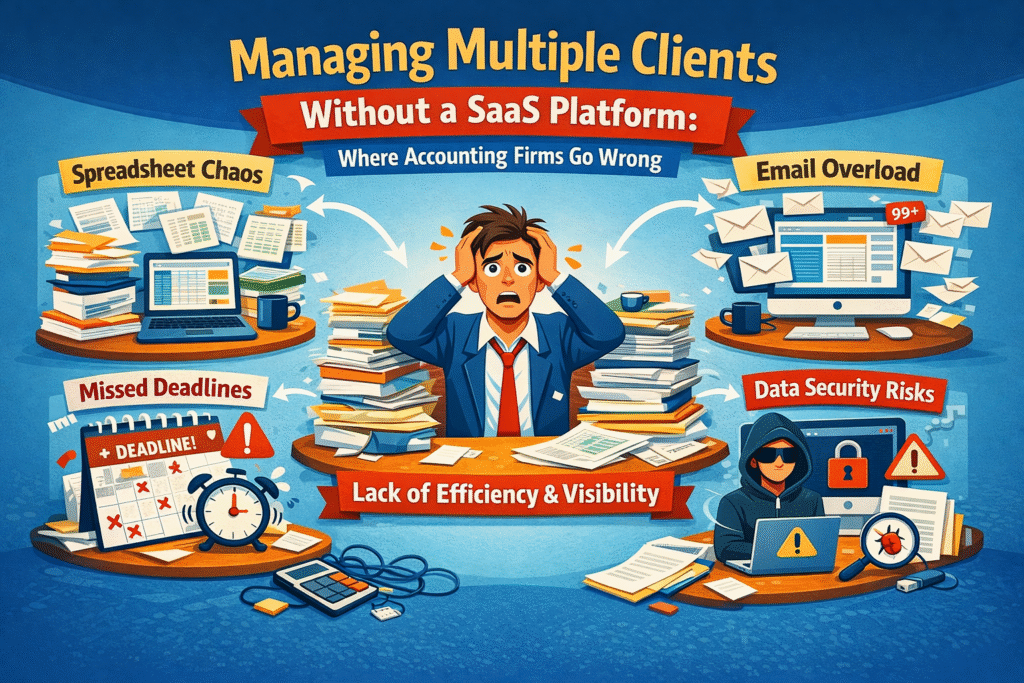
How Accounting Firms Handle Multiple Clients Without SaaS?
Many accounting firms in India and worldwide still rely on manual and semi-digital workflows. In a situation where different teams handle dozens, if not hundreds, of client accounts at the same time, the most typical tools are:
- Spreadsheets: these were used to keep track of unfinished tasks, bookkeeping records, and ad-hoc data, shared with teams via email.
- Email threads: usages include approvals, client correspondence, reminders, and document exchange.
- Shared folders or local drives: used for storing client invoices, receipts, tax documentation, and compliance files.
- Standalone desktop accounting software: these were locally installed on individual PCs and updated manually, thereby creating version-control issues.
These are not integrated systems. One software application tracks billing, a second handles payroll, and a third manages tax returns, with no automatic communication among them. Staff may need to transfer data manually from one software application to another, thereby re-entering the data and increasing the risk of transcription errors.
To a large extent, here are the ways in which many firms still manage multiple clients: accountants maintain separate files for each client. They manually copy figures into return templates, send reminders via calendar apps, and continue to rely on memory, sticky notes, or informal chats for follow-ups. It is a set of tools assembled through human effort rather than an engineered workflow system.
Guess what? This system, although presently perfect for a small number of clients, will not stand the test of time when the workload and intricacies increase – as we shall see in the next section.
The Core Challenges of Managing Multiple Clients Without a SaaS Platform
Lack of Centralized Client Visibility
A modern platform with a single dashboard summarizing all client work at a glance is exactly what seems to be missing most profoundly and severely undermines a firm’s functionality and performance. Imagine the difficulty of tracking the tax filing status of 30 clients, whose information is scattered across spreadsheets and email chains, when you don’t have a central view of deadlines, approvals, or outstanding items. When there is no centralized accounting management system, it is practically impossible to figure out who is responsible for what, when deliverables are due, and what is awaiting review.
Such fragmentation leads to confusion:
- Missed deadlines as reminders are not automated.
- The ownership of the task becomes unclear when accountability is not centrally tracked.
- Partners depend on team members for file updates, resulting in delays and possible misalignment
By contrast, on platforms where every client’s key tasks GST, payroll, TDS returns, audit preparation appear on a unified dashboard, with clear status indicators and alerts.
The Case of Workflow Inefficiencies and Manual Processes
Manual data entry consumes significant time. At the end of each month, accountants must re-enter transaction data from bank statements into spreadsheets, perform manual balance reconciliations, and duplicate work across tools. Approvals are sent via email, where files can get lost, mislabeled, or hidden in casual conversation threads.
Firms without modern accounting workflow software for Indian firms often repeat tasks that should be automated: reconciliation, classification, notifications, reminders, data exports, and report generation. Instead of focusing on value-added tasks, the teams have to spend their time chasing updates.
The cumulative cost? Several hours are lost every week that could have been spent on advisory work, client engagement, and review.
Missed Deadlines and Compliance Risks
India has a very strict compliance calendar. GST filings, income tax returns, TDS deadlines, audit submissions, and payroll cut-offs each have strict deadlines and penalties for non-compliance. Trying to manage all that for multiple clients with manual systems often results in:
- Frantic last-minute efforts
- Errors in tax codes or entries by humans
- Late submissions
- Costly fines that reduce client trust
Without automated reminders and structured workflows, critical compliance tasks get overlooked – a risk that can damage both clients and the firm’s reputation.
Poor Team Coordination and Accountability
In firms without integrated software, internal communication is primarily through meetings, WhatsApp groups, and ad hoc emails. There is little accountability when tasks are not formally assigned or tracked. One team member thinks another has updated the client records, only to find out they are week-old stale numbers.
This lack of coordination reduces productivity and morale because accountants spend time determining who should do what rather than doing the work.
Where Accounting Firms Go Wrong Without SaaS
Scaling Headcount Instead of Systems
Many companies hire additional staff to cope with work overload. The logic is simple: more people, more work. However, if there are no proper systems in place, the strategy becomes counterproductive: every new employee adds complexity, increased onboarding, additional communication overhead, and greater coordination.
Thus, overall productivity is not the mere sum of employee numbers in the absence of basic processes.
Using Tools Not Designed for Multi-Client Management
A common mistake is applying single-client accounting tools across multiple clients. A desktop accounting package may work fine for one business’s books but when replicated across dozens of clients, it becomes a management nightmare. Importing and exporting data between systems, managing licences, and consolidating outputs introduce friction that SaaS tools eliminate by design.
This approach fails even harder for CA firms and knowledge processing organisations (KPOs) that need:
- Consistent workflows
- Standardized reports
- Cross-client comparisons
- Team access control
And without these, it is hardly possible to imagine anything other than a complete disarray.
Not Applying Standardization Across Different Client Workflows
Each accounting professional tends to work in the way they prefer. If there is no one way to follow a certain work process:
- Some clients are reconciled weekly, while others are reconciled monthly.
- Approvals are done in different ways.
- Document naming conventions are very different.
Inconsistencies always lead to lower quality, more rework, and longer review periods.
Delayed Reporting and Limited Insights
When data is distributed across multiple files and systems, it is impossible to provide real-time financial visibility into clients. Therefore, firm partners either make decisions based on stale data without realizing it, or they spend a significant portion of their day manually compiling reports.
This scenario hampers strategic oversight and undermines the firm’s agility to proactively respond to clients’ needs.
The Hidden Business Costs of Not Using Accounting SaaS Software
Not utilizing the most up-to-date tools comes at a cost that is certainly higher than mere inconvenience; it is a strategic disadvantage:
- Lower productivity: Manual, repetitive work reduces time available for high-value advisory work.
- Employee burnout: Accountants are so overloaded with administrative work that some give up.
- Compliance exposure: When you rely on manual processes, you are more prone to mistakes and thus, more liable to sanctions.
- Client dissatisfaction: Trust and referrals are gradually lost through delays and inaccuracies.
- Competitive disadvantage: Tech-enabled firms not only deliver faster and smarter insights, but they also get a bigger slice of the market.
This is the main reason why transitioning to accounting SaaS software and accounting management software is not a matter of choice but a necessity.
Why Accounting SaaS Software Is Built for Multi-Client Firms?
Modern accounting SaaS software was created not just as an additional tool but rather to address multi-client issues, most of which were outlined above.
Centralized Client and Workflow Management
Such platforms help partners and teams to access a single dashboard for:
- Viewing task statuses across all clients
- Compliance deadlines
- Next steps and bottlenecks
Such visibility is extremely valuable; it transforms chaos into order.
Automation of Routine Accounting Tasks
SaaS solutions automate:
- Phone bank feeds and reconciliation
- Invoice processing
- GST and TDS tracking
- Report generation
As a result, it reduces manual labor and increases accuracy.
Real-Time Collaboration and Audit Trails
Teams use a common platform with automated documentation and audit trails. The system captures, timestamps, and indexes each action. This not only improves coordination but also simplifies audits and client reviews.
Scalability Without Complexity
By using SaaS, companies can acquire more clients without complicating the situation. They increase capacity rather than complexity, which is ideal for rapidly growing CA firms and KPOs. For example, adopting an all-in-one accounting SaaS platform makes it easier to manage increasing workloads with precision and confidence.
Key Features to Look for in Practice Management Software for CA Firms
While assessing software, firms should put primary emphasis on:
- Multi-client workflow support: Ability to manage diverse client needs simultaneously.
- Compliance tracking and reminders: Built-in alerts for GST, returns, TDS, and audits.
- Real-time dashboards and reporting: Instant insights for partners and clients.
- Access controls and audit logs: Ensure security and accountability.
Therefore, this is the main reason practice management software for CA firms is a necessity, not a luxury.
Accounting SaaS Adoption in India: What Firms Should Consider
Basically, when deciding on IT solutions, Indian firms should account for:
- Data security and regulatory compliance especially around GST and e-invoicing.
- Ease of team adoption, lower learning curves speed up implementation.
- Cloud scalability: Solutions that grow with your firm.
Evaluations should include CA firm management software India and cloud accounting software India preferences tailored to local compliance needs.
How Exactly Can An Appropriate Accounting Software Help A Business Operate More Effectively?
The changes brought about by an ideal system cannot be negated:
- Standardised workflows across clients – delivering consistency and quality.
- Improved accuracy and faster delivery – fewer errors, faster turnaround.
- Better client communication and retention – clients see value in timely, transparent reporting.
Firms that invest in the best software to manage multiple accounting clients position themselves as trusted advisors, not just number keepers.
Conclusion: From Manual Management to Scalable Control
It is no longer advisable to manage multiple clients using spreadsheets, email, and siloed tools alone. Firms that resist change and continue to use outdated methods will face the triple problem of inefficiency, compliance risk, and client dissatisfaction. In fact, today’s accountants and auditors are professionals who deserve and require tools that support them, not ones that hinder or hold them back.
Accounting software for firms in India and modern accounting SaaS software are the solutions in such cases. They convert messy workflows into smooth, manageable, and scalable processes. They give teams the power to produce timely, accurate work confidently. They also provide partners with operational transparency and a real-time understanding of client portfolios.
One way a unified system can elevate work quality while reducing stress and risk is through solutions like WeekMate, allowing firms to focus on strategy, advisory, and growth rather than firefighting routine tasks.
If your firm is still using disparate systems, now is the perfect time to switch to a centralized, scalable accounting management system. The future of efficient, client-centric accounting is here – grab it now.
FAQs
1. How can an accounting firm complete bookkeeping efficiently for many clients and still make deadlines?
Accounting firms that rely on spreadsheets and email can struggle to track deadlines. Top-notch firms are leveraging Accounting SaaS tools with integrated compliance calendars, automated reminders, and centralized dashboards to monitor all client deadlines.
2. Why don’t CA firms use traditional accounting software, and how do they manage multiple clients?
Traditional or single-user accounting software cannot be used for multi-client users. They don’t have centralized visibility, standardized processes, or collaboration capabilities - none of which are necessary for CA firms running dozens of clients concurrently.
3. What is the greatest risk if you do not have accounting management tools?
The largest risk is non-compliance. Failing to submit your GST on time, a delayed audit, or an incorrect tax filing can put you in legal trouble, resulting in penalties, reputational damage, and loss of client trust. These risks are mitigated so dramatically by accounting management software through automation and real-time monitoring.
4. How do CA firms scale their business with accounting SaaS software?
Accounting SaaS software enables firms to increase the number of clients they serve without proportionally increasing headcount. Increased automation, streamlined processes, and improved team communication enable firms to continue growing profitably without sacrificing quality work or customer service.