Most HR teams in India still maintain payroll on spreadsheets, request leave approvals via WhatsApp, and manually verify attendance from biometric logs. It might work for a while, but when it breaks, it can be painful. If PF deduction is missed or TDS entry is wrong, you can only expect penalties and unhappy employees.
This is the gap that AI-powered HRMS software is addressing. Around 40% of Indian companies now use AI heavily or completely, as per the Deloitte State of AI in the Enterprise Report 2026. This puts it ahead of all other countries surveyed. HR has become one of the departments that has taken up AI the fastest, particularly through recruitment, payroll, and attrition forecasting.
We’ve put together this guide as a step-by-step exploration of AI-powered HRMS, the problems it can solve, and the features it can provide. Besides, it’ll also tell you what to expect and skip when choosing a platform that supports an Indian business, instead of a generic international one. Once you’ve gone through it, you’ll have enough information to decide what is suitable for your company and what is not.
What Is AI-Powered HRMS Software?
AI-powered HRMS is basically a human resource management system that helps HR by eliminating tasks they used to do manually. This is done through machine learning and automation. Traditional HRMS software simply digitizes existing records. AI-powered HRMS is able to read patterns from the data and act on them.
Take attendance. A traditional system logs punch-in and punch-out times. An AI-driven one flags unusual absence patterns before they turn into a retention problem. Take payroll. A traditional system calculates salary based on fixed rules. An AI system catches an anomaly, say, a sudden mismatch in overtime hours, before the payslip goes out.
The difference isn’t cosmetic. It’s the gap between a system that stores information and one that actually helps you make decisions with it.
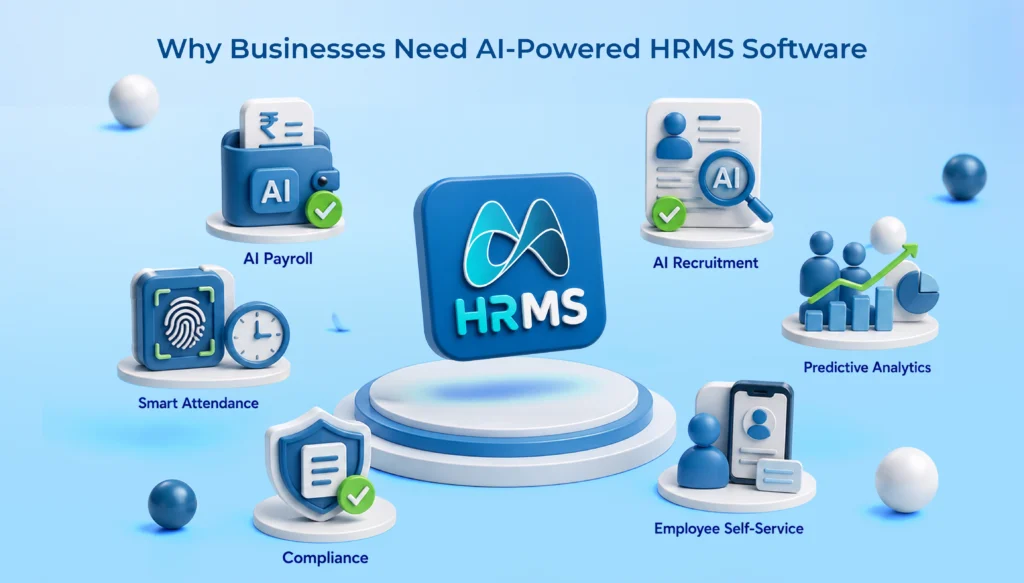
Why Businesses Need AI-Powered HRMS Software
Growing companies run into the same wall eventually. HR headcount doesn’t scale at the same pace as the workforce, and the manual processes that worked for 30 employees start breaking at 150.
The usual pain points show up in a predictable order:
- Manual payroll calculations that eat up days every month and still produce errors
- Attendance tracking that depends on someone physically reconciling biometric data
- Leave management handled through email threads and shared spreadsheets
- Compliance risk around PF, ESI, TDS, and Professional Tax that grows with headcount
- Employee engagement that quietly drops because nobody’s tracking sentiment until someone resigns
- HR data scattered across five different tools with no single source of truth
The use of AI-powered HRMS platforms to automate and speed up repetitive work allows HR departments to avoid being burdened with routine checks. Instead, they will focus more on what matters. Also, these systems are able to extract data from processes that are difficult to detect manually. For example, a system that can predict the resignation of an employee two months in advance is more useful to the company or the manager than a system that only tells about a resignation yesterday.
Top Features of AI-Powered HRMS Software
Not every “AI-powered” HRMS on the market meaningfully uses AI. Here’s what genuinely matters, and why.
AI-based Recruitment and Resume Screening
Rather than an HR manager reading 300 resumes, this AI system not only shortlists the applicants based on their skills, but also ranks them and schedules interviews automatically. It does not entirely replace the human decision-maker. It actually takes away the tedious job of manually reviewing dozens of applicants so one can concentrate more on strategic judgment-making.
Intelligent Employee Onboarding
Documents get verified automatically, and the offer is sent right after it is generated, leaving a good impression on the new hire. Instead of receiving scattered information through fifteen emails, they will have a clear-cut plan for the first week at the company.
AI Attendance and Leave Management
We have smart attendance that goes beyond punch-in logs. Leave forecasting uses machine learning models trained on past data to predict when a person will most probably request time off. Besides that, we detect patterns from data like chronic Monday absenteeism, which a manager might never even think to check.
AI Payroll Processing
Salary computations are done in the background based on attendance records, leave records, and other deductions required by law. The payroll system will be alerted if a mismatch is found. Because of this, errors are corrected before payday. They take care of the tax and law-related aspects so that PF, ESI, and TDS records are updated with the new rates.
Performance Management
Regular checks on goals, continuous feedback, and AI-assisted insights into who is making it and who is not prevent reviews from becoming annual guessing games. Managers get to know KRA status on an ongoing basis rather than having to figure everything out at year-end. If someone gets off their course, their flag gets raised sooner than one might think.
Employee Self-Service Portals
With chatbots handling queries, people can access their salaries and apply for leave without any interruption from the HR team. They simply view their own attendance history, take home the old payslips, and get their questions answered directly without expecting an email response. As a consequence, the HR time that otherwise answers the same five questions repeatedly is now being put to other uses.
Predictive HR Analytics
The system identifies issues like turnover risk, workforce planning, and productivity trends in time, rather than waiting until an employee resigns. The machine learning model identifies employees after analysing the employees’ attendance patterns, engagement with the company, and tenure data. Workforce planning becomes hassle-free because hiring gaps emerge long before a last-minute rush for a vacancy.
Compliance Monitoring
Policies remain updated with the latest changes, while audit reports are always available at your disposal instead of waiting for the last minute. Statutory changes in respect of PF (Provident Fund), ESI (Employees’ State Insurance), and TDS (Tax Deducted at Source) rates are reflected in the system automatically. There is no need for someone to manually go through government announcements.
Worth noting: Not every business would need all eight of these things at the very beginning. A 20-person startup company is probably more interested in payroll accuracy and onboarding issues than in predicting future outcomes. At the same time, a 500-person company will almost desire to have access to the complete range.
Benefits of AI-Powered HRMS Software
The features matter because of what they add up to. In practice, businesses see gains across a few consistent areas, and most show up faster than teams expect.
Increased HR Productivity
Teams stop spending entire days reconciling attendance sheets and chasing approvals. That time goes into actual people problems instead, coaching, hiring, retention, rather than admin work.
Better Employee Experience
Self-service portals and faster approvals mean fewer frustrated pings to HR. Employees get answers to payslip and leave questions without waiting for someone to reply.
Reduced Human Errors
Manual payroll runs typically carry some rate of error, and it adds up over a year. Automated systems with built-in validation catch mismatches before they reach a payslip.
Faster Decision-Making
Managers can work with actual dashboards rather than old spreadsheets. Potential employee turnover, absenteeism patterns, and performance gaps appear almost instantly rather than when it’s already too late in the quarter.
Improved Workforce Planning
Predictive analytics show where hiring gaps are forming months before they turn into a staffing crisis. That gives HR and business leads room to plan instead of react.
Cost Savings
The lower operational cost shows even after taking the software investment into consideration. Reduction in hours spent on manual work, fewer payroll errors, and fewer penalties for not complying with regulations. When put together, these bring down the cost a lot.
Stronger Compliance
This matters more than most businesses realize, given how often Indian labour codes shift. Automated updates and audit-ready reports keep filings accurate without someone tracking every notification manually.
Scalable HR Operations
HR functions scale without a proportional increase in headcount. A team that manages 50 employees on a good HRMS can usually handle 200 without doubling HR staff.
Not every business realizes all of these on the same timeline. Compliance gains show up almost immediately. Cost savings usually take two or three payroll cycles to become visible.
Industries That Benefit from AI HRMS
AI-powered HRMS isn’t limited to any one sector, though the value shows up differently depending on the business.
IT and software companies use it for rapid onboarding and distributed team management. Manufacturing relies on it for shift scheduling and compliance across factory floors. Healthcare organizations need it for credential tracking and round-the-clock shift rostering. Retail and BPO businesses lean on attendance automation given high headcount churn. Logistics companies need mobile-first tools since much of the workforce is never at a desk.
Typically, startups and small/medium-sized companies adopt AI HRMS not to employ a large HR department too fast. It’s a solution they use to cut costs and yet maintain a human touch in their HR processes. At the same time, big companies implement it to achieve uniformity across several places and departments. Educational organizations rely on it for keeping track of their faculty and submitting regulatory reports.
How to Choose the Right AI-Powered HRMS Software
These days, it’s common to get bombarded by a lot of service providers advertising AI capabilities. Here is what really identifies a good AI platform from a mere fancy label.
Don’t settle for mere automation when you have a choice of true AI capabilities. Instead of showing off a slide, ask them to show a live demo of their predictive analytics. Make them go deep into payroll integration, mostly how they handle PF, ESI, and TDS, which are specific aspects of Indian regulations. Also, find out if their attendance management supports your method, like it is done through biometrics, with geo-fencing, or via facial recognition?
A few more things worth checking before signing anything:
- Recruitment automation and how much manual review it still requires
- Performance management flexibility for your specific KRA structure
- Analytics dashboards that a non-technical HR manager can actually read
- Mobile accessibility, since field and remote staff need this more than office staff do
- Security and data privacy standards, particularly around DPDP Act compliance
- Scalability as headcount grows from 50 to 500
- Third-party integrations with your existing accounting or ERP tools
- Customer support responsiveness, which matters more than most buyers expect until something breaks
Pricing matters too, obviously. But the cheapest option that doesn’t handle Indian statutory compliance correctly ends up costing more in penalties than it saves in subscription fees.
Future Trends in AI-Powered HRMS
HR technology in India isn’t standing still. A few trends are shaping what “AI-powered” will mean by 2027.
Generative AI is beginning to penetrate the work of HR assistants, who will be the ones writing the policy documents, replying to employees in their native language, and creating performance review summaries.
Predictive workforce planning is now more advanced and is able to predict hiring needs based on business growth instead of waiting for a problem to arise. Skill gap analysis is getting more detailed, and instead of just training people based on a generic training schedule, it is comparing every single employee to their corresponding role requirements.
Voice-enabled HR support is emerging too, letting field staff mark attendance or request leave without opening an app. And with the new Labour Codes rolling out, compliance automation is shifting from a nice-to-have to a baseline requirement. India’s HRTech market is projected to cross USD 2.5 to 3 billion by 2026, growing at roughly 15 to 20 percent annually, which tells you this isn’t a passing trend.
Why Choose WeekMate AI-Powered HRMS Software
WeekMate approaches this differently from most platforms built for the Indian market. It’s not AI bolted onto an old system. AI-enabled analytics, attendance tracking, and payroll processing are built into the core platform from the ground up.
The compliance side covers PF, ESI, and TDS automatically, which matters given how often these rates shift. Attendance runs through geo-fencing, biometric punching, or facial recognition, whatever fits your team’s setup. Payroll processing handles customizable salary structures without the recurring monthly add-on fees some competitors charge.
In addition to payroll, WeekMate also takes care of the entire employee life cycle. Aspects like onboarding, setting up a performance plan that includes a 360-degree review for the whole team, and providing self-service options via a mobile app. It means that the employees wouldn’t have to wait for HR to handle basic requests.
WeekMate is a cloud-based HRMS software in India. It also offers on-premise software deployment at the client location as an option for businesses looking for stricter data management, and is scalable from a 20-person startup company to an enterprise with no system switchover.
FAQs
1. What makes HRMS software AI-powered instead of just automated?
Automation relies on predetermined rules, whereas machine learning via AI enables software to discover anomalies in absence patterns, assess turnover risk, and detect payroll irregularities, things that rule-based systems would not identify as unusual at all.
2. Is AI-powered HRMS software worth it for a small business?
Generally speaking, it is worth investing in AI-powered HRMS. For instance, a 20-member startup will greatly enjoy payroll accuracy and automated onboarding tools. It will be only after the company reaches about 100+ team members that the role of forecasting will become much more critical.
3. Does AI-powered HRMS replace the need for an HR team?
No. It removes the repetitive, error-prone parts of HR work, resume screening, payroll math, and attendance reconciliation, so the HR team can focus on judgment calls, culture, and people problems that software can’t handle.
4. How does AI-powered HRMS handle Indian statutory compliance like PF, ESI, and TDS?
A properly built platform automates statutory calculations and updates them as rates or rules change, generating audit-ready reports along the way. This is worth verifying directly with any vendor since compliance depth varies a lot between platforms.
5. What should a business check before switching to an AI-powered HRMS?
Start with payroll accuracy, compliance coverage, and integration with existing tools like your accounting software or biometric devices. Everything else, dashboards, chatbots, and predictive analytics, matters less if the core payroll and compliance layer isn’t solid.