Modern organizations are changing in every way because of artificial intelligence. Finance teams are forecasting smarter, marketing is completely personalized, and operations are in sync like never before. So here is a fair question: why should the HR department be left behind? The truth is, it should not be left behind, and the best companies are making sure it is not.
This is where HR management software comes in. To be honest, the way we handle human resources has changed more in the last five years than it did over the previous two decades. The reason for this change is simple: ‘artificial intelligence’. AI is changing how companies take care of their people, processes, and performance.
So if you are still using the simple HR software, you are probably missing out on great advantages. The best platforms that we have today come with intelligent features that learn, adapt, and help the team on a daily basis.
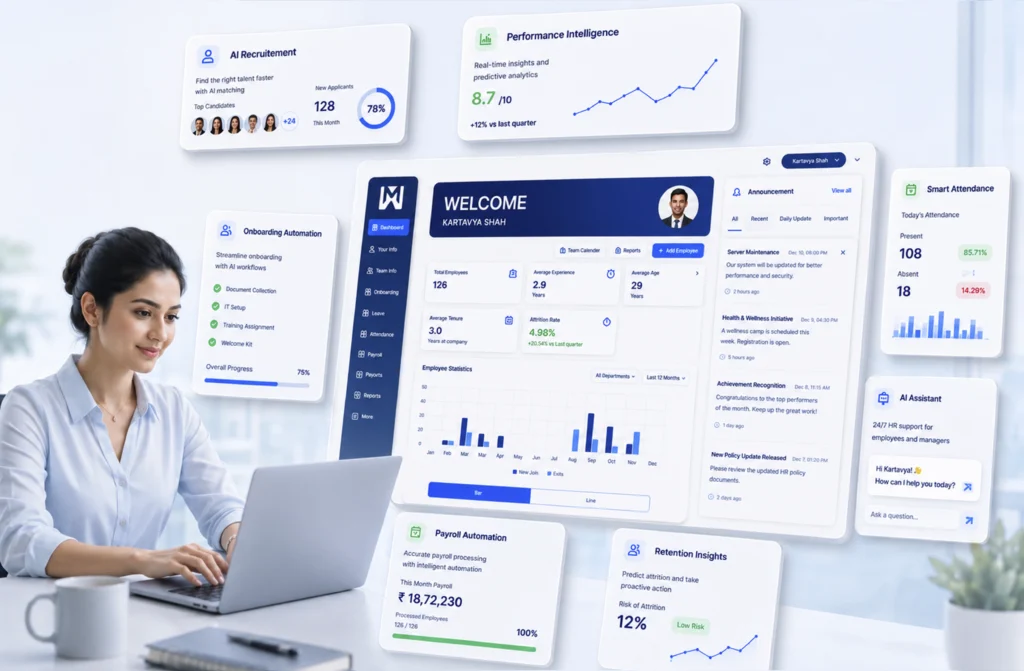
Choosing appropriate HR management software features can change the way your company hires new people, retains existing employees, or develops its team. From automating repetitive daily tasks to enabling predictive decision-making, AI is reshaping what HR can do across every sector of work.
10 AI Features To Look For In A Modern HR Management Software
Let’s take a look at the most important AI features that any modern HR platform should have. If you are an HR manager at a growing startup or a CHRO at a large company, this list will help you know what to look for:
1. AI-Powered Recruitment and Hiring Tools
Hiring today is not only about manually filtering the candidate resumes. It is about selecting the right people accurately and consistently. And we all know that this process is lengthy and very time-consuming. But we have a key. In these scenarios, AI solutions for hiring and recruitment can really help you. Here’s how they do it:
Instead of going through individual resumes manually, AI tools help you to quickly scan, rank, and shortlist candidates from vast databases based on their skills, experience, and how well they fit the role. It is further enhanced by the use of machine learning models that match candidates based on successful past hiring decisions and outcomes.
In addition, AI-powered chatbots can carry on initial conversations, answer basic questions, and schedule interviews in real time. This relieves teams and also enhances the candidate experience.
Further, AI takes into consideration only skills and qualifications, which removes bias or the influence of other factors that sometimes unintentionally occur.
Here’s an example. An AI-powered HRMS can significantly reduce the time to hire. This gives an edge to the companies. Since top candidates often get several offers in a week, moving quickly can be a crucial factor for hiring a standout or losing them to another company.
2. Intelligent Performance Tracking Systems
Traditional performance reviews are often irregular and slow. Modern HR software for performance tracking with AI focuses on ongoing, real-time feedback throughout the year.
AI-enabled systems provide live performance dashboards that allow managers to track progress and fix issues as and when they occur. Also, predictive analytics can help identify trends in future performance, making it easier to recognize top performers and support those who may need help.
A key benefit is personalized feedback. Employees are assessed based on their actual performance rather than standard or generic comments, leading to greater engagement and motivation. Goals are also automatically assigned to align individual KPIs with team and company goals.
Another often ignored benefit is fairness. Human managers may unintentionally bring hidden biases into reviews. AI can show clear performance data along with personal feedback, giving everyone a balanced view. It does not replace the manager’s judgement, but it helps make discussions more focused on facts.
In the end, using AI for productivity tracking creates a culture of transparency, accountability, and continuous improvement.
3. Smart Attendance and Workforce Monitoring
Most people don’t like to track attendance, but it’s a necessary part of work. Traditional methods like punch cards, sign-in sheets, and simple biometrics often miss key details, especially in today’s hybrid and remote work environment.
A modern AI attendance tracking system offers a simple, accurate and efficient process with real-time updates. It uses tools like facial recognition and biometrics to verify who is present. Further, GPS-based attendance makes remote and field teams more flexible and reliable.
These systems also reduce admin work by automating shift scheduling and leave management. HR teams can now easily identify attendance patterns and know who is present.
4. Predictive Analytics for Employee Retention
Nowadays, retaining employees has become difficult for modern workplaces. These days, smart companies don’t just wait for people to quit; they try to predict when they might leave.
There are AI-driven retention tools that use predictive analytics and large data to detect early signs of disengagement. Some of these signs are:
- Less participation in team meetings or chat platforms.
- A sudden decrease in performance metrics.
- Decreased use of paid time off.
- Less participation in internal training or development opportunities.
It further allows organizations to implement targeted retention strategies such as personalized engagement programmes, career growth options, and better compensation.
5. Automated Employee Onboarding
Onboarding is the first actual experience employees have in an organization. This phase greatly affects what follows in their professional journey.
From the moment documents are checked, processes move faster because machines handle setup tasks one after another. New joiners receive guided steps, automated reminders, and an onboarding procedure dedicated to their specific roles. Each stage adjusts quietly behind the scenes, ensuring relevance without manual input.
This reduces chaos and helps employees become familiar and productive faster. But more than that, it creates a positive first impression.
It also lightens the workload for HR teams, thereby improving the overall employee experience. A well-executed onboarding process leads to higher engagement, faster productivity, and less attrition.
6. Conversational AI and HR Chatbots
Much of an HR team’s day is often spent answering the same questions over and over. This can result in slow progress while staff wait for answers. Efficiency improves when automated conversations handle routine requests instead. As a result, dependence on HR decreases.
AI chatbots provide quick, 24/7 support to employees. It promptly answers standard questions on leave, salary details or company policies. They are connected thoughtfully to human resources platforms and pull information from policy documents and employee records. It leads to accurate replies since it comes from live data rather than guesswork.
There’s another benefit: chatbots keep track of the most common employee questions. Patterns begin emerging when multiple queries cluster around one topic.
For example, a lot of people might ask about remote work policies in a single week. This repetition suggests either unclear guidelines or weak message delivery from management. Insight grows as data accumulates across weeks. Clarity gaps become visible only after repeated concerns surface. A shift in internal communication could follow such observations.
7. Learning and Development Recommendations
Generic training programmes now feel dull, failing to engage. In a dynamic work environment, growth continues without pause. Thanks to artificial intelligence, skill-building adapts closely to individual needs, gaining stronger results.
Through analysis of worker abilities, artificial intelligence detects missing competencies while guiding suitable education plans based on personal needs. Learning routes shaped by these insights follow professional ambitions instead of standard course packages meant for broad groups.
This method enhances efficiency while shaping a team prepared for what comes next. It creates a genuine culture of continuous learning and not a compliance-driven programme.
8. Payroll Automation and Compliance Management
Dealing with payroll often brings challenges that require careful attention. Where manual methods are used, mistakes tend to appear more frequently, along with compliance issues.
With automation through artificial intelligence, number handling becomes smoother, and everything is in line with the rules.
It calculates salaries without any manual inputs; deductions and taxes are identified using the current rules and employee data. It also stays up to date with changing regulations, ensuring compliance across different regions.
9. Integration with Digital HR Transformation Tools
A major difficulty in HR is fragmented systems failing to communicate together. When different software handles individual functions, information often becomes isolated, reducing overall effectiveness.
Here, digital HR transformation tools play a critical role.
Data moves freely across various departments, as modern HR platforms can be connected easily with ERP, CRM and other systems. This creates a single hub for managing employee information.
Because information flows without interruption, decisions are quicker yet hold greater precision. Leaders get a complete picture instead of scattered reports across multiple tools.
10. Advanced Data Security and Privacy Features
Because HR systems manage confidential staff information, security matters most. Examples include social security numbers, salary figures, medical records, performance reviews, etc. One incident involving unauthorised access may damage confidence while leading to significant regulatory penalties. Thus, modern HR platforms use artificial intelligence to strengthen their security.
Below are the key features you should consider:
- Unusual access behaviors are identified instantly through artificial intelligence systems.
- Fraud prevention tools that spot manipulated payrolls or fake employee records.
- Secure employee information through full encryption pathways
- GDPR, CCPA, HIPAA, and other relevant compliances.
- Role-based access controls.
Why WeekMate Stands Out
True artificial intelligence tools are rare among systems that claim to have them. Yet actual usefulness often depends on alignment with daily human resources workflows. WeekMate was built to fill this gap.
It brings together every function described earlier. Not only recruitment, but also performance tracking, along with daily attendance controls. Onboarding processes link directly to training modules, while learning records update automatically. Payroll calculations integrate seamlessly, supported by consistent data flow. Security measures apply throughout, embedded within each section. Artificial intelligence operates quietly inside all components, enhancing tasks without disruption.
Is your organisation seeking a constructive shift in digital HR practices? You are at the right place. WeekMate offers an initial step that can evolve as your needs change.
Final Thoughts
AI is not a future concept in HR anymore. It forms part of everyday human resources tasks. What matters most is selecting the right HR management software features, which are not just limited to basic automation but offer support in making better judgments.
AI in HRMS is quietly reshaping HR tasks like hiring, growth tracking, retention, and more. A noticeable change is occurring as we move from manual work to intelligent systems and from waiting for issues to arise to planning in advance.
And for organizations that aim to stay ahead, choosing the right HR management software has become a necessity, not a choice.
Here’s something worth noting: replacing every system immediately isn’t required. Start instead with a single function, recruitment or tracking attendance, and build slowly over time. Tools such as WeekMate turn gradual shifts into smooth progress without strain.
Now might be the moment to consider changes in how human resources work, especially when technology can reshape processes. Shifting towards AI-driven solutions could support stronger adaptability within company structures.
FAQs
1. Is AI in HR software replacing HR professionals?
Not quite. Artificial intelligence does not remove human resources staff from their roles. Rather, duties across these teams begin evolving quietly. Application filtering becomes automated. Payroll documentation updates itself without intervention. Simple employee questions receive instant replies through AI. This turns the attention towards meaningful work: shaping long-term plans, strengthening team bonding, and building the work culture.
2. How long does it take to implement AI-powered HR software?
Implementation duration varies by system complexity. Usually, it can happen within several weeks. But in some cases, it can extend beyond a month. Factors like data readiness affect timing. Custom features could also slow deployment. WeekMate and similar tools offer guided onboarding to speed this up.
3. Is AI-driven HR software safe for sensitive employee data?
Yes, provided the platform you choose has proven credibility. Security is not compromised if the application uses full encryption, complies with regulations such as GDPR or HIPAA, and implements access controls based on user roles. It should also integrate artificial intelligence for spotting risks. However, human supervision cannot be removed, despite high-level defences.
4. Can small businesses benefit from AI HR features?
Absolutely. Small businesses, indeed, tend to benefit the most. With limited staff handling personnel matters, minor shifts, like streamlining routine steps, can free up significant effort.
5. What is the difference between an HRMS and an AI-powered HR platform?
A traditional HRMS is used to store and manage employee data. Beyond storage, AI-powered platforms interpret data to forecast outcomes and guide choices. What defines such tools is their ability to process rather than just hold facts. Simple databases lack these dynamic functions found in advanced setups.