The way we work is now forever changed. In India and around the world, hybrid work models are no longer a trend, but they’ve become the way of working. Teams divide their time among office desks, home setups, and, occasionally, co-working spaces in different cities. That flexibility is great for morale and recruiting, but it also introduces real headaches for HR and leadership: fragmented attendance records, payroll confusion, communication gaps, and the ever-present nagging worry about compliance.
This is where the modern cloud based HRMS software solution becomes the game-changer. It consolidates everything you need to manage a hybrid workforce into a single, secure, and accessible platform. Whether you are leading a growing IT services company in Bengaluru, a manufacturing business with field staff, or a startup with remote developers, digital HR solutions such as WeekMate HRMS can help you maintain organization and compliance, and grow your business without dealing with daily firefighting.
What is a Cloud HRMS System?
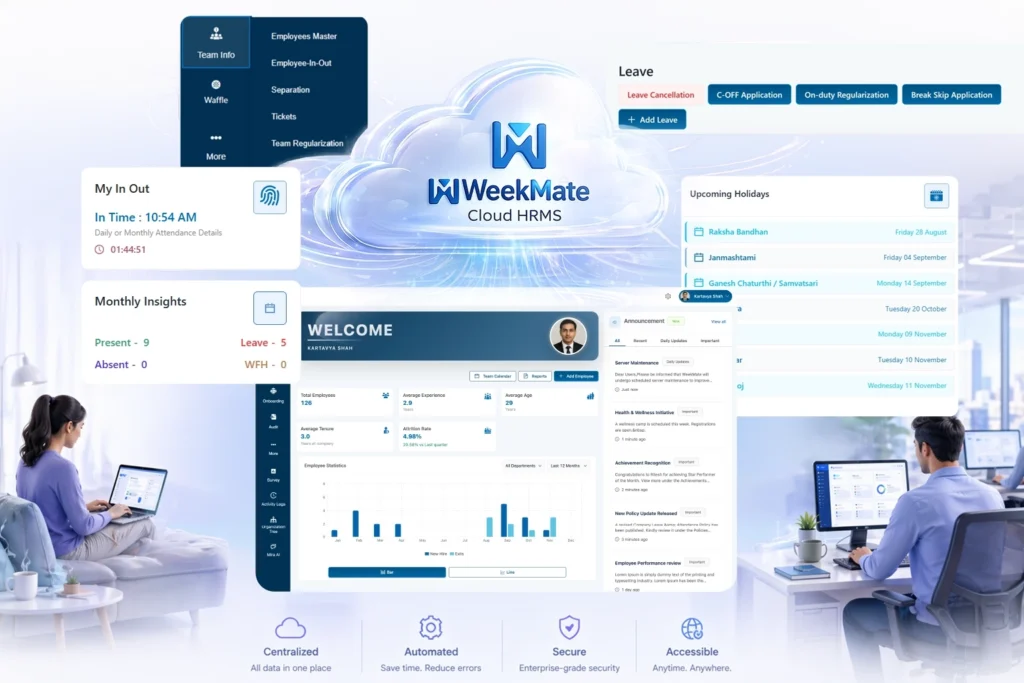
A cloud based HRMS software is a web-hosted human resource management system that provides comprehensive functionalities for end to end management of human resource activities, and you can use it at any time from anywhere on your computer or mobile device.
Unlike the old HR systems, where documents were kept on Excel sheets or on desktops, and even physical files were stored in on-premises facilities, digital HR solutions are much more dynamic and automated.
Core modules typically include:
- Centralized employee records
- Automated payroll management system
- Performance tracking and appraisals
- Leave and attendance management
- Recruitment and onboarding tools
For instance, WeekMate HRMS integrates these with AI-powered automation, along with the flexibility of cloud and on-premises deployment, which is ideal for Indian enterprises cautious about data privacy and compliance.
Understanding Hybrid Workforce Management
A hybrid work environment offers employees the option to work in the office, remotely, or a combination of both. Companies in India are embracing this to improve work-life balance, access wider talent pools (especially from Tier-2 and Tier-3 cities), and save on real estate costs. However, hybrid workforce management comes with unique challenges:
- Communication gaffes between on-site and remote teammates.
- Hard to track productivity without micromanaging.
- Managing attendance, leaves, and shifts for employees in different locations and time zones
- Ensuring fair performance evaluation across varied work setups.
Without the proper resources, these problems could swiftly lead to disengagement, mistakes, and even compliance risks under Indian labor regulations.
Key Challenges Without an HRMS in Hybrid Workplaces
Many businesses are still using unintegrated tools or manual processes. The result?
- Endless back-and-forth for attendance and leave approvals.
- Mismatched timesheets and holiday calendars lead to payroll mistakes.
- Compliance shambles with PF, ESI, TDS, and state labor laws.
- The unavailability of centralized data makes it difficult to generate reports with ease or forecast workforce needs.
Leave and attendance management gets difficult, especially with some employees clocking in via biometric scans at the office and others working remotely. These inefficiencies consume HR time and disappoint employees.
Advantages of Cloud Based HRMS for Hybrid Business
Migration to cloud HRMS software brings immediate and long-term benefits.
Employee Management in a Central Location
You have a unified database that serves as your powerful employee management software. HR, managers, and employees can all get up-to-date, accurate information from anywhere, whether in Mumbai or a hill station. No more searching through email or shared drives.
Streamlined Payroll Processing
An automated payroll management system computes salaries, deductions, taxes and produces payslips within minutes. It remains compliant with the latest Indian statutory requirements and helps avoid errors and payment delays that break employees’ trust.
Leave and Attendance Tracking
Real-time leave and attendance management system supporting multiple modes. This includes biometrics for office staff, GPS/selfie-based for field force, and web login for remote workers. Approvals are faster through self-service portals, and WFH or comp-off tracking becomes effortless.
Enhanced Collaboration & Communication
Employees access self-service portals to view their records, request leave, or obtain payslips. Integrated engagement features and notifications ensure everyone is on the same page and minimize miscommunication in hybrid setups.
Improved Efficiency for the Organization
With cloud based HRMS software eliminating manual work, HR teams are now free to focus on strategic activities. Data-driven insights using organizational efficiency tools help leaders make smarter decisions on hiring, promotions, and resource allocation.
The result of WeekMate HRMS is happier teams, fewer compliance risks, and tangible productivity gains. Many Indian SMEs claim to save 15-30 hours a month on routine HR tasks.
Features to Look for in the Best HRMS for Hybrid Workforce Management
There are several features to consider when searching for the best HRMS for hybrid workforce management:
When evaluating solutions for your needs, consider obtaining (or looking for) the following capabilities to help identify the best HRMS for hybrid workforce management:
- Full cloud based with excellent mobile access.
- Automation of routine tasks such as paying employees and sending reminders.
- Seamless integration with current software (time and attendance devices, accounting software, etc.).
- Customizable dashboards and reports.
- Data security at multiple levels, compliance, and role-based access.
WeekMate HRMS excels in this domain with its AI-based automation, support for remote/hybrid/office teams, and diverse configuration options.
Here’s a quick comparison table:
|
Feature
|
Traditional HR Systems |
Cloud Based HRMS (e.g., WeekMate)
|
|
Accessibility
|
Office-bound, desktop only |
Anytime, anywhere via cloud & mobile |
| Payroll Automation |
Manual calculations, high errors |
Automated payroll management system with compliance
|
|
Leave & Attendance
|
Spreadsheets & registers |
Real-time tracking with multiple punch options |
| Scalability |
Limited, expensive upgrades |
Grows easily with your team
|
|
Data Security & Compliance
|
Risk-prone |
Enterprise-grade with audit trails |
| Hybrid Workforce Support |
Poor |
Excellent for remote + office teams
|
How Cloud HRMS Can Help You Grow Your Business?
And when your business grows, your cloud based HRMS software grows with you. It enables advanced workforce planning, detects skill gaps using performance data, and enhances the overall employee experience, which is key to retaining employees in high-demand Indian markets.
When organizations adopt digital HR solutions like WeekMate, they advance their digital transformation. Instead of being a purely administrative function, HR today is a strategic partner in organizational productivity.
Real-World Use Cases
Remote Hiring: On the first day of work, a new employee in a different city or state can complete paperwork, sign documents online, and gain access to the system, all without ever setting foot in a physical office.
Multi-Office Payroll Processing: An organization with offices in Delhi and Hyderabad, along with remote teams, processes salaries smoothly in a single run, managing different state compliances like a breeze.
Distributed Teams Performance: Managers monitor goals and provide real-time feedback, ensuring that appraisals are fair whether an employee works from home or on the factory floor.
Such scenarios are all too familiar to Indian enterprises making the move to hybrid models after the pandemic.
Tips For Finding The Right HRMS
Assess your existing challenges and what you aim to accomplish in the future.
- Compare features, including hybrid workforce management and leave and attendance management.
- Review pricing and opt for clear models that don’t punish growth.
- Review user comments, the quality of support, and how easy it is to implement.
- Make sure the system meets Indian statutory requirements and provides a high level of data security.
- A brief demo or trial can say a lot about how easy the platform really is.
For more details, refer to this blog on How Cloud HRMS solves HR problems.
Final Thoughts
In today’s hybrid work world, old-school ways of working just aren’t cutting it. Good cloud based HRMS software, such as WeekMate, is crucial for managing hybrid workforces, keeping operations running smoothly, and ensuring your employees are happy. It gives strength to a digital HR solution that automates payroll management, simplifies complex employee management tasks, and provides a framework for organizational efficiency tools to any business looking to grow.
By selecting the right system to invest in today, Indian companies can reduce risk, save time and money, and cultivate a workforce that is more engaged and productive, preparing them to meet the challenges of tomorrow. The benefits in terms of compliance, efficiency, and employee satisfaction are well and truly worth it. If your company is trying to figure out how to manage hybrid work, this is a great time to look into how a modern HRMS can revolutionize your people operations.
FAQs
1. What is cloud based HRMS software, and why is it suitable for hybrid teams?
Cloud based HRMS is software that can be accessed securely from anywhere via the internet. It’s perfect for hybrid businesses because it allows remote attendance, provides real-time updates, and keeps data centralized without the need for physical infrastructure.
2. How does an HRMS payroll management system comply with Indian regulations?
An automated payroll system accurately deducts PF, ESI, TDS, professional tax, and other statutory deductions. It produces compliant reports and payslips, minimizing errors and Audit risks for businesses across states.
3. Can cloud HRMS track leave and attendance for in-house & work-from-home employees?
Yes. Today’s solutions come with flexible leave and attendance management features, such as biometric on-site tracking, GPS/selfie for field workers, and web login for WFH, to ensure tracking is fair and accurate.
4. Is WeekMate HRMS the best HRMS for hybrid workforce management?
WeekMate HRMS is tailor-made for hybrid, remote, and in-office configurations. It includes AI automation, payroll, attendance, and employee lifecycle management, with adaptable cloud- and on-premises deployment, ideal for Indian SMEs and expanding organizations.
5. What are the advantages of digital HR solutions in hybrid work models?
Digital HR solutions lead to enhanced efficiency, reduced manual errors, improved employee experience through self-service, and actionable, data-led insights for stronger decision-making and organizational efficiency tools.
6. What is the time frame to deploy a cloud based HRMS?
All but the earliest type of modern platform, including WeekMate, offer fast onboarding in the order of days to a few weeks, thanks to user-friendly interfaces, data import utilities, and dedicated customer support.
7. Can cloud HRMS boost employee engagement in hybrid working models?
Definitely. Self-service portals, transparent leave and payroll policies, and real-time communication tools make for more engaged and appreciated employees, even when they are dispersed geographically.