HR was never exhausting. But somewhere along the way, it just became repetitive: screening resumes, chasing approvals, fixing payroll errors, answering the same employee questions over and over. Then gradually, automation came in. It certainly helped, but not much. Now in 2026, things are shifting in a very noticeable way.
We’re moving from “automating HR” to something far more interesting. We’re building HR systems that can think, decide, and act on their own. And that’s where Agentic AI in HRMS comes into the picture.
Businesses today are not just worried about reducing the workload. They are working to make HR processes smarter. That’s because the best HR management software isn’t just tools anymore. They’re becoming partners.
What is Agentic AI in HRMS?
Defining Agentic AI
Agentic AI is an automated system that does not work on standard rule-based automation. So traditional AI follows instructions. But, agentic AI independently sets goals, makes decisions, and executes tasks. It almost works like a digital teammate.
So instead of saying, “Screen these resumes,” you’re saying, “Find the right candidate.” And the system figures out how to get there. It analyzes, decides, adjusts and then executes.
In HR, that means:
- It can prioritize hiring needs without being told.
- It can flag employee issues before they become problems.
- It can even suggest decisions you didn’t realize needed to be made.
How Agentic AI Works Inside a Modern HRMS Platform
Inside a modern HRMS, agentic AI doesn’t sit in one corner doing one job. It connects everything.
Recruitment, payroll, attendance, and engagement are part of a continuous loop of data and decision-making. The AI agent continuously learns from patterns like employee behavior, team performance, and historical HR data. Based on all this, it starts predicting what might happen next. So instead of reacting to problems, it tries to prevent them.
Why This Shift Matters So Much in 2026
Work has changed a lot. Teams are no longer sitting in the same office. Hiring is global. Expectations are higher. And decisions must happen fast and sometimes instantly.
Manual HR processes just can’t keep up with that pace anymore. Even traditional automation struggles because it’s rigid. It doesn’t adapt well.
Agentic AI changes that. It brings flexibility, speed, and something HR systems have always lacked: awareness.
The Evolution of HR Automation
There was a time when HR automation felt something great. You could automate emails, schedule interviews, generate reports, and that was enough.
When you think about it, you realise that those systems were still dependent on humans to guide every step.
But now, in 2026, HR systems are becoming responsive in a much deeper way. Not just executing tasks, but shaping them.
From Rule-Based Systems to Something More Fluid
Earlier systems worked like this: “If X happens, do Y.” It was simple, predictable, but limited.
Because real-world HR isn’t that straightforward. Now, systems adjust based on context. They learn from outcomes. They improve with time. They now understand intent more than just following instructions.
Key Trends Driving HR Automation in 2026
When you notice closely, you will see a few patterns in those companies that are adopting advanced HR systems:
- Conversational AI is replacing traditional HR helpdesks
- Predictive analytics is guiding hiring and retention
- AI-driven employee lifecycle management
- Autonomous compliance tracking
Industries Rapidly Adopting Next-Gen HR Technology
Not surprisingly, industries dealing with complexity are moving first.
IT & SaaS: High hiring volume, remote team
Healthcare: Compliance-heavy operations
Manufacturing: Workforce scale and shift management
Startups: Need for scalable HR
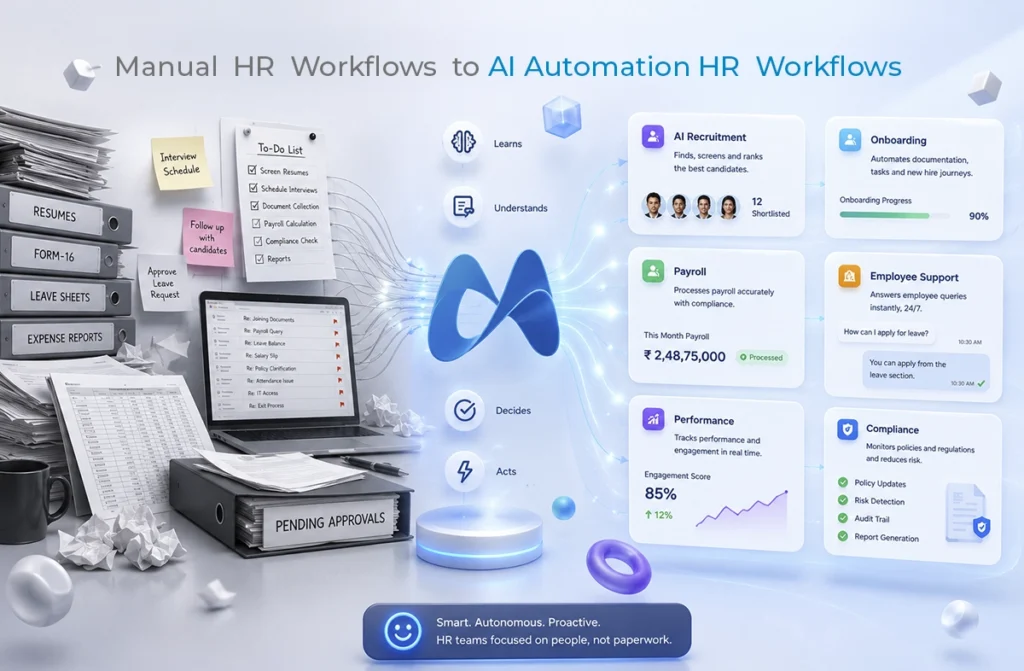
Major Manual HR Tasks Being Replaced by Agentic AI
This is probably the most visible change. Tasks that once took hours are now handled in the background. They are not completely removed; just redefined.
Recruitment and Candidate Screening
Resume screening used to be very time-consuming. Now, it happens almost instantly.
It’s not just about speed. AI systems are matching candidates based on skills, behavior patterns, and even cultural alignment. Interviews get scheduled automatically, and follow-ups happen without reminders.
Employee Onboarding and Documentation
New employees often feel overwhelmed on day one. Too many forms, too many policies, not enough clarity. Agentic AI changes that.
It creates structured onboarding paths, explains policies in simple language, and ensures nothing gets missed.
Payroll and Attendance Management
Payroll errors used to be stressful. But now, systems handle calculations, deductions, and compliance all in real time with their payroll automation systems.
Further, attendance tracking adapts to hybrid work models and leave management becomes seamless.
Employee Support and HR Helpdesks
Instead of waiting for HR responses, employees now interact with AI assistants. They ask questions, get answers and move on.
And over time, these systems get more accurate, more helpful and more human-like.
Performance Management and Engagement
Annual reviews feel outdated now. Systems track performance continuously. Feedback is generated in real time. Patterns are analyzed quietly in the background.
Managers no longer have to rely on memory.
Compliance and Policy Management
Regulations change. Policies evolve. Risks appear unexpectedly.
Earlier, HR teams reacted to these changes. Now, systems continuously monitor HR statutory compliance. They flag risks early, suggest actions and even generate audit reports.
Benefits of Reducing Manual HR Tasks Using AI
This is where things come together. Because it’s not just about replacing tasks. It’s about changing outcomes.
Efficiency Gains
Tasks have become faster. But more importantly, they’re lighter. HR teams aren’t overloaded anymore. They have space to think, plan, and focus on people instead of processes.
A Better Employee Experience
When systems respond instantly and accurately, employees feel supported. Not because someone is constantly checking on them. But because the experience just works.
Data Accuracy and Compliance
Mistakes are reduced, and reports become cleaner. Hence, the decisions become more reliable.
Cost Savings and Scalability
Less manual work means fewer resources spent on repetitive tasks. And scaling has become easy.
HR Becomes Strategic
This is probably the biggest shift. HR isn’t just executing anymore. It’s guiding decisions, shaping culture, influencing growth. And that changes how businesses operate at a deeper level.
The Future of HRMS with Agentic AI
Autonomous HR Departments
Not fully autonomous, but close. Systems handle operations. Humans focus on strategy. It’s a balance, and when done right, it works beautifully.
Employee Experiences That Feel Personal
Every employee gets a different journey. Learning paths, benefits, engagement strategies—all tailored. It doesn’t feel generic anymore.
Ethical AI Becomes Non-Negotiable
With power comes responsibility. And this is where companies need to be careful. Bias needs to be addressed. Decisions need to be transparent, and data needs to be protected.
Humans + AI, Working Together
This isn’t about replacement. It’s about collaboration. AI handles repetition. Humans handle judgment, empathy, and leadership. And together they create something far more effective.
Choosing the Best HR Management Software for Agentic AI
Important Features to Look For
- Workflow automation
- Predictive analytics
- Employee self-service tools
- Seamless integrations
Questions You Should Ask Vendors
- Can the AI be customized?
- How secure is the data?
- Will this scale with our growth?
Common Mistakes to Avoid
Some things to watch out for:
- Ignoring integration challenges
- Overlooking employee adoption
- Choosing outdated systems
It’s not just about features, it’s about fit.
Challenges of Implementing Agentic AI in HRMS
Let’s not ignore this. Implementing agentic AI isn’t frictionless.
- Data quality can slow things down.
- Employees might resist change.
- Too much automation can feel impersonal.
- Regulations still need careful handling.
But with the right approach, these are manageable.
Final Thoughts
One thing is clear in 2026, that HR is no longer just a support function. It’s becoming a strategic driver and decision-making force.
And Agentic AI in HRMS is playing a big role in that transformation. From reducing manual work to enabling intelligent workflows, the shift is real. And businesses that embrace it early? They’re not just keeping up. They’re moving ahead.
So if you’re exploring ways to modernize your HR operations, it might be time to look into the best HR management software built for this new reality.
FAQs
1. What is Agentic AI in HRMS?
Agentic AI is an automated system that does not work on standard rule-based automation. It lets systems make decisions, handle HR tasks, and improve workflows independently.
2. How is it different from traditional automation?
Traditional automation only works by following a set of rules. Whereas Agentic AI can adapt, learn from experience, and respond to different situations by itself.
3. Is it suitable for growing businesses?
Yes. Agentic AI is especially helpful for companies that want to grow without adding more work for their HR teams.
4. Does it replace HR teams?
No, it does not replace humans. It actually helps by automating repetitive tasks so people can focus on more strategic work.
5. Is Agentic AI safe to implement?
Yes, Agentic AI is safe to use when companies make data security, transparency, and responsible AI practices a priority.