If you’re reading this now, your HRMS likely isn’t performing like it should. You might have payroll getting stuck. Maybe your HR department is being forced to do things manually that software promised to fix years ago. Or you have grown beyond the capabilities of Keka or HROne and wonder whether changing is worth it at all.
The truth is: switching HR software is quite painful but you don’t necessarily have to take risks. The most common business concern is having the data lost during the switch. Employee files accumulated over many years, payroll data, vacation leaves, etc. All that information seems too important to risk.
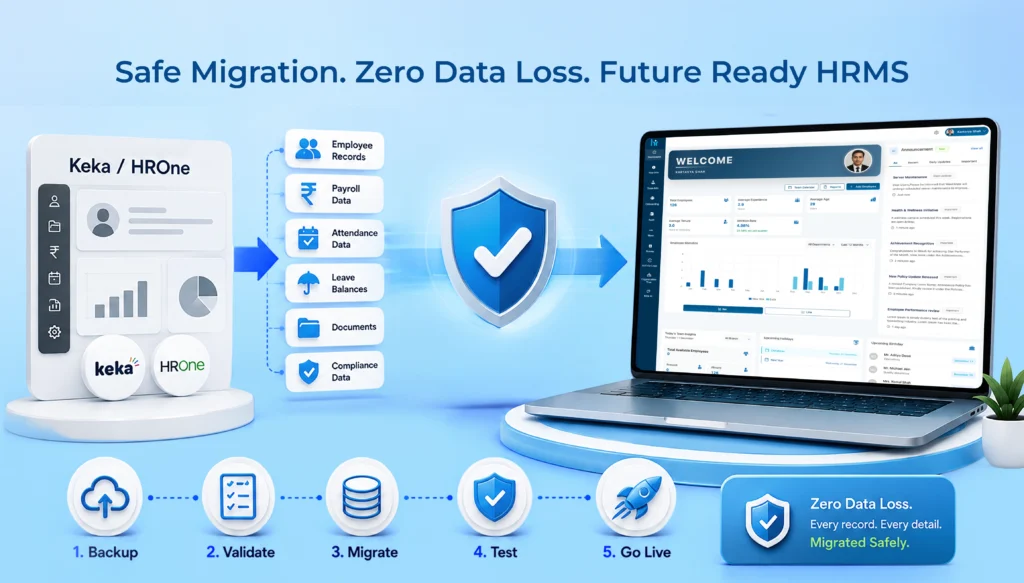
This HRMS migration guide walks you through exactly why companies move away from Keka and HROne, what to look for in a replacement, and how a proper migration to WeekMate HRMS actually works, step by step, without losing a single record along the way.
Why Companies Migrate from Keka or HROne
Nobody switches HR software on a whim. There’s usually a build-up of small frustrations that eventually becomes too big to ignore.
Business Growth Requires More Flexible HR Software
What worked for a 50-person company often breaks down at 200 or 500 employees. Approval chains get messier. Reporting structures change. And a lot of businesses find that their existing HRMS just wasn’t built to flex with that kind of growth. You end up working around the software instead of the software working for you.
Need for Better Payroll & Attendance Integration
This one comes up a lot. Payroll and attendance are supposed to talk to each other seamlessly. When they don’t, HR teams end up manually cross-checking attendance sheets against payroll runs every single month. That’s hours of work that shouldn’t exist in 2026.
Cost Optimization
Higher pricing tiers on some platforms don’t always bring you more value. Businesses find out late that they have been paying for modules they aren’t even using whilst still missing some core features that they actually require. After some time, it would be a much more economical decision to switch than to keep subscribing.
Better Employee Experience and Self-Service
Modern-day employees expect to access their pay slips, apply for a leave, make changes to their details, without the need to send an email to HR every time. And if your current system is outdated, it is a real productivity loss, not simply a minor inconvenience.
Improved Customer Support and Faster Implementation
It’s really important but gets overlooked. For example, if a pay system stops working at 5 minutes to payday, you are really in trouble if the technical support isn’t fast enough to find a solution. A very slow support system results in even an unimportant break turning into a really big problem.
Signs It’s Time to Upgrade Your HRMS
Not sure if you’re actually at the point of switching? Here are the signs that usually show up first:
- Manual HR work keeps increasing instead of decreasing
- Payroll processing takes longer each cycle
- Attendance discrepancies keep popping up, and no one can pinpoint why
- Customization requests get met with “that’s not possible right now”
- Reports feel basic, or take too much manual effort to build
- Integrations with other tools you use just don’t work smoothly
If two or three of these sound familiar, it’s probably worth exploring your options.
Keka vs WeekMate HRMS: Feature Comparison
Let’s get into specifics. Here’s how WeekMate stacks up against Keka across the areas that matter most day to day.
Employee Database
Both platforms offer centralized employee records, but WeekMate is built to handle custom fields and document types more flexibly, which matters a lot for businesses with varied compliance or industry needs.
Payroll Processing
Keka’s payroll is solid for standard use cases. WeekMate takes it further with tighter attendance-payroll sync, so there’s less manual reconciliation before every payroll run.
Attendance & Leave Management
This is one of the areas businesses complain about most with their existing tools. WeekMate’s attendance module is designed to catch discrepancies early, rather than surfacing them only at month-end.
Performance Management
Both offer performance review workflows. WeekMate’s version leans toward simpler, more customizable review cycles, useful for companies that don’t want a rigid one-size-fits-all process.
Recruitment & Onboarding
Keka has a mature recruitment suite. WeekMate’s onboarding flow focuses on getting new hires functional faster, with document collection and role setup happening in parallel instead of one after another.
Employee Self-Service Portal
Both platforms offer self-service. The difference tends to show up in day-to-day usability, WeekMate’s interface gets fewer complaints about being confusing for non-tech-savvy employees.
Mobile App
Both have mobile apps for attendance and leave requests. WeekMate’s app is built with a lighter, faster experience in mind, which matters more than people expect once employees are using it daily.
Pricing & Scalability
This is often the deciding factor. WeekMate’s pricing structure is generally more transparent, without the tier creep that catches growing businesses off guard.
Customer Support
Support responsiveness is one of the top reasons companies leave Keka. WeekMate is built around dedicated support access, especially during critical periods like payroll runs.
|
Feature
|
Keka |
WeekMate
|
|
Employee Database
|
Centralized, standard fields |
Centralized, flexible custom fields |
| Payroll Processing |
Reliable, standalone |
Tightly synced with attendance
|
|
Attendance & Leave
|
Good, month-end reconciliation needed |
Real-time discrepancy detection |
| Performance Management |
Structured, less flexible |
Customizable review cycles
|
|
Recruitment & Onboarding
|
Mature recruitment suite |
Faster, parallel onboarding |
| Self-Service Portal |
Available |
Simpler, more intuitive
|
|
Mobile App
|
Functional |
Lightweight, faster |
| Pricing & Scalability |
Tiered, can grow quickly |
Transparent, scalable
|
|
Customer Support
|
Standard support |
Dedicated support access
|
HROne vs WeekMate HRMS: Feature Comparison
HROne is a different comparison altogether, since its strengths and gaps aren’t quite the same as Keka’s.
Core HR
HROne covers the basics well. WeekMate adds more flexibility around how HR data is structured and reported.
Payroll Automation
HROne automates payroll reasonably well for standard structures. WeekMate is built to handle more complex payroll scenarios without needing manual overrides.
Attendance Tracking
Both track attendance, but WeekMate’s system is designed to reduce the back-and-forth between attendance logs and payroll teams.
Workflow Automation
HROne offers decent workflow automation for approvals. WeekMate lets you customize these workflows more deeply, which matters for businesses with layered approval chains.
Reports & Analytics
This is a common gap companies mention with HROne, reports often need extra manual work to get into a usable format. WeekMate’s reporting is built to be usable out of the box.
Mobile Experience
Both platforms have mobile access. WeekMate’s mobile experience is generally rated as more intuitive for everyday tasks like leave requests.
Pricing
Pricing between the two is competitive, but WeekMate tends to offer more clarity on what’s included at each tier, so there are fewer surprises later.
Implementation Time
This is where WeekMate stands out. Implementation is typically faster, which matters a lot if you’re trying to avoid a long stretch of running two systems in parallel.
|
Feature
|
HROne |
WeekMate
|
|
Core HR
|
Standard coverage |
Flexible data structure |
| Payroll Automation |
Good for standard payroll |
Handles complex payroll well
|
|
Attendance Tracking
|
Reliable |
Reduces manual reconciliation |
| Workflow Automation |
Decent approval flows |
Deep customization
|
|
Reports & Analytics
|
Often needs manual work |
Usable reports out of the box |
| Mobile Experience |
Functional |
More intuitive
|
|
Pricing
|
Competitive |
Clearer tier structure |
| Implementation Time |
Moderate |
Faster
|
HRMS Migration Checklist for Businesses
Before you touch anything, get organized. This checklist saves you from the panic of realizing something’s missing halfway through HRMS migration.
Audit Existing HR Data
Start by understanding exactly what data you have, employee records, payroll details, attendance logs, all of it, before you even think about moving anything.
Clean Duplicate Records
Old systems tend to accumulate duplicate entries over time, especially if employees were ever re-added or updated manually. Clear these out before export, not after.
Backup Employee Data
Always keep a full backup before starting, no exceptions. Even a well-planned migration should have a fallback in place.
Review Payroll History
Old payroll runs need to be accurate before they’re transferred. Any errors sitting in your current system will just carry over if they’re not caught now.
Export Attendance Records
Pull historical attendance data in a format your new system can actually read. This step is easy to rush, and that’s usually where gaps show up later.
Verify Leave Balances
Make sure current leave balances are correct at the point of export. Mismatched balances are one of the first things employees notice after a switch.
Collect Employee Documents
IDs, contracts, and other files need to be gathered and organized ahead of time, rather than chased down mid-migration.
Review Compliance Records
PF, ESI, tax details, anything compliance-related deserves a second look. These aren’t the kind of records you want to get wrong.
Identify Required Integrations
List out every tool your current HRMS connects with, payroll software, biometric devices, accounting tools, so nothing gets missed in the new setup.
Prepare User Access Roles
Decide who needs access to what before the new system goes live. Setting this up in advance avoids access issues on day one.
Step-by-Step HRMS Migration Guide Without Data Loss
This is the part most people are actually here for. Here’s how a clean migration typically plays out.
Step 1: Assess Current HRMS
Start by understanding what’s working and what isn’t in your current setup. This shapes your entire migration plan.
Step 2: Define Migration Goals
Are you migrating just to fix payroll issues, or is this a full overhaul? Knowing this early keeps the process focused.
Step 3: Prepare Data
Organize employee records, payroll data, and attendance history into a structure that’s easy to work with.
Step 4: Export Existing Data
Pull all relevant data out of Keka or HROne in the formats your new system can actually accept.
Step 5: Validate & Clean Data
This step gets skipped too often, and it’s usually where data loss actually happens. Check for missing fields, duplicate entries, and formatting mismatches before moving forward.
Step 6: Import into WeekMate
Once data is clean, it gets imported into WeekMate, ideally in batches so errors are easier to catch and fix.
Step 7: Configure Payroll & Attendance
Set up your payroll structure, tax rules, and attendance policies to match how your business actually operates.
Step 8: Test Data Accuracy
Run test payroll cycles and compare them against your old system’s numbers. Everything should match before you go live.
Step 9: Employee Training
Even the best software fails if employees don’t know how to use it. A short training session goes a long way here.
Step 10: Go Live
Once testing checks out and your team is comfortable, you’re ready to fully switch over.
How WeekMate Ensures HRMS Migration Without Data Loss
This is really the core of what businesses want to know, will their data actually survive the move intact.
WeekMate assigns a specialized migration team to every project meaning that the responsibility is shared and both parties don’t have to speculate. Data is transferred via secure channels, and the payroll history, balance of leaves, and attendance data are transferred as entire records rather than as partial exports.
Employee records get transferred together with everything else, and the user’s role-based access is granted before the launch of the system rather than after. The validation check is a compulsory step right before launching the system, thereby spotting possible mismatch earlier than later, when the employees have already been using the new system. And, once you are up and running, support won’t just fade away. Post-migration assistance is part of the whole process, not one that comes at the end.
Common HRMS Migration Challenges and Solutions
Even well-planned migrations run into hiccups. Here’s what usually comes up, and how HRMS migration without data loss gets handled.
| Challenge |
Solution |
| Data duplication |
Thorough data validation before import |
| Missing employee records |
Multiple verification checks during migration |
| Payroll mismatches |
Parallel payroll testing before go-live |
| Attendance inconsistencies |
Historical reconciliation against old records |
| User adoption |
Structured employee training sessions |
| Downtime |
Phased implementation instead of a single cutover |
Best Practices for a Successful HRMS Migration
A few habits separate smooth migrations from stressful ones.
Plan early, ideally weeks before your actual switch date, not days.
Involve both HR and IT teams from the start, since migration issues are rarely just one department’s problem.
Run a pilot migration with a small employee group first, it catches issues before they affect everyone.
Test payroll thoroughly before going live, this is the one area where mistakes get noticed immediately.
Keep backups throughout the process, not just at the beginning.
Train employees before go-live, not after they’ve already hit a wall.
And keep an eye on the system for a few weeks post-launch, since some issues only show up once real usage begins.
Why Businesses Choose WeekMate
At this point, the pattern is probably clear. Businesses moving away from Keka or HROne tend to land on WeekMate because implementation is quicker, onboarding doesn’t drag on for months, and pricing stays predictable as the business grows.
Payroll compliance is handled without constant manual checking, attendance runs on automation instead of spreadsheets, and employees get a self-service experience that doesn’t need a manual to figure out. Add dedicated support on top of that, and it’s a setup built to scale as the business does, not something you’ll outgrow again in a year or two.
Conclusion
Deciding whether to migrate HRMS is probably seen as making a big change, and yes, it is. Even so, when properly planned with data audited, cleaned, and validated stage by stage, there is no chance left for something valuable to be lost. Typically speaking, it’s the business that rushed migration that had lots of problems, not the one that switched.
If you’re currently on Keka or HROne and starting to feel the friction, it might be worth having a proper conversation about what a move to WeekMate would actually look like for your team. Schedule a demo with the WeekMate team, walk through your specific setup, and see exactly how the migration would play out before committing to anything.
FAQs
1. Will we lose any data during migration to WeekMate?
No. With proper backup, validation, and testing at each stage, a WeekMate migration is designed to move every record over intact, including payroll history, attendance, and leave balances.
2. How long does a typical HRMS migration take?
It depends on company size and data complexity, but most businesses complete migration within a few weeks, including testing and training.
3. Can we run our old HRMS and WeekMate in parallel during the switch?
Yes, and it’s actually recommended. Running both briefly, especially during payroll testing, helps confirm accuracy before fully switching over.
4. Does WeekMate support businesses migrating from platforms other than Keka or HROne?
Yes. While this guide focuses on Keka and HROne, WeekMate’s migration process is built to handle data from most existing HR systems.
5. What happens if we find an error after going live?
WeekMate’s post-migration support is there specifically for this. Issues found after launch are addressed as part of ongoing support, not treated as a separate cost.