Ask any HR manager in India what keeps them up at night, and “the new labour codes” will come up within the first minute. Not because the rules are impossible to follow. It’s the pace of change, and the fact that no two states seem to be moving at the same speed, that makes compliance feel like a moving target.
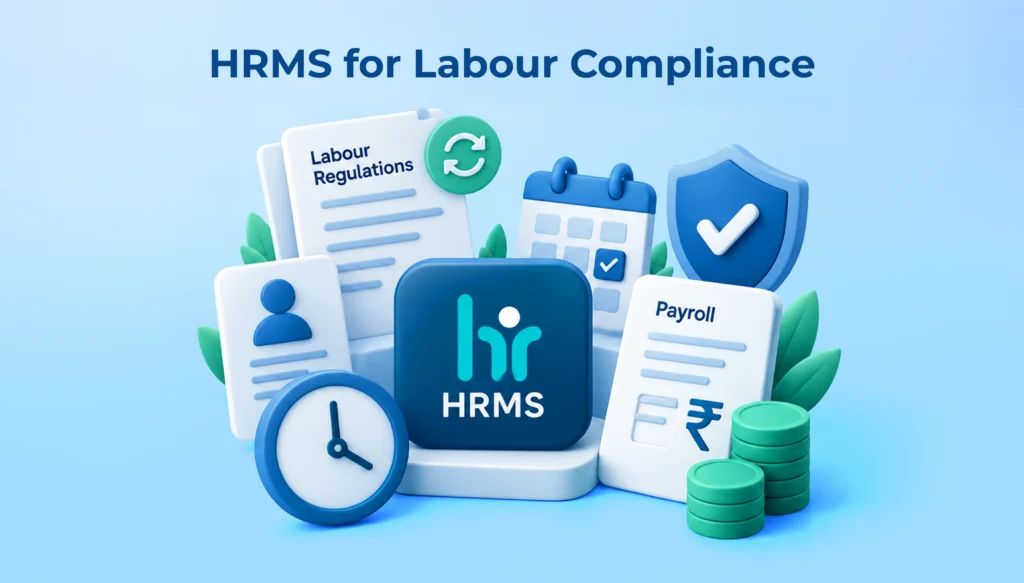
That’s exactly where labour law compliance software earns its keep. Instead of HR teams manually cross-checking every circular against every employee record, the software does the heavy lifting, quietly, in the background, and flags what actually needs attention.
If you’re evaluating an HRMS software in India, this is worth reading before you shortlist anything. We’ll walk through why regulations keep shifting, what compliance software actually does, and how the right HRMS turns a stressful compliance season into something closer to routine.
Why Changing Labour Regulations Are a Challenge for Businesses
Here’s the thing nobody tells you when you start a business in India: labour law isn’t one law. It’s a patchwork, and right now, that patchwork is being rewoven in real time.
India’s four new Labour Codes were notified in November 2025, folding close to 30 older central laws into one framework. Sounds simpler on paper. In practice? Central rules and state rules don’t move together. Gujarat, Haryana, Madhya Pradesh, and a handful of other states already have final rules in place with their own effective dates. Several large states are still working through drafts. So a business with offices in Ahmedabad and Pune could genuinely be operating under two different compliance timelines right now, for the same law.
Add to that:
- Different rules across states and even industries for the same category of employee
- Wage definitions that changed overnight; the new 50% rule means basic pay must now form at least half of total CTC, which directly affects PF and gratuity math
- Manual attendance, leave, and payroll tracking that was never built to flex this fast
- The very real risk of an inspection catching an employer mid-transition, unaware their salary structure is now non-compliant
None of this is really anyone’s fault. It’s just what happens when 29-odd laws get consolidated into four, and rollout happens state by state instead of all at once. But the businesses that get caught off guard are usually the ones still running compliance out of spreadsheets and a shared drive.
What Is Labour Law Compliance Software?
In simple terms, it is software that keeps your statutory obligations related to Provident Fund (PF), Employees’ State Insurance (ESI), Income Tax, Gratuity, Minimum Wages Act, and Weekly Hours (working days) tied directly to your current number of employees, payroll details, etc., so that the statutory obligations & payroll don’t differ.
Instead of an HR person manually checking whether a new circular applies to your organisation, then updating salary structures by hand, the system centralises everything: employee master data, attendance, payroll, leave, and statutory contributions, in one place. When a rule changes, the underlying calculations change with it, or at least flag where a manual review is needed.
The difference from manual compliance is less about “automation” as a buzzword and more about timing. Manual processes catch mistakes after payroll runs, usually during an audit. Automated systems catch them before the payslip goes out. That gap, small as it sounds, is where most compliance penalties actually happen.
How HRMS Software Helps Businesses Stay Compliant
1. Automated Compliance Tracking
This is the part that saves the most sleep. A good HRMS keeps a running list of what’s due, when, and for whom, so nothing gets missed because someone was on leave the week a filing deadline fell.
It’s not glamorous work, but it’s the difference between finding an error yourself and having a labour inspector find it for you. Records stay audit-ready by default, not scrambled together the night before.
2. Accurate Payroll and Statutory Calculations
Payroll is where the new wage rules bite hardest. If your allowances (HRA, conveyance, special allowance) push past 50% of CTC, the excess now counts as “wages” for PF and gratuity purposes, which can quietly increase your statutory costs by a noticeable margin.
An HRMS applies this logic consistently, every cycle, across every employee. No one’s manually recalculating 200 salary structures in Excel and hoping they got the formula right the third time.
You can read our guide on statutory compliance to know more about it.
3. Centralised Employee Records
Every audit, every inspection, starts with the same question: can you show us the records? When attendance lives in one register, leaves in another spreadsheet, and salary history in someone’s inbox, that question takes days to answer.
Centralising everything means:
- One source of truth for employee details, attendance, leave, and salary history
- Faster response during inspections: pull the report instead of piecing it together
- Fewer data mismatches between departments
It sounds like a small thing until you’re the one digging through three years of paper trail with an inspector waiting.
4. Better Attendance and Working Hours Management
Effective monitoring of work hours, including overtime, really depends on accurate records. Handwritten time sheets can be altered, sometimes on purpose. Also, spreadsheets don’t have any indication when someone’s work hours have gone beyond the legal limit.
Automated attendance tracking closes that gap. It logs hours as they happen, supports leave and overtime rules baked into the system, and removes the guesswork around whether a shift pattern is even compliant in the first place.
5. Faster Adaptation to Labour Law Updates
This is the point where having a state-wise rollout really comes into play. When Karnataka finalises its rules a month before Maharashtra, or vice versa, HR teams have to get the ball rolling again and quickly update their ways of working without having to throw all the old plans away every month.
A flexible HRMS enables you to adjust salary components, leave rules, and compliance procedures as regulations get introduced, rather than waiting until your yearly review to be able to catch up. That flexibility might be more valuable than any single feature in a list of specs.
6. Improved HR Compliance Management
Beyond the mechanics of payroll and attendance, there’s the softer side: policies, approval chains, documentation. An HRMS standardises how these get created and tracked, so compliance isn’t dependent on one person’s institutional memory.
Visibility improves too. Instead of HR compliance living in someone’s head (and leaving with them if they resign), it lives in the system, searchable and consistent.
Key Features to Look for in Statutory Compliance Software
Not every HRMS is built with compliance as a first-class concern. Some treat it as an afterthought bolted onto a payroll module. When you’re evaluating options, here’s a rough checklist worth running through:
|
Feature |
Why it matters |
|
Automated payroll processing |
Reduces manual calculation errors in statutory contributions |
| Attendance and leave management |
Keeps working-hour and leave compliance data accurate |
|
Employee document management |
Speeds up audits and inspections |
| Compliance reminders and alerts |
Nothing slips past a filing deadline |
|
Centralised reporting |
One report, not five spreadsheets stitched together |
| Audit-ready records |
Records stay presentable without last-minute prep |
|
Configurable workflows |
Adapts to state-specific rule changes without a rebuild |
| Data security and access controls | Protects sensitive employee and payroll data |
|
Real-time dashboards |
Gives HR leadership visibility without asking IT for a report |
If a platform is missing more than one or two of these, it’s probably going to need workarounds down the line. Worth asking vendors directly rather than assuming.
Benefits of Using HRMS for Labour Law Compliance in India
Zoom out, and the case for HRMS-driven compliance in India comes down to a handful of practical wins:
- Fewer compliance errors, because the system checks before payroll runs, not after
- More accurate employee and payroll data, since it’s entered once and used everywhere
- Noticeably less manual admin work for HR and payroll teams
- Faster access to records when audits or inspections happen
- Better overall preparedness, rather than reacting to each new rule as it lands
- An easier path through the ongoing labour code rollout, state by state, without rebuilding processes each time
None of these are flashy. But add them up over a year, and they’re the difference between a compliance function that’s calm and one that’s constantly catching up.
How WeekMate Helps Businesses Simplify HR Compliance
This is where a platform like WeekMate HRMS fits in. It’s built as a cloud-based HR and payroll system for Indian businesses, with PF, ESI, and TDS compliance handled as a core part of payroll processing, not an add-on.
In practice, that means employee data, attendance (including WFH and comp-off tracking), payroll, and HR workflows all sit in one system instead of four disconnected tools. Employees get a self-service portal through the mobile app for payslips and leave requests, which cuts down the back-and-forth that usually clogs up HR’s inbox. Reporting is centralised too, so pulling audit-ready records doesn’t mean waiting on three different departments.
It’s not a magic fix for the labour code transition; no software is. But it does mean your HR team is working off one accurate system of record instead of stitching together spreadsheets while the rules keep shifting underneath them. For teams also managing sales pipelines or project workflows, WeekMate’s other modules (CRM, TaskHub) sit on the same platform, though we’d recommend confirming those integration specifics directly with the WeekMate team for your setup.
This kind of setup is really part of a bigger shift finance and HR teams are making together, away from disconnected tools and toward one integrated finance SaaS suite that keeps payroll, billing, and compliance moving in sync.
Best Practices for Preparing Your Business for Labour Regulation Changes
A few things worth doing regardless of which HRMS you use:
- Review applicable labour regulations regularly, not just once a year during audit prep
- Keep employee and payroll records accurate and current, always
- Stop relying entirely on spreadsheets; they don’t scale with rule changes
- Use automated compliance tracking wherever you can
- Maintain proper documentation for every policy change, dated and traceable
- Train HR and payroll teams as regulations shift, not after something goes wrong
- Choose a platform that can scale with your headcount and your compliance complexity
Honestly, most of this is common sense. The hard part is doing it consistently when there’s no deadline forcing you to.
The Future of HR Compliance Management
Automation’s role in HR compliance is only going to grow from here, especially with the labour codes still working through state-level rollout over the next year or two. Real-time workforce data is becoming less of a nice-to-have and more of a baseline expectation, particularly for businesses operating across multiple states with different rule timelines.
AI is starting to play a part too, not replacing HR judgement, but flagging gaps and inconsistencies faster than a manual review ever could. Integrated HRMS platforms, ones that combine payroll, attendance, and compliance in a single system, are becoming the practical default rather than the premium option. It’s less about chasing the newest feature and more about not getting caught flat-footed when the next state notifies its rules.
Conclusion
Labour law in India isn’t standing still, and honestly, it probably won’t for another year or two while the new codes finish rolling out state by state. Businesses that treat compliance as a system, not a scramble, are the ones that stay ahead of it.
Labour law compliance software won’t rewrite the rules for you. But it will make sure your payroll, attendance, and employee records are always ready for whatever comes next, rather than being rebuilt every time a new rule lands. If you’re exploring what that looks like for your business, WeekMate HRMS is worth a look for streamlined HR, payroll, and compliance management, all in one place.