
Managing your workforce isn’t easy. You’re tracking attendance, planning shifts, handling leave, and running payroll – all at once. Miss a connection between these, and small mistakes turn into big headaches.
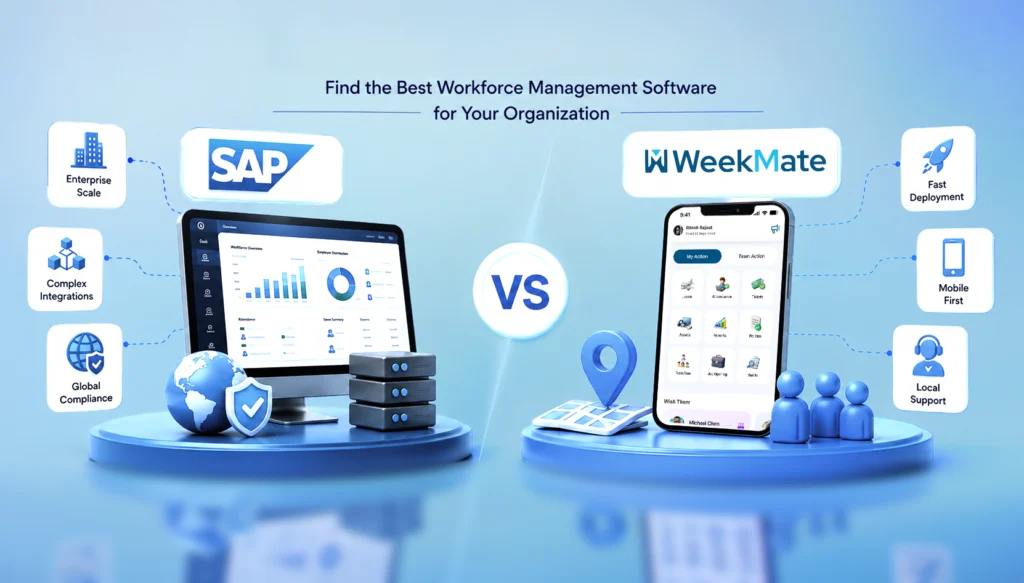
This is where the best workforce management software helps. Two names come up a lot: SAP and WeekMate. SAP is a large, global system. WeekMate is built for Indian businesses.
In this article, we’ll compare both SAP and WeekMate. You can pick what fits your business.
What Exactly Is Workforce Management Software?
A workforce management system helps you manage your people – when they clock in, where they’re working from, how shifts are planned, and how it all connects to payroll.
Most good platforms cover:
- Tracking attendance (biometric, GPS, or app-based)
- Shift scheduling
- Leave management
- Payroll integration
- Workforce analytics, to spot things like absenteeism or overtime
- Labour law compliance
Done right, this saves HR teams hours every week. And a wrong tool just adds more work.
SAP Workforce Management: A Quick Overview
As you all are mostly aware, SAP is one of the largest enterprise software companies in the world. Its workforce management tools usually come bundled with its broader SuccessFactors or ERP suite.
It’s built for large enterprises and multinationals – companies already running SAP for finance or HR at scale. It easily handles complex organizational structures and multi-country compliance. SAP really helps if you’ve got thousands of employees across many countries.
But for smaller businesses, it does not help much. Implementation takes months, costs add up fast, and the interface is not for very simple tasks. Like, someone just wants to mark attendance and move on.
It works best for companies with a dedicated IT team, a complex ERP already in place, and the budget for a long rollout.
WeekMate Workforce Management: A Quick Overview
WeekMate takes a different approach. It is an HRMS and payroll software in India built specifically for how businesses actually operate.
It is for SMEs, mid-sized companies, and growing businesses that need a system up and running fast, without hiring a small army of consultants.
Some of the features include attendance tracking (with GPS, geo-fencing, and face recognition included), shift scheduling, leave management, payroll sync, and a mobile app that works well for field and on-ground staff.
It’s mobile-first, so field employees and shift workers can mark attendance from wherever they’re working. Setup takes days, not months. And because it’s built with Indian compliance requirements in mind, HR teams don’t need to add on extra tools for statutory needs.
When something breaks or needs modifications, you have a local team to assist you. They understand the context, and you do not have to route a ticket through multiple time zones.
SAP vs WeekMate: Feature Comparison
Here’s the comparison between the two, feature by feature:
| Feature | SAP | WeekMate |
| Employee Attendance Tracking | Yes | Yes |
| Shift Scheduling | Yes | Yes |
| Leave Management | Yes | Yes |
| Payroll Integration | Yes | Yes |
| Mobile App | Yes | Yes |
| GPS Attendance | Limited, depends on the module | Yes |
| Geo-fencing | Limited | Yes |
| Face Recognition Attendance | Optional add-on | Yes |
| Employee Self Service | Yes | Yes |
| HR Dashboard | Yes | Yes |
| Custom Reports | Yes | Yes |
| Ease of Use | Moderate | High |
| Setup Time | Longer | Faster |
| Customer Support | Enterprise-level | Dedicated local support |
| Pricing | Higher | Affordable |
On paper, both check similar boxes. The real difference shows up in how fast you can get value out of it and how much it costs to get there.
Attendance Tracking: Where WeekMate Pulls Ahead
Attendance is where most workforce management tools either win or lose trust. SAP supports biometric and card-based attendance well, but GPS tracking and geo-fencing often depend on which module or add-on you’ve licensed, which means extra cost and extra configuration.
WeekMate builds these in from the start. GPS attendance, geo-fencing for site-based teams, and face recognition all come as part of the core offering. For businesses with field staff, delivery teams, or multiple work sites, this matters more than it sounds. It means real-time, proper attendance without combining separate tools.
Shift Scheduling and Workforce Planning
Both platforms handle rotational shifts, night shifts, overtime, and shift swapping.
SAP’s scheduling engine is built for complex, rule-heavy setups such as union agreements or multi-shift factories with strict labour laws.
WeekMate keeps it simpler, without missing anything. Auto-scheduling, shift swaps, and forecasting are all there, just easier to use. For most mid-sized teams, that’s the right balance.
Payroll and HR Integration
This is where a disconnected system really lacks. If attendance doesn’t sync with payroll automatically, someone has to do the calculations manually. This is where mistakes happen.
Both SAP and WeekMate offer payroll integration, leave syncing, and centralized employee records.
SAP’s strength is connecting payroll with a much broader ERP ecosystem: finance, procurement, inventory, all connected.
WeekMate focuses specifically on getting attendance-to-payroll automation right. For a business that isn’t running a full ERP, it is all that is needed.
User Experience and Implementation
SAP usually means an enterprise-level setup. Dedicated training and onboarding that can take weeks or months.
WeekMate is simple and quick to deploy. Training takes little time, and teams pick it up fast since it doesn’t feel like learning something new.
Which Businesses Should Choose SAP?
SAP makes sense if you’re:
- A large enterprise or multinational
- Already running other SAP modules and need tight integration
- Operating across multiple countries with complex compliance needs
- Backed by a large IT team that can manage ongoing configuration
Which Businesses Should Choose WeekMate?
WeekMate tends to be the better fit for:
- SMEs and mid-sized companies
- Startups that want to move fast without heavy IT support
- Manufacturing, healthcare, retail, logistics, and education sectors
- Field workforce and multi-location businesses that need mobile-first tracking
Pros and Cons at a Glance
Let’s take a look at some of the pros and cons:
SAP
Pros: Enterprise-grade capabilities, advanced integrations, strong global presence, extensive modules for large organizations.
Cons: Expensive, complex implementation, and a longer learning curve for everyday users.
WeekMate
Pros: Easy to use, affordable, fast deployment, strong attendance tracking, mobile-friendly, local support, and scalable as your team grows.
Cons: Fewer advanced ERP-level modules compared to SAP, though for most SMEs, this isn’t a gap that’s actually felt day-to-day.
Why WeekMate Is a Strong SAP Workforce Management Alternative
If SAP feels like overkill for where your business is right now, WeekMate is worth a serious look. It brings faster implementation, lower overall cost, a genuinely modern interface, and mobile workforce management that’s built for how Indian teams actually work on the ground.
Add in attendance automation that just works, and support that understands local compliance without you having to explain it every time.
Final Thoughts
SAP earns its reputation for a reason. It’s built for huge-scale businesses with complex ERP needs. But for startups, SMEs, and growing companies in India, that scale often adds more baggage than benefit.
WeekMate is simple, affordable, and grows with your business, without the long rollout or the high price tag.
Look at where your business actually is today. Not where it might be in five years. If you need something that gets your team running fast, WeekMate is worth a look.
FAQs
1. Can WeekMate handle growing or multi-location businesses?
Yes. WeekMate works well for SMEs, startups, and mid-sized businesses, including ones with multiple branches or field teams. It’s built to grow with your team, so you won’t need to switch systems later. Very large, multi-country enterprises may still prefer SAP, but for most growing businesses in India, WeekMate does the job well.
2. Does WeekMate support GPS and geo-fencing attendance?
Yes. GPS attendance and geo-fencing come built into WeekMate’s core offering, along with face recognition attendance. No separate add-ons needed.
3. How long does WeekMate take to implement compared to SAP?
WeekMate typically gets businesses up and running within days. Due to the scale and complexity, SAP implementations take several weeks to months.
4. Is WeekMate a good alternative to SAP for Indian businesses?
For businesses focused on the Indian market with mobile, field-based, or multi-location teams, WeekMate offers a faster, more affordable, and locally supported alternative to SAP’s workforce management capabilities.
5. Which is more cost-effective – SAP or WeekMate?
WeekMate is generally more affordable, especially for SMEs, since it avoids the licensing, consultant, and long-term maintenance costs. These costs are typically associated with SAP implementations.