We’ve all seen it happen in every HR team: time and attendance figures in one file, payroll in another, and someone spending the last week of each month manually balancing the two. A punch not recorded, a leave request that somehow didn’t flow into the payroll, an overtime hour that no one flagged. Not one of those incidents should be significant individually. But when you factor in that there’s a team of people in an increasingly larger organization doing this manually, you begin to see: salary errors, disgruntled workers, HR personnel who spend a disproportionate amount of time correcting figures rather than working on what’s strategically important.
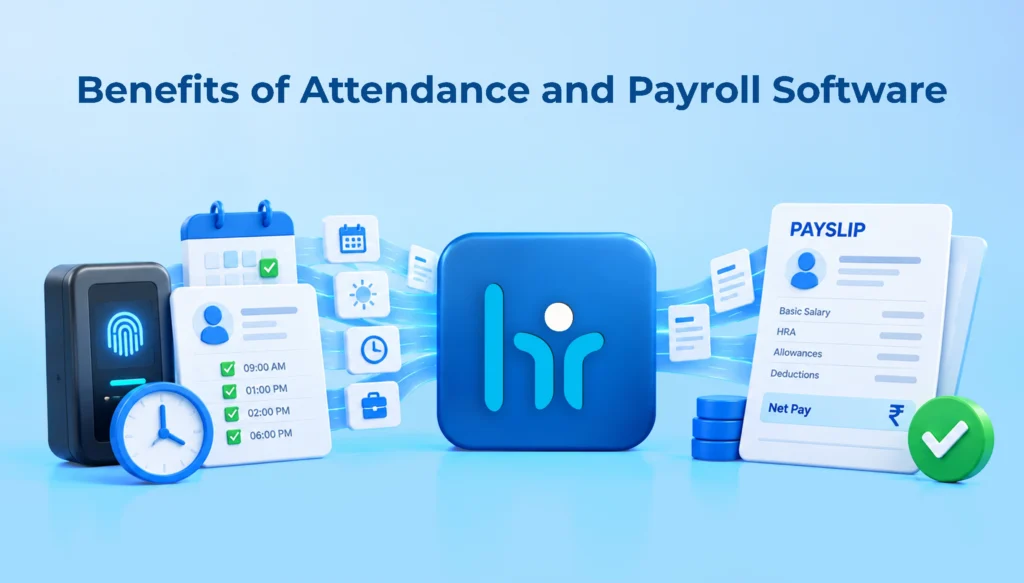
This is exactly the gap that attendance and payroll software closes. When attendance tracking and payroll processing run as one connected system instead of two disconnected tools, data moves automatically from the moment an employee clocks in to the moment their salary gets calculated. No manual transfer, no copy-pasting between sheets, no guessing whose leave request actually got approved.
For organizations seeking out HRMS and a payroll software platform, such a level of integration is no longer a value-add. It is now the bare minimum standard, most of all for SMBs in India trying to manage compliance like PF, ESI, professional tax, TDS, as well as daily attendance management.
What Is Attendance and Payroll Software Integration?
Basically, integration is just having your attendance system and your payroll system communicating directly without a human being involved. Instead of having an HR executive export attendance logs and manually pasting them into a spreadsheet, the attendance and payroll systems work automatically, sending the data directly from check-in to payslip.
Everything that contributes to an employee’s salary is directly entered from the attendance system: time in/out, overtime, presence, absence, holidays, shift patterns. Any overtime incurred due to extra hours on a Tuesday will automatically flow through to the payroll once typed into attendance; there’s no need to re-type this manually.
That’s the whole point. One source of truth, feeding both sides of the equation.
How Attendance Data Directly Impacts Payroll
Attendance isn’t just a side detail in payroll calculations. It’s often the biggest variable. Here’s where the two genuinely intersect:
Working days and payable days: Payroll should have a clear idea of the number of days the employee actually worked and not on the calendar.
Calculations for overtime hours: If overtime hours are worked based on attendance, it must be converted into the proper amount of overtime pay, according to your company’s policy.
Leave and loss-of-pay deductions: Unapproved absences or leave beyond the allotted balance should automatically translate into salary deductions, not get missed until someone notices at month-end.
Late coming and attendance policies: Repeated late arrivals often trigger deductions or warnings under company policy, and that only works reliably if the system is tracking it consistently.
Shift and holiday information: Shift differentials and holiday pay depend entirely on accurate shift and calendar data feeding into payroll.
Get any one of these wrong manually, and the payslip is wrong. Get them automated, and the payslip reflects reality every single time.
Key Benefits of Integrating Attendance and Payroll Software
1. Reduces Manual Data Entry
The most immediate win is the simplest one. Nobody has to export a spreadsheet, reformat it, and paste it into another tool. Attendance data moves into payroll on its own, which strips out an entire category of repetitive work that used to eat up HR’s calendar every month.
2. Improves Payroll Accuracy
Manual transfer is where errors creep in, a misread number, a skipped row, a formula that wasn’t updated after someone changed their shift. When payroll pulls directly from real-time attendance data, deductions, overtime, and payable days are calculated from the actual source, not from a copy of a copy.
3. Enables Automated Payroll Processing
Here’s where it truly gets worthwhile. There’s no need to instruct the payroll engine to roll on, as the automated payroll processing will do it for you. What previously required days of cross-checking and double-checking to run can now be done in the background, leaving time for the payroll team to really focus on the bit that takes their judgement.
4. Simplifies Biometric Attendance and Payroll Integration
Biometric devices, fingerprint scanners, face recognition, or even the use of cards may record when a person clocks in and out. With biometric attendance and payroll integration, the data syncs to payroll immediately without any human intervention. It also prevents buddy punching and manual timesheets, which is more critical than people think when a team reaches a certain size.
5. Provides Better Employee Time Tracking
Beyond payroll, one of the benefits of using integrated software is that HR gets a more complete view of how time is spent throughout the organization. The employee time tracking software in HRMS displays and analyzes employee time at a granular level, providing accurate information essential to workforce planning.
6. Ensures Consistent Attendance and Payroll Policies
When policies for overtime, late arrivals, leave, and deductions are built into the system, they apply the same way to every employee, every time. There’s no room for one manager interpreting the late-coming policy differently from another, or for exceptions quietly creeping in because nobody’s tracking them centrally.
7. Saves Time for HR and Finance Teams
Less spreadsheets, less repeated calculation, less negotiating with finance on payroll numbers to reconcile before the run. That saved time is what enables HR to focus on retention, engagement, and recruiting rather than sorting paperwork for the last week of each month.
8. Improves Compliance and Record Keeping
With accurate consolidated attendance and payroll records audits and statutory filings become much simpler. For Indian companies, it also means cleaner filings across everystatutory compliance obligation, from PF and ESI to professional tax and TDS.
Key Features to Look for in Integrated Attendance and Payroll Software
Not every HRMS handles this integration equally well. When you’re evaluating options, look for:
Real-time attendance tracking
Biometric and mobile attendance integration
Automated salary calculations
Leave and holiday management
Overtime calculation built into policy rules
Shift management for multi-shift or hybrid teams
Custom attendance policies you can configure, not just toggle on or off
Payroll reports and payslip generation
Employee self-service portal for leave, attendance, and payslip access
How Integrated Attendance and Payroll Software Improves Business Efficiency
The broader point, though, is balance. Someone clocks in, the hours are counted, leave is approved or noted, and when payroll happens, none of that is a surprise. No barrier to transferring among departments, no mirrored data entry, no confusion to recover figures before issuing salaries.
That flow also keeps leadership more aware of workforce expenses. When attendance and payroll are in one place, it becomes much easier to notice trends: groups who always seem to be pushing up overtime numbers, groups with unexpected levels of presence, without spending half your day pulling three reports and mashing ’em together.
Choosing the Right Attendance and Payroll Software
Before you commit to a platform, weigh it against a few practical questions:
Ease of integration: How much setup work does it actually take to connect attendance and payroll, and does it work with the biometric or mobile check-in method your team already uses?
Scalability: Will it hold up as your headcount grows, or is it built for a team half your size?
Automation capabilities: Does it genuinely automate calculations, or does it just digitize the manual process?
Biometric device compatibility: Can it plug into the hardware you already have, or does it force a hardware switch?
Customizable payroll and attendance policies: Can you configure overtime rules, leave policies, and deduction logic to match how your company actually operates?
Reporting and analytics: Are the reports useful for decision-making, or just raw exports?
Data security and compliance: Does it meet Indian statutory requirements and handle employee data responsibly under the DPDP Act?
Employee self-service features: Can employees check their own attendance, leave balance, and payslips without emailing HR every time?
Why Businesses Should Move to an Integrated HR and Payroll System
Disconnected attendance and payroll solutions were never built for scale. They work fine so long as your team is small enough that one employee can track down every discrepancy. The second your team grows, cracks appear as payroll errors, risk, and HR teams trying to do reconciliations instead of HR.
An integrated system solves the root of the problem, culminating in a single source of truth for employee data. Attendance informs payroll, payroll accurately reflects the working days and hours, and HR has the time to focus on the work that calls for a human touch.
Final Thoughts
Integrating attendance and payroll software isn’t just a case of making life easier; it’s about halting the build-up of time-consuming manual corrections, compliance concerns, and HR time-wasters. Less time spent on correction means payroll runs become easier and less of a headache.
If you are still running your attendance and payroll as two separate systems, perhaps you should see for yourself how a connected HRMS feels and functions. Come, take a look at WeekMate’s integrated HRMS and payroll platform.
Frequently Asked Questions
It's the connection between an attendance tracking system and a payroll system so that working hours, leave, overtime, and attendance records automatically flow into salary calculations, without manual data transfer.
Biometric devices capture exact check-in and check-out times, removing manual entry errors and the possibility of proxy attendance, so the hours feeding into payroll are accurate from the source.
Yes. When overtime rules are configured in the system, extra hours logged through attendance automatically convert into the correct overtime pay during payroll processing.
Yes, especially for growing SMBs. Manual reconciliation becomes harder to manage as headcount increases, and an integrated system scales without adding administrative overhead.
It can, when the platform is built for Indian payroll requirements. Look for support for PF, ESI, professional tax, and TDS, along with secure data handling aligned with the DPDP Act.