
The majority of entrepreneurs do not pick and buy a customer relationship management system merely out of desire. Usually, it is a missed opportunity that leads to the purchase of one as a way of not losing leads or having to wonder which department is responsible when questions are raised, such as “Who is this lead assigned to?” without getting a satisfactory reply.
These kinds of scenarios are what trigger the process of finding and buying an affordable CRM system. It has little to do with one’s long-term marketing or sales plans.
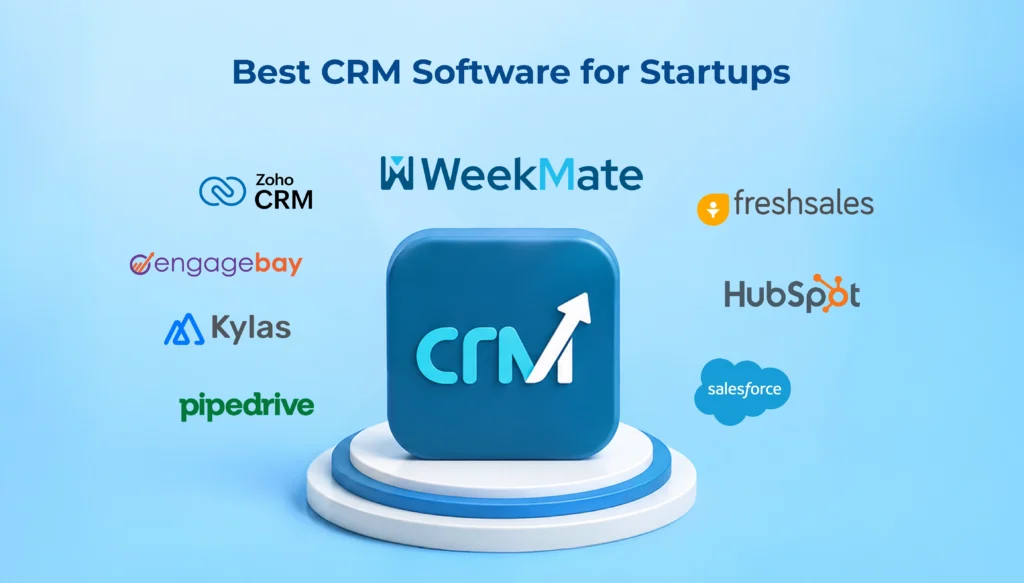
This guide discusses the 8 best CRM software for startups in 2026, based on factors like price, how easy it is to set up, how well it handles automation, and how it performs when a small sales team uses it daily. We examined a platform’s strong and weak areas as well as who the product is intended for, to prevent you from selecting based merely on a website screenshot.
A brief reminder before you begin exploring pricing: CRM vendors usually update or make adjustments to product tier pricing, add-ons, and regional fees without giving notice. View the figures as just rough estimates to get you started, and check the vendor’s own pricing page for the latest and most accurate information on pricing before you allocate your resources because of this.
Why Startups Need a CRM Earlier Than They Think
Here’s the thing about early-stage sales. It feels manageable right up until it isn’t. Ten leads in a spreadsheet is fine. Eighty leads across WhatsApp, email, a landing page form, and three ad campaigns is a different story entirely.
A few signs this is already happening in your startup:
- Leads are coming in from multiple channels, and nobody’s tracking which ones actually got a reply
- Follow-ups depend on someone remembering, not on a system that reminds them
- Customer information lives in three different tools, or worse, in someone’s head
- There’s no repeatable sales process, just whatever the founder did last time
- Team members can’t see what a teammate promised a client last week
None of this means you need enterprise software. It means you need structure before the chaos compounds. Startups that adopt lightweight CRM software for startup sales teams early tend to build cleaner habits than ones that bolt on a CRM after the mess is already six months deep. In fact, a fair share of Indian SMB sales teams still run on spreadsheets or manual tracking rather than a structured system, which is exactly the gap a startup CRM software closes early.
How We Selected These CRM Software for Startups
We didn’t just skim pricing pages. Selection was based on eight practical criteria that actually matter to a five-to-fifty person team:
- Ease of Setup and User Experience: Can a non-technical founder or sales rep get moving in a day, not a week?
- Pricing and Startup-Friendly Plans: Does the cost scale sensibly, or does it punish you the moment you add a sixth user?
- Sales Automation and AI Features: Reminders, lead scoring, and workflow triggers that reduce manual admin work.
- Lead Management Capabilities: How cleanly leads move from capture to close, and whether nothing falls through the cracks.
- Integrations: WhatsApp, email, ad platforms, and the tools a startup is already using.
- Customization and Scalability: Whether the CRM can flex with your process today and still make sense at 50 employees.
- Mobile App and Remote Access: Because most founders and reps aren’t chained to a desk.
- Customer Support and Onboarding: Whether you get real help setting things up or just a knowledge base link.
Top CRM Software for Startups: Quick Comparison
| CRM | Best For | Starting Price (approx.) | Free Plan |
|---|---|---|---|
| WeekMate CRM | Indian startups wanting affordable, ownership-based CRM with WhatsApp integration | ₹400/user/month or one-time license | Free trial available |
| HubSpot CRM | Startups wanting a generous free CRM | Free forever; Starter from ~₹1,900/seat/mo | Yes, unlimited users |
| Zoho CRM | Small businesses needing an all-round CRM | Free for 3 users; Standard from ~₹1,333/user/mo | Yes, up to 3 users |
| Pipedrive | Sales-focused startups managing pipelines | No free plan; Essential from ~₹1,333/user/mo | No, 14-day trial only |
| Freshsales | AI-powered sales teams | Free for 3 users; Growth from ~₹860/user/mo | Yes, up to 3 users |
| Kylas CRM | Indian startups and SMBs, unlimited users | Flat fee, roughly ₹12,999 to ₹23,800/month | 7-day trial |
| Salesforce Starter Suite | Fast-growing startups planning to scale | ~₹2,380/user/month, capped at 10 users | No |
| EngageBay | CRM, marketing, and helpdesk in one platform | Free for 15 users; paid from ~₹1,215/user/mo | Yes, up to 15 users |
Prices shown above are approximate and extracted from publicly available pricing lists as of 2026. To avoid misunderstandings, get a confirmation of the current rates directly from the website since most CRM providers change their pricing, seat limits, and regional rates rather suddenly.
8 Best CRM Software for Startups in 2026
1. WeekMate CRM
Best for: Indian startups and growing businesses looking for an affordable CRM that is easy to implement.
One of the biggest differentiators for WeekMate CRM is the way they charge their customers. Unlike most of the names on this list, WeekMate not only offers you an affordable one-time licensing option, but also gives you a range of pricing options that work for most situations. A startup adding its eighth or ninth team member does not get punished for growing.
Key features:
- Visual sales pipeline with support for multiple pipelines
- Built-in integration of WhatsApp, Gmail, and Outlook
- Leads captured from Meta Ads, Google Ads, and IndiaMART, so ad leads land straight into the CRM
- AI-driven insights through WeekMate’s MIRA AI for lead prioritization and next-step suggestions
- Built-in invoicing and multi-currency support
- Full customer timeline covering calls, emails, WhatsApp threads, and meeting notes in one place
- Real-time dashboards showing pipeline health and rep performance
Pros:
- No forced per-seat pricing model; startups can scale users without recalculating their entire budget
- Genuinely useful WhatsApp CRM integration, not a bolted-on afterthought
- Data ownership options, including on-premise hosting for teams that want more control
- Guided onboarding rather than a self-serve help center you’re left to figure out alone
Cons:
- Less globally recognized than HubSpot or Salesforce. So hiring reps are not really trained on it.
- Smaller third-party app marketplace compared to Zoho or Salesforce
Pricing: Starts around ₹400 per user per month, with a one-time licensing structure also available for teams that prefer to avoid recurring seat fees. Exact numbers depend on team size and required modules, so it’s worth requesting a direct quote.
Why choose WeekMate CRM?
If your team runs sales conversations through WhatsApp and Indian ad platforms, and you’re tired of CRM pricing that punishes growth, this is one of the more startup-friendly options on the list. It’s also worth pairing with WeekMate’s HRMS and Payroll platform if you want your CRM and HR data under one roof rather than two separate logins.
2. HubSpot CRM
Best for: Startups that want a genuinely usable free CRM before committing real budget.
HubSpot’s free CRM has stayed free since 2014, and that matters. Most “free” CRM tiers exist purely to get you into a sales call. HubSpot’s free plan actually includes unlimited users, up to a million contacts, and basic pipeline, deal, and contact tools. For a startup with zero CRM budget, it’s a reasonable place to start.
Key features:
- Free forever CRM with unlimited users
- Sales Hub, Marketing Hub, and Service Hub can be bought separately or bundled
- Email tracking, meeting scheduling, and live chat
- AI-assisted reporting and forecasting on paid tiers
Pros:
- Free plan is not a trial, so there’s no clock running out
- Huge ecosystem of integrations and third-party apps
- Marketing and sales data live in one system if you eventually add Marketing Hub
Cons:
- Pricing jumps sharply once you move past Starter into Professional tiers
- Complex, multi-hub pricing structure makes it hard to predict your real monthly cost
- Onboarding can take longer than expected for teams unfamiliar with HubSpot’s structure
Pricing: Free forever. Starter plans begin around $20 per seat per month. Professional tiers for Sales Hub run roughly $100 per seat per month, and Marketing Hub Professional starts much higher. HubSpot also runs a startup discount program offering meaningful reductions for eligible early-stage companies.
3. Zoho CRM
Best for: Small businesses needing an all-round CRM without an enterprise price tag.
Zoho CRM has continued to be a top choice for small and medium businesses (SMBs) that are focused on affordable CRM for startups. It’s not the most polished interface you’ll use. But the price-to-feature ratio is hard to argue with, especially once automation and Blueprint, Zoho’s process management tool, come into play at the Professional tier.
Key features:
- Free plan for up to 3 users, covering leads, contacts, and deals
- Blueprint for visual process management and workflow standardization
- Zia, Zoho’s AI assistant, for predictive sales analytics and anomaly detection on higher tiers
- Multiple pipelines and customizable modules, fields, and page layouts
- Integrates with over 40 other Zoho apps (Books, Campaigns, Desk, and more)
- Mass email tools and sales forecasting from the Standard tier upward
Pros:
- Hard to beat on price-to-feature ratio at this end of the market
- Deep ecosystem if you’re already using other Zoho products
- Genuinely usable free tier, not just a stripped-down trial
Cons:
- Automation and advanced analytics are largely locked behind Professional and Enterprise tiers
- Custom fields are capped on lower tiers (10 per module on Standard), which limits data-heavy sales processes
- Interface feels less polished than HubSpot or Pipedrive out of the box
Pricing: Free for 3 users. Standard runs roughly $14/user/month, Professional around $23, Enterprise around $40, and Ultimate around $52, all billed annually.
Must Check: Top Zoho CRM Alternatives for Indian Businesses
4. Pipedrive
Best for: Sales-focused startups managing pipelines and little else.
Pipedrive, unlike many CRM tools, does not try to combine everything that users need in a single platform: marketing, support, and customer relationship management (CRM). Pipedrive’s main task is visual pipeline management, which it performs really well and clearly. This simple and straightforward approach has really pleased the company founders to such an extent that they hardly have time to look at the deal status from a bunch of menus.
Key features:
- Visual, drag-and-drop sales pipeline with customizable stages
- AI Sales Assistant that flags win probability and suggests next actions
- Full email sync and tracking with Gmail, Outlook, and other clients
- Communication history logged automatically against each lead
- Add-ons for lead generation (LeadBooster) and website visitor tracking
- Import, export, and merge tools for clean data migration
Pros:
- Clean, intuitive pipeline visuals that need almost no training
- Strong email sync on mid-tier plans and above
- AI Sales Assistant genuinely useful for spotting deals likely to stall
Cons:
- No free plan at all, only a 14-day trial
- Add-ons for lead generation and marketing tools cost extra on every tier, including the top one
- Limited built-in marketing or service functionality compared to all-in-one platforms
Pricing: No free tier. Entry-level plans start around $14/user/month billed annually, scaling up through mid tiers around $39 to $59/user/month, and higher tiers reaching $79 to $99/user/month depending on features needed. A five-person startup on the entry plan alone runs about $70/month, but adding lead-capture and website-visitor add-ons can push that past $150/month.
5. Freshsales
Best for: AI-powered sales teams that want built-in calling without third-party add-ons.
Freshsales from Freshworks relies heavily on the Freddy AI assistant. It helps them determine the best leads, provide deal insights, and even recommend the next best steps. This application includes a cloud phone system, which is a standout feature since most other solutions force you to add a separate calling tool to your CRM.
Key features:
- Freddy AI for contact scoring, deal health insights, and next-best-action suggestions
- Built-in cloud phone dialer, no third-party telephony integration needed
- Email sequences and workflow automation on Growth tier and above
- Multiple pipelines and advanced reporting on Pro tier and above
- AI email content suggestions to speed up rep outreach
Pros:
- Native phone dialer included without extra integration work
- Freddy AI is genuinely useful for prioritizing leads once your plan includes it
- Long 21-day free trial, longer than most competitors offer
Cons:
- Meaningful AI features don’t unlock until the Pro tier, a steep jump from the entry plan
- Deep customization isn’t its strong suit if your sales process has a lot of edge cases
- Freddy AI’s accuracy depends heavily on clean data; duplicate or incomplete records drag scores down
Pricing: Free for up to 3 users. Growth plan around $9/user/month. Pro, where Freddy AI features actually activate, runs around $39/user/month. Enterprise sits around $59/user/month.
6. Kylas CRM
Best for: Indian startups and SMBs that want unlimited users without per-seat penalties.
Kylas took a genuinely different approach to CRM pricing for Indian SMBs: flat monthly rate, unlimited users, no punishing every new hire with another seat license. For a startup adding reps quickly, that model alone can be worth the switch.
Key features:
- Flat-rate pricing with unlimited user licenses, scaling by record volume instead of seat count
- Lead management with source tracking and lead disqualification tools
- Customizable sales pipelines and dashboards
- WhatsApp, calling, and email-based communication support
- Onboarding and training included by CRM experts as part of the plan
- Facebook Business Suite, Meta for Business, and telephony integrations
Pros:
- Unlimited users at a flat cost, ideal for teams adding reps quickly
- Strong for daily lead tracking and pipeline customization
- Onboarding support included rather than sold as a separate add-on
Cons:
- Reporting flexibility is more limited than Zoho or Salesforce
- Mobile interface isn’t optimized for field-heavy sales workflows
- Weaker fit for teams doing physical, location-based visits, since it assumes a live desk-based connection
Pricing: Flat rate plans, roughly ₹12,999/month (around $155) for unlimited users on mid tiers, up to around $1,250/month on the top tier depending on record volume and features. A 7-day free trial is available.
7. Salesforce Starter Suite
Best for: Fast-growing startups planning to scale into enterprise-level CRM eventually.
Salesforce Starter Suite is the gateway for your organization to join one of the world’s biggest CRM ecosystems. If you are a startup and anticipate that your company will need advanced configuration, complex reporting, or a large partner and integration ecosystem in a couple of years, then it is better that you start on Salesforce now and prevent a complicated migration process later.
Key features:
- Lead and opportunity management with customizable sales paths
- Email tools with built-in templates and campaign management
- Einstein Activity Capture for automatic email and calendar syncing
- Einstein Send Time Optimization to time outreach for higher open rates
- Slack included at no extra cost for team collaboration
- Access to the broader Salesforce AppExchange ecosystem on higher tiers
Pros:
- Backed by the largest CRM ecosystem and partner network available
- Built-in AI features (Einstein) even at the entry tier
- Smooth upgrade path into Pro Suite, Enterprise, and beyond as you scale
Cons:
- Hard cap of 10 users on the Starter Suite; growing past that means a steep jump to Pro Suite
- No permanent free plan, unlike HubSpot, Zoho, or Freshsales
- Can feel like more software than a very early-stage startup actually needs
Pricing: Starter Suite runs about $25/user/month, with a hard cap of 10 users. Pro Suite starts around $100/user/month for teams that outgrow the cap.
8. EngageBay
Best for: Startups needing CRM, marketing, and helpdesk in one platform without three separate subscriptions.
EngageBay bundles CRM, email marketing, live chat, and helpdesk ticketing into one login, and its free plan supports up to 15 users, which is generous compared to most competitors capping free tiers at 3.
Key features:
- CRM and deal management with multi-currency support and sales automation
- Email marketing with A/B testing, broadcasts, and visual automation workflows
- Landing pages, pop-ups, and web forms integrated directly with the CRM
- Built-in helpdesk and live chat, sold separately by most competitors
- AI-powered email and content generation, plus AI lead and deal scoring
- Appointment scheduling and telephony support
Pros:
- Free-forever plan for up to 15 users, more generous than most free CRM tiers
- Genuinely all-in-one: marketing, sales, and support without separate subscriptions
- Significantly cheaper than HubSpot for comparable core functionality
Cons:
- Reporting and analytics are described as minimal compared to larger platforms
- Best advertised rates require biennial (two-year) billing commitments
- Daily email sending limits and occasional deliverability issues reported by users
Pricing: Free plan for up to 15 users and roughly 250 contacts. Paid plans start around $12.74 to $14.99/user/month, scaling to about $119.99/user/month on the top Pro tier depending on billing term.
Which CRM Is Best for Different Types of Startups?
Not every startup needs the same CRM, and pretending otherwise wastes money. A quick breakdown:
1. Best CRM for bootstrapped startups
WeekMate CRM or Zoho’s free tier. Both avoid the per-seat cost spiral that hits growing teams on other platforms.
2. Best CRM for SaaS startups
Freshsales or HubSpot. Both handle longer B2B sales cycles with sequences and lead scoring built in.
3. Best CRM for B2B startups
Pipedrive or Zoho Professional, where multiple pipelines and deal-stage customization matter more than marketing bells and whistles.
4. Best CRM for small sales teams
Pipedrive’s entry tier or Kylas, depending on whether you value pipeline visuals or unlimited unpenalized seats more.
Must Check: Top CRM Software for Small Businesses
5. Best CRM for startups with remote teams
WeekMate CRM or HubSpot, both offering mobile-ready dashboards and cloud access that don’t fall apart outside the office.
6. Best CRM for startups looking for AI automation
Freshsales for Freddy AI, or WeekMate CRM if WhatsApp-based lead nurturing through MIRA AI matters more than a native dialer.
How to Choose the Right CRM for Your Startup
- Consider your team size: A 3-person founding team and a 40-person sales org need genuinely different tools. Don’t buy for the team you hope to have in three years.
- Set a realistic budget: Include add-ons in your math, not just the headline seat price. Several vendors on this list quietly add $30 to $50/month in required extras.
- Prioritize ease of adoption: The best CRM is the one your team actually opens every day. A powerful tool nobody logs into is worse than a simple one everybody uses.
- Look for automation instead of extra features: A long feature list looks impressive on a comparison page. Automated follow-up reminders and lead routing actually save hours.
- Check integration requirements: If your leads come from WhatsApp, Meta Ads, or IndiaMART, confirm native support rather than assuming a workaround exists.
- Choose a CRM that can scale: Not infinitely, just enough that switching tools isn’t inevitable the moment you hit 20 employees.
Common Mistakes Startups Make When Choosing a CRM
- Buying enterprise software too early, then paying for capacity nobody uses for two years
- Ignoring automation capabilities and treating the CRM as a glorified spreadsheet
- Choosing based only on price, then discovering the cheap plan can’t do lead scoring or automation at all
- Not checking integration options before signing up, then discovering WhatsApp or ad-platform sync needs a third-party workaround
- Poor user adoption and training, so half the team keeps working out of Excel anyway
- Failing to define a sales process before crm implementation, which means the CRM just digitizes the chaos instead of fixing it
Why WeekMate CRM Is a Smart CRM for Indian Startups
A few things stand out specifically for founders building in India rather than importing a US-first tool and hoping it fits local workflows:
Startup-friendly pricing that doesn’t scale linearly with headcount the way most per-seat CRMs do. Easy implementation, with WeekMate’s team handling setup and migration rather than leaving you to figure it out from documentation. Integrated WhatsApp CRM, since that’s genuinely where most Indian sales conversations happen, not email.
Meta Ads and Google Ads integrations so ad-generated leads land directly in the pipeline. IndiaMART integration, useful for B2B and manufacturing-adjacent startups sourcing leads from that platform specifically. AI-powered workflows through MIRA AI for lead prioritization. And it scales as the business grows, from a 5-person founding team up through mid-sized operations, without forcing a full re-platform.
When Should a Startup Invest in a CRM?
There’s no universal headcount trigger. But a few signals tend to show up right before founders finally give in and adopt a CRM software for startups:
Leads are getting missed. Not occasionally, regularly. Follow-ups are inconsistent, dependent on memory rather than a system. Sales data is scattered across spreadsheets that three different people update differently. Multiple team members now handle customers, and nobody has a single shared view of who said what. Reporting takes hours to assemble manually before every investor update or team meeting.
If two or more of these sound familiar, you’re already past the point where a CRM for early-stage startups would help. You’re at the point where it’s overdue.
Frequently Asked Questions
1. Which CRM is best for startups?
It depends on your priority. WeekMate CRM suits Indian startups wanting affordable, WhatsApp-first CRM without per-seat penalties. HubSpot suits startups wanting a genuinely free starting point. Freshsales suits teams that want built-in AI lead scoring and calling.
2. Is there a free CRM for startups?
Yes. HubSpot, Zoho, Freshsales, and EngageBay all offer free tiers, though user limits and feature access vary significantly between them. HubSpot’s free plan is the most generous on user count.
3. Which CRM is easiest to use for startups?
Pipedrive and WeekMate CRM both rank highly for ease of adoption, largely because their interfaces stay close to how sales reps already think about pipelines and follow-ups, rather than forcing a steep learning curve.
4. Which CRM is best for Indian startups?
WeekMate CRM and Kylas CRM are both built with Indian SMB and startup workflows in mind, including WhatsApp integration, flexible or flat-rate pricing, and local support.
5. Can I switch from spreadsheets to a CRM?
Yes, and most of the tools on this list, including WeekMate CRM, offer guided onboarding and migration support specifically to make that transition manageable rather than a multi-week headache.
6. Which CRM grows with my startup?
Zoho, HubSpot, and WeekMate CRM all offer a realistic growth path from a small founding team through a mid-sized sales organization without forcing a full platform switch along the way.