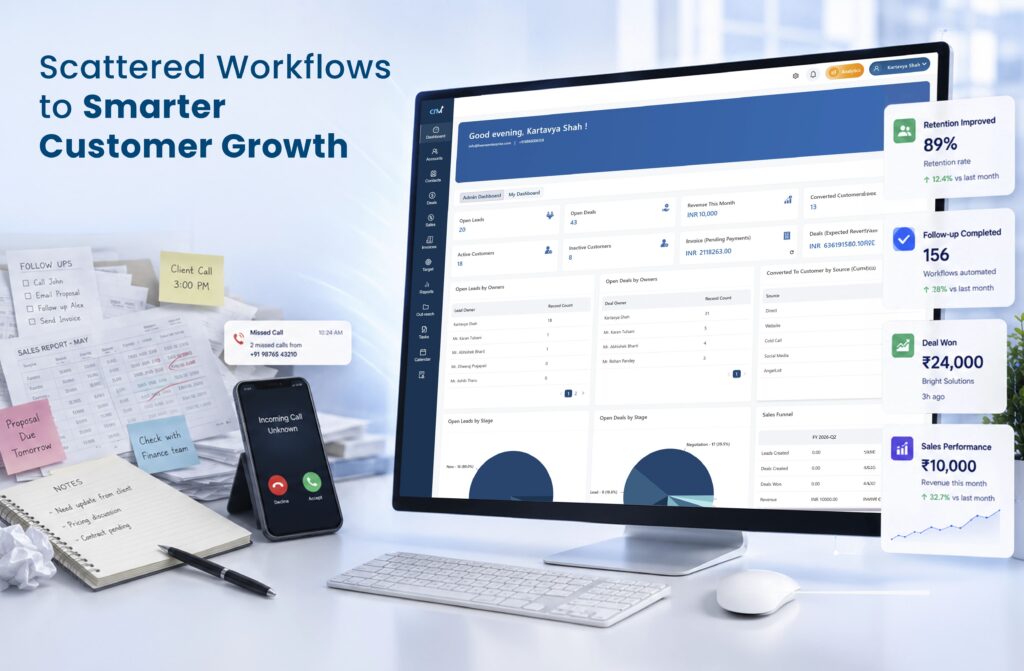
Modern businesses can no longer afford to rely on spreadsheets, sticky notes, or isolation to maintain their customer relationships. As the sales cycle gets longer and customer demands rise, organizations are moving toward smarter systems that deliver greater efficiency and greater visibility.
That’s where custom CRM solutions are revolutionizing business operations. Unlike generic platforms, tailored CRM systems adapt to specific workflows, automate repetitive sales activities, and provide real-time insights that help teams make faster decisions.
Businesses today are also focusing heavily on how to improve customer retention strategies and increase sales performance with CRM software. Automation has become central to achieving these goals because it reduces manual effort while improving customer engagement consistency.
Solutions such as WeekMate allow businesses to merge productivity management with smart CRM workflows to establish a trusted, more efficient ecosystem.
What Is Custom CRM Software for Sales Teams?
Custom CRM software is a customer relationship management system built specifically around a company’s day-to-day operations, sales process, and customer interaction methods.
Traditional CRM systems generally have predefined features and standard workflows. Although these programs may be suitable for certain small businesses at first, they often need to be replaced as the business grows.
A CRM tailored specifically to your needs will allow you to:
- Automate internal workflows.
- Track customer interactions more efficiently.
- Integrate with existing business systems.
- Customize dashboards and reporting.
The main benefit of customization is alignment. Instead of forcing businesses to fit their processes to the software, they can create software that fits their processes. This flexibility makes tailored CRM systems significantly more valuable than rigid, off-the-shelf alternatives.
Why Sales Teams Need Custom CRM Software?
Many companies choose a standard CRM product at first because it can be up and running quickly. But the limitations begin to show as the business grows.
Common customer relationship management tools can have too many unnecessary features and too few essential ones for a particular business sector. Teams can be challenged by inflexible workflows, inadequate integrations, or ineffective reporting hierarchies.
That’s why more organizations are turning to a custom CRM software development company to design solutions that fit their business models.
73% of customers want companies to understand their unique needs and expectations. Off-the-shelf solutions usually lack the level of customization needed to meet these demands.
Businesses can scale more quickly with a customized CRM without compromising operational efficiency or the customer experience.
Must Read: Benefits of Custom CRM Software for Growing Businesses
How Custom CRM Improves Customer Retention?
Customer retention has emerged as one of the key business growth indicators in 2026. Because acquiring new customers is costly, maintaining relationships over time is crucial to profitability.
A well-developed customer data management system enables businesses to consolidate customer interactions, transaction history, communication preferences, and the ways they engage with customers.
This level of visibility also allows companies to better tailor their communication to the recipient. For instance, a series of automated reminders, customized proposals, and recovery efforts may be triggered based on the customer’s behavior. These automations provide a more engaging customer experience without the need for additional manual labor.
Businesses looking to improve customer retention strategies are increasingly investing in CRM automation because it enables proactive engagement instead of reactive communication. Automation further reduces the risk of missed follow-ups, late responses, or uneven customer experiences.
Sales teams often spend a significant amount of time on repetitive administrative tasks rather than actual selling. And this is where CRM automation makes a tangible difference.
Tailor-made systems enable this to be done automatically for lead assignments, follow-up scheduling, and even task reminders and progress reports. This means your salespeople are more likely to focus on building relationships and closing deals.
Companies can also increase sales performance with CRM by implementing:
- Automated lead scoring.
- Sales forecasting dashboards.
- Pipeline tracking.
- Real-time reporting.
According to research, less than 40% of sales professionals’ time is spent on actual selling, with administrative duties taking up most of their workday. Automation tackles this problem efficiently.
As a result of eliminating tedious tasks, organizations achieve better response times, reduced human error, and faster deal closings.
Manual Sales Tasks vs CRM Automation
|
Manual Process
|
CRM Automation Benefit
|
|
Manual data entry
|
Automatic customer record updates |
| Spreadsheet lead tracking |
Real-time pipeline management
|
|
Reminder follow-ups
|
Automated notifications and sequences |
| Separate communication tools |
Centralized communication tracking
|
|
Static reports
|
Live dashboards and analytics
|
CRM Features That Improve Sales & Customer Retention
A good CRM allows you to achieve the best of both worlds: high efficiency and effective customer experience management.
One of the most critical features is a centralized customer data management system. Companies require a holistic view of the customer across channels to deliver consistent customer interactions.
Workflow automation is also a key feature. CRM platforms can be tailored and used to automate the everyday tasks and workflows specific to your business.
Just as important are the integration capabilities. Today, businesses work on different platforms for accounting, communication, marketing, and support. With CRM integration, you can ensure your data flows seamlessly between systems.
Analytics dashboards also play a key role. By tracking sales performance, customer engagement, and operational bottlenecks in real time, insights allow vice-president teams to significantly outperform their counterparts. Mobile access is also needed, particularly in remote and hybrid work settings.
How WeekMate CRM Supports Sales Teams
WeekMate enables businesses to increase productivity while improving CRM efficiency. Traditional CRM software enables users to manage only such records. With WeekMate, customers can better align teams around customers through real, daily execution and operational responsibility.
The framework supports:
- Task and workflow visibility.
- Tracking of customer interactions.
- Team coordination.
- Goal-driven productivity control.
This seamless integration enables companies to coordinate their sales and operational processes.
Choosing the Right Custom CRM Partner
Finding the right development partner is a key driver of CRM success. A professional custom CRM software development company should be well-versed in both technological development and business processes.
Companies should assess:
- Industry experience.
- Customization abilities.
- Integration expertise
- Scalability planning.
- Post-launch support.
It is also important to ask practical questions before development begins:
- Will the CRM grow with the business?
- How flexible are the automation workflows?
- What integrations are supported?
- How is data security managed?
Cost matters, but long-term operational value matters more. A robust CRM is an infrastructure investment, not a quick software buy.
Conclusion
Automation is no longer a nice-to-have plug-in for CRM applications; it is evolving into the very basis by which business efficiency is measured.
Modern custom CRM solutions enable organizations to reduce manual sales efforts, increase customer engagement, and scale their operations more efficiently. From internal automation to complex predictive analytics, tailored CRM systems deliver operational flexibility not often available from standardized platforms.
As companies focus on improving customer retention and increasing sales performance through CRM, automation-driven CRM systems will continue to play a central role in growth. WeekMate embodies this modern approach by combining productivity management with customer workflow optimization, helping businesses build smarter, more scalable operational systems for the future.
If you’re still evaluating whether a custom CRM is the right fit, explore our custom CRM software guide to understand its features, benefits, implementation process, and business use cases.
FAQs
1. What are custom CRM solutions?
Tailored CRMs are customized CRM systems that align with a company’s specific workflows, sales process, and customer management requirements. They are more flexible, scalable, and adaptable than traditional CRM software.
2. How does sales automation replace manual sales activities?
CRM software automates repetitive tasks such as follow-ups, lead tracking, reminders, and reporting. This gives sales teams less manual work and more time to close deals and build relationships.
3. Why is a customer data management system important?
A customer data management system allows users to store all information in one place, and teams can easily access it on the go to get precise data. It enables better personalization, communication, and decision-making between teams.
4. Is it possible to improve customer retention with CRM software?
Yes, companies can enhance their customer retention strategies by leveraging CRM platforms to better track customer behavior over time, personalize communications, automate follow-ups, and more. With CRM systems, businesses can now enhance how they interact with customers and improve customer retention.
5. How can companies improve sales effectiveness with CRM?
CRM can help businesses improve sales performance by enabling them to more effectively manage their pipelines, automate workflows, efficiently track leads, and leverage analytics to refine predictive sales decisions.
6. What should companies look for in a CRM development company?
A trustworthy bespoke CRM software development company must offer scalability, integration support, various customization options, and project-long technical support tailored to business-specific needs.
7. How does WeekMate support CRM optimization?
WeekMate integrates productivity with CRM processes to help teams streamline their activities, capture customer experiences, and drive operational efficiency through a unified platform.