It’s difficult to get project management right. But in the three years, things have really changed. What used to be limited to a shared spreadsheet and some Slack threads (and maybe a Trello board) would quite honestly have been enough.
But not anymore.
These days, it’s very common for project teams to be scattered across different cities, time zones, sometimes even continents. The number of departments and vendors involved in each project has increased, and with that, the complexity of the projects has increased. The tools we were content with before can no longer cope with the increased workload, and as a result, work processes have started to break down. Missed handoffs. Status updates ignored. Managers are spending half the week finding out what’s really going on!
That is precisely the kind of environment where AI and automation are most likely to be a good fit. Through them, we can completely rethink the process of job execution: work planning, work tracking, work delivery. Modern project management tools have become smart enough to identify potential issues and assign tasks based on employees’ current workload. They also free up time that would otherwise be wasted on administrative work. As a result, the actual project work is not being affected, and you can deliver better results in a shorter amount of time.
In this blog, we look at what’s changing, the struggles traditional methods will have in keeping up, and where one should really focus attention when searching for a technology that will be the future of project management software. You will gain a clear picture of what this industry is like right now and the best way to make the right decision, whether you’re just exploring tools or looking to replace your existing tool that is already too small for your expanded team size.
What Is Modern Project Management Software?
At its core, project management software helps teams plan, assign, track, and complete work without losing visibility along the way. That part hasn’t changed. What has changed is how much the software does on its own.
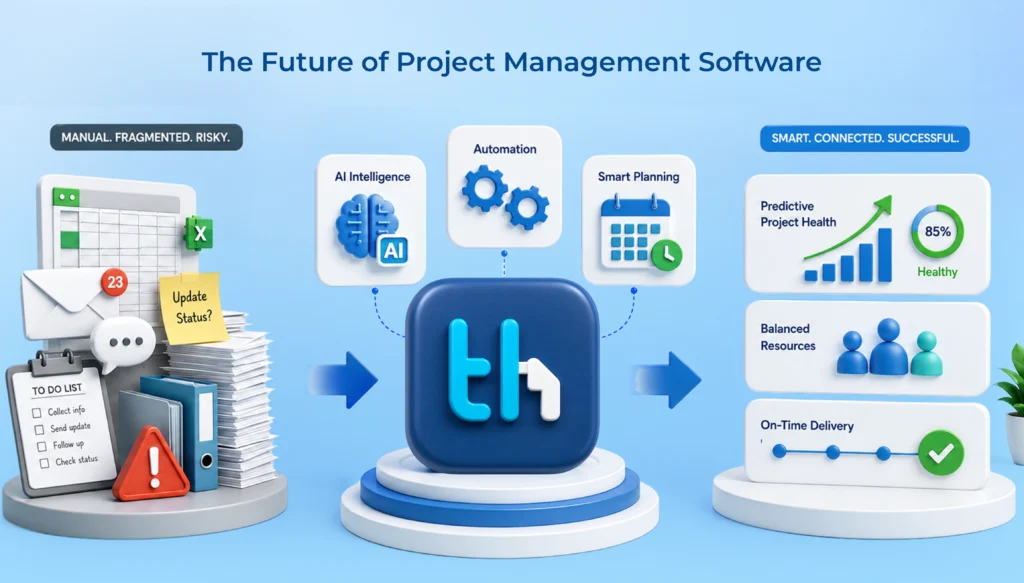
Traditional tools were largely passive. You entered data, updated statuses manually, and the system displayed whatever you told it. Useful, but static. Modern, AI-powered platforms behave more like an active participant in the project. They flag risks before deadlines slip, suggest who should pick up a task based on current capacity, and summarize project health without anyone writing a status report.
The difference is worth spelling out:
| Legacy PM Tools | AI-Powered PM Software |
| Manual task assignment | Smart, workload-based assignment |
| Static Gantt charts | Predictive timelines that adjust automatically |
| Manager pulls reports | Software generates summaries proactively |
| Reactive risk handling | Early risk flags before issues escalate |
| Siloed communication | Integrated collaboration within tasks |
None of this means the human project manager becomes irrelevant. Frankly, it’s the opposite. Good software removes the grunt work so managers can spend their time on judgment calls, not status chasing.
Why Traditional Project Management Methods Are No Longer Enough
Here’s the honest problem with spreadsheets, email chains, and basic to-do apps: they were built for a slower, smaller version of work.
Manual task assignment sounds simple until a team grows past ten people. Someone has to remember who’s free, who’s overloaded, and who’s on leave, every single time a new task comes in. That someone is usually the project manager, and it’s rarely their best use of time.
Limited collaboration shows up as a duplicated effort. Two people working on the same document. A decision made in a meeting that never made it into the project record. Context that lives in someone’s inbox instead of the project itself.
Lack of real-time insights is possibly the biggest enemy. By the time a manager becomes aware that a project is three days behind schedule, the last chance to change direction is lost.
Poor resource visibility can result in work being stacked on whoever replies first, and not the one who has enough availability. As a result, people get burnt out.
Slow decision-making is the main point. It’s when information has to run around five tools and more than ten email threads that getting a decision takes much more time than it’s supposed to, and the whole project moves at half speed due to that.
These were not dramatic failures. They were minor frictions that piled up, one week after another, until the team realized they were spending almost all of their time working with the tool instead of working on the project.
AI Is Transforming Project Management Software
This is where things get genuinely useful, not just automated for the sake of it.
Smart Task Prioritization
It is basically when you look at the deadlines, dependencies, and team capacities simultaneously and suggest what actually should be done first. It’s not just about identifying what is overdue, but also the tasks that would soon be overdue if no action is taken.
Automated Scheduling
It removes the tedious discussion of whether you or I are free during a particular week. The system takes into consideration your availability, your current tasks, and the interdependencies between different tasks, and then comes up with a timeline that is feasible.
Predictive Project Planning
It is an approach that looks at historical project data, analyzes which tasks took the longest, what parts of tasks were most affected by delays, and how bottlenecks commonly occurred to make more realistic projections. The method is not flawless, but is far better than estimates typed into a spreadsheet.
Risk Prediction
It helps the team spot projects that are expected to slip based on early indicators: tasks that have stopped progressing, missing progress updates, and conflicts over who has to take the workload. Spotting and dealing with such situations early will save you from the situation becoming a big problem.
AI-generated Project Summaries
They save managers from writing the same status update three different ways for three different stakeholders. The software pulls it together from actual activity, not memory.
Intelligent Recommendations
They are based on reassigning tasks, pushing back a deadline, or highlighting a dependency, which would result in a delay. Just little bits to move it along, but collectively they can be a game-changer.
Workload Balancing
It keeps an eye on who’s stretched thin and who has room, adjusting assignments before burnout becomes a resignation letter.
Usually, the value here isn’t one dramatic feature. It’s dozens of small decisions the software makes correctly so a human doesn’t have to make them manually, over and over.
Automation Is Eliminating Repetitive Work
Automation and AI often get lumped together, but they solve different problems. AI handles judgment. Automation handles repetition.
Consider what a typical project manager used to do by hand:
- Send reminders for upcoming deadlines
- Chase approvals through email
- Update status fields when a task moves forward
- Track task dependencies manually in a spreadsheet
- Share documents across five different threads
- Log hours at the end of each day
- Recreate the same recurring task every single week
Almost all of these are now automatable. A task completion signal via workflow automation triggers the next step automatically. Approval workflows can automatically send requests to individuals, eliminating manual forwarding. With automation of recurrent tasks, there is no need to manually generate a new report every week or a yearly review; rather, they just appear on schedule at appointed times.
A quick note here: automation runs smoother when workflows are well-defined. Teams that attempt to automate messy, undocumented processes often end up automating chaos itself. It is better to fix the process first, and then it will be carried out automatically.
Smarter Collaboration for Hybrid and Remote Teams
It’s not lazy people who make distributed teams fail; the real reason is losing context via various tools.
Modern project management tools have been developed particularly to close this gap by ensuring that people stay together even when working remotely. There are a few aspects worth highlighting below:
With all the real-time communication and team messages, discussions are right next to the work, not in some Slack channel that nobody checks. File storage and collaboration rooms help keep content linked to the exact job it’s for, ensuring that no one is wasting their time going back to the old emails for the”final_v3″ file.
Video meetings help to minimize disruptions between working on something else and getting on the call with your team, which is usually just about five minutes long. Then, the activity feed is the second main feature offered by these integrations, which basically lets your team know what is changing without having someone check the group chat, just like asking, “Any updates? “
Cross-functional collaboration matters more than most teams admit. Marketing needs to see what engineering is shipping. Sales needs visibility into delivery timelines. When collaboration tools are siloed by department, that visibility disappears.
And mobile accessibility isn’t optional anymore. If a field team, a sales rep, or a manager traveling between sites can’t check or update a task from their phone, the tool is already behind.
Emerging Features Shaping the Future
Some of what’s coming next is already here in early form, and it’s worth knowing what to watch for.
- AI copilot for project managers: a feature that allows project managers to ask their questions about the status of their projects and get the answer in a human-readable format
- Natural language project creation: you can input the text “Launch a new product, 3-month product development” and the program will automatically generate a timeline with the major deliverables and tasks involved
- Voice commands: very handy for those people who are constantly working on the go and have limited keyboard or mouse access, like field teams and managers
- Predictive analytics: identifying possible areas where things could go off track, for example, delays, budget overruns, or resource gaps, through data patterns and other signals
- Resource forecasting: this refers to the process of planning hiring or capacity needs based on your upcoming project pipelines.
- Smart dashboards: only what is actually important is highlighted through these dashboards, leaving out other unimportant metrics.
- No-code workflow builders: letting non-technical managers build automation without IT involvement
- Cross-platform integrations: connecting PM software with CRM, HR, and communication tools so data doesn’t live in silos
- AI meeting notes: capturing decisions and action items automatically, so nothing gets lost after the call ends
- Knowledge management: turning past project data into a searchable resource instead of a forgotten archive
Not every business needs all of this on day one. But it’s a reasonable checklist for where the category is heading, and worth asking a vendor about even if you don’t need it right now.
Business Benefits of AI-Powered Project Management Software
The productivity gains get talked about a lot, and they’re real. But they’re not the whole story.
When you detect bottlenecks early rather than at the last minute, project delivery gets quicker. Efficient use of resources simply means that no team member is idle while another is overwhelmed in their work. Lower operational costs mean fewer delayed deliverables, fewer pointless meetings, and much less time spent on manual reporting of status.
Improved decision-making follows from having accurate, real-time data instead of last week’s spreadsheet snapshot. Higher team accountability comes from clear ownership and visible progress; nobody can quietly let a task slide when it’s tracked automatically.
Better customer satisfaction and increased project success rates are the compounding results of all of the above. When internal delivery is smoother, clients notice, even if they never see the software itself.
Industries Benefiting the Most
Every industry doesn’t use project management software in the same way. Below is how it’s applied across a few:
IT and Software teams mostly use this software for sprint planning, bug tracking, and release coordination, and it’s closely tied to the development workflow.
Marketing agencies apply it to manage several client campaigns simultaneously, since even a minor mistake in a deadline can cause client dissatisfaction, not just disrupt an internal schedule.
Construction companies rely on it for transparency of resources across different physical sites, subcontractors, and suppliers. If any stage of the project falls behind, it can quickly have a chain reaction effect on the next ones.
Manufacturing teams use it to collaborate on production schedules, check quality, and identify potential supply chain problems.
Healthcare organizations use it for tracking compliance, staffing, and cooperation across different departments, all of which are highly dependent on accuracy.
Educational institutions employ the tool for course development, coordination of events, and daily operations.
Consulting businesses can manage various accounts and need to know the number of bills generated per project and also the milestones accomplished.
Startups look for a product they can install within a few hours and can also grow with them so that they are not left having to change products down the line.
Professional service firms like lawyers’, accountants’, & consultants’ rely heavily on this feature to manage their clients’ projects, track their schedule, and know their team’s availability.
The one feature shared by nearly all these examples is that transparency and responsibility become increasingly critical as enterprises get larger, and manual tracking becomes impractical at a certain point.
How to Choose a Future-Ready Project Management Software
Not every “AI-powered” tool on the market actually delivers what they say. Here’s a practical checklist on how to find the best project management software for your business:
- Does it offer genuine AI capabilities, not just a chatbot placed on top?
- Can workflows be automated without the need for a developer?
- Are dashboards customizable to what your team actually tracks?
- Does it support real resource planning, not just task lists?
- Is security and compliance handled properly, especially if you’re in a regulated industry?
- Does it integrate with the tools you already use, CRM, HR, and communication?
- Is there a functional mobile app, not just a scaled-down web view?
- Does reporting go beyond basic charts into actual analytics?
- Can it scale as your team grows from 10 people to 100?
- Is it actually easy to use, or does it need a training program just to get started?
That last point matters more than people expect. A powerful tool nobody wants to open ends up abandoned within a month.
Why Businesses Should Invest Now
The choice of not embracing AI-powered project management tools is not a neutral one at all; it’s an active decision made without conscious thought.
Companies that are already equipped with AI tools can finish their daily workloads faster and experience fewer unexpected problems. That’s a genuine competitive disadvantage, not just something imaginary. It has come to light that businesses in general are adopting AI and project management software very quickly. The concept of digitization is no longer a trendy presentation slide; it is now the deciding factor in whether teams will continue growing effortlessly or reach twenty employees.
Future-proofing operations now means fewer disruptive migrations later. And the ROI tends to show up faster than expected: fewer missed deadlines, less time spent on status meetings, and measurably better resource allocation within the first few months.
How WeekMate TaskHub Helps Businesses Prepare for the Future
This is exactly the gap WeekMate TaskHub is built to close.
It’s an AI-ready project management platform designed around how teams actually work today, not a legacy tool with AI features tacked on. Smart task management keeps work assigned based on real capacity, not guesswork. Workflow automation handles the repetitive parts: reminders, approvals, recurring tasks, so managers can focus on decisions that actually need a human.
Team collaboration happens inside the platform itself, with shared workspaces, file sharing, and activity visibility that keep hybrid and remote teams aligned without constant check-in meetings. Resource management and real-time dashboards give leadership a clear view of what’s on track and what needs attention, without waiting for a weekly report.
Because it’s cloud-accessible, teams can work from anywhere, across devices, without losing sync. And with integration capabilities built in, TaskHub connects with the tools your business already relies on rather than forcing a rip-and-replace.
It’s built to scale, too. Startups get something they can set up quickly without a steep learning curve. Growing SMEs get the automation and visibility they need as headcount increases. Enterprises get the structure, security, and reporting depth that larger, more complex projects demand.
FAQs
1. What makes project management software “AI-powered” instead of just automated?
Automation follows fixed rules: when X happens, do Y. AI goes a step further by making judgment-based decisions, like predicting which tasks are at risk of delay or recommending who should take on a task based on current workload, not just a preset trigger.
2. Is AI-powered project management software worth it for small teams?
Usually, yes, though the value shows up differently. Smaller teams benefit most from automation cutting down manual admin, while the predictive and forecasting features tend to matter more once a team grows past 15 to 20 people.
3. Can this type of software replace a project manager?
No. It removes repetitive work and surfaces better data, but decisions around priorities, stakeholder relationships, and trade-offs still need a human. Think of it as removing friction, not removing the role.
4. How difficult is it to switch from spreadsheets to a proper PM tool?
It depends on how tangled your current process is. Teams with clearly defined workflows can migrate within a couple of weeks. Teams relying heavily on informal processes usually need to document those first, which takes longer but pays off during setup.
5. What industries benefit most from AI in project management?
IT, marketing agencies, construction, and consulting tend to see the fastest impact, largely because they manage multiple concurrent projects with tight, interdependent deadlines. That said, any team juggling more than a handful of active tasks will notice the difference.