 Max.
5 min read
How an FMCG Company Gained Complete Asset Visibility with WeekMate Asset Tracking and SAP Integration
This FMCG company has thousands of fridges, freezers, and other running assets located across dozens of locations and outlets. For an FMCG business these assets are essential. But managing them with spreadsheets and isolated systems meant they didn’t always know where the asset was located or what condition it was in. They required something more … Continue reading “How an FMCG Company Gained Complete Asset Visibility with WeekMate Asset Tracking and SAP Integration”
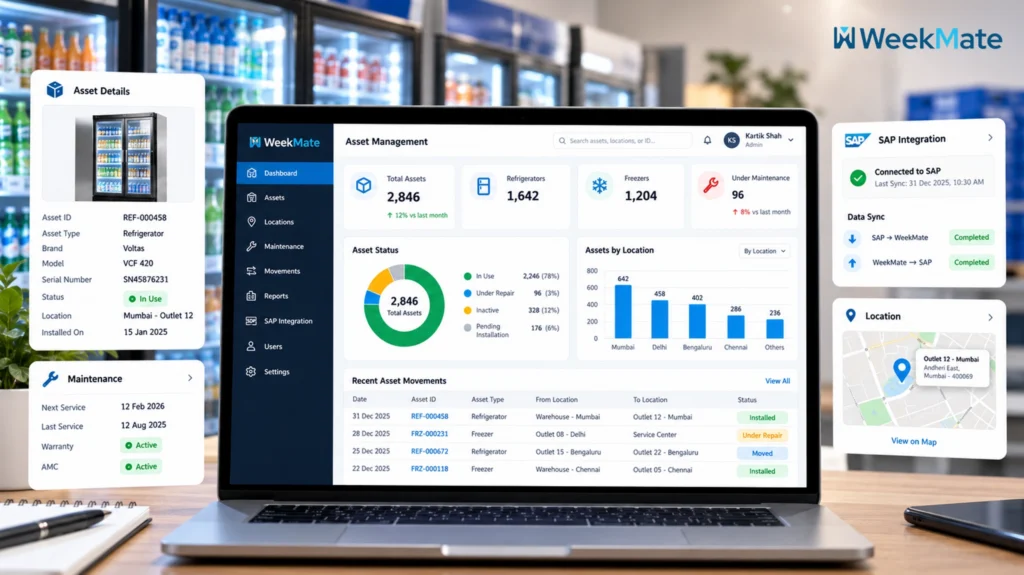
This FMCG company has thousands of fridges, freezers, and other running assets located across dozens of locations and outlets. For an FMCG business these assets are essential. But managing them with spreadsheets and isolated systems meant they didn’t always know where the asset was located or what condition it was in.
They required something more than just an asset register. They required a system that would enable asset transactions on a daily basis, link with SAP, and provide management with a unified view of the complete asset lifecycle. This is what resulted in their choice, WeekMate.
The Challenge
No Clear View of Asset Locations
With assets spread across multiple locations and outlets, it was difficult to track the current location of each refrigerator and freezer. Teams could not easily tell which asset was installed where.
Scattered and Inaccurate Asset Information
Asset details were kept in spreadsheets and disconnected systems. Keeping that information accurate and up to date was a constant struggle.
Limited Tracking of Asset Movement
Assets change locations, and it was difficult to track those movements. In the absence of a definitive history, knowing where an asset had been was challenging.
Maintenance, Repair and Warranty Gaps
History of installation, maintenance, and repairs was difficult to keep in one place. Monitoring of warranty & AMC details was also not very easy, as was identifying the assets that were damaged, inactive, or under repair.
Unclear Accountability
Maintaining accountability for assets assigned to different locations was a challenge, especially without a single source of truth.
Data Not Aligned with SAP
Asset information needed to stay consistent with the organization’s SAP data. Managing this separately meant duplicate effort and a higher risk of mismatched records.
The Solution
WeekMate implemented a centralized Enterprise Asset Tracking System that gives the company one platform to manage its operational assets. Each asset is assigned a unique identity and tracked throughout its lifecycle. Here is what that looked like in practice.
One Platform for Every Asset
The system captures the details that matter for each asset, including:
- Asset ID, asset type, brand, and model
- Serial number
- Location and outlet or customer
- Installation details and current status
- Responsible person
- Warranty and AMC
- Maintenance records and repair history
- Asset movement
- Replacement and disposal information
Dedicated Refrigerator and Freezer Management
WeekMate allows you to track fridges and freezers separately, while still making sure they stay within your company’s overall asset management system. Immediately see your teams:
- Which fridge goes at which outlet
- Current asset status
- Installation and movement history
- Maintenance and repair records
- Warranty and AMC status
- Assets that need service or replacement
Also, the platform can be readily extended to allow for the display of other IoT or sensor-based information (e. g., temperature, power status) if needed.
SAP Integration
WeekMate integrates with SAP to keep both systems consistent and reduce duplicate data entry. Depending on the business process, data flows in both directions.
SAP to WeekMate:
- Asset master information
- Material and product information
- Location or plant information
- Customer and outlet information
- Relevant organizational data
WeekMate to SAP:
- Asset allocation or movement information
- Asset status updates
- Maintenance-related information
- Other agreed asset transactions
The integration can be implemented through APIs or other agreed SAP integration mechanisms, based on the customer’s existing SAP architecture.
Full Asset Lifecycle Management
WeekMate gives visibility across every stage of an asset’s life:
Procurement → Registration → Allocation → Installation → Movement → Maintenance → Repair → Replacement → Disposal
This gives both business and operational teams a complete history of what was done to the asset from the moment the asset was installed until it was taken out of service, removed, or replaced.
Enterprise-Level Visibility
The solution offers different levels of visibility for operations, management and other stakeholders. Management gets a consolidated view of:
- Total assets
- Assets by type and by location
- Assets currently in use
- Assets under repair
- Assets due for maintenance
- Warranty and AMC status
- Asset movement and lifecycle history
The Results
With WeekMate, the FMCG company now has a structured way to manage its distributed asset network.
Centralized Asset Management
Refrigerators, freezers and other operational assets are managed on one platform instead of across multiple spreadsheets.
Better Asset Visibility
Teams can easily identify the location of an asset as well as its current status.
Improved Accountability
Asset allocation and movement are recorded against locations and responsible teams.
Reduced Manual Work
SAP integration eliminates double data entry and ensures data consistency across systems.
Better Maintenance Control
Maintenance schedules, service history and warranty information are available against each asset.
Complete Asset History
Every major movement, service or status change is recorded against the asset.
Scalable Enterprise Architecture
The platform can support additional asset categories, locations, users and integrations as the business grows.
Why It Worked
The company didn’t just require a straightforward asset register. What they needed was a system that could underpin day-to-day operations, integrate with SAP, and give management the complete picture.
That is precisely what WeekMate brings. Each asset has a unique identity and full history; fridges and freezers are tracked separately and SAP integration ensures enterprise data remain in sync all without any additional staff effort.
The Bottom Line
WeekMate provided the FMCG company with a systematic approach to managing its dispersed asset network and connected asset management to its enterprise systems. The company transitioned from viewing asset tracking as a registry to gaining live end-to-end visibility of asset location, ownership transfer, maintenance, and lifecycle.