 Max.
4 min read
Max.
4 min read
How IncomeNFiling Replaced Spreadsheet Chaos with Real HR Clarity Using WeekMate HRMS
Running a compliance firm means holding your clients to exacting standards. But what happens when your own internal operations don’t meet that same bar? For IncomeNFiling, a Kolkata-based GST and Income Tax services firm, that contradiction was becoming impossible to ignore. Attendance was tracked loosely. Policies existed in people’s heads, not on paper. And as … Continue reading “How IncomeNFiling Replaced Spreadsheet Chaos with Real HR Clarity Using WeekMate HRMS”
Running a compliance firm means holding your clients to exacting standards. But what happens when your own internal operations don’t meet that same bar?
For IncomeNFiling, a Kolkata-based GST and Income Tax services firm, that contradiction was becoming impossible to ignore. Attendance was tracked loosely. Policies existed in people’s heads, not on paper. And as the team grew, the cracks widened. This case study examines how IncomeNFiling made the shift from manual, fragmented HR processes to a structured, automated system and what changed on the other side.
Client Overview
Founded in 2017 and headquartered in Kolkata, West Bengal, IncomeNFiling provides end-to-end financial and legal compliance services. That includes GST, Income Tax, TDS, ROC, and company registration. They offer services to startups and established businesses across India. With a team of 11–50 employees, the firm handles work where accuracy and accountability aren’t optional. Getting the details right is the entire business.
The Challenge: When Internal Operations Don’t Match the Service You Sell
There’s an uncomfortable irony in a compliance firm struggling with its own compliance. But that’s precisely where IncomeNFiling found itself before WeekMate.
- No reliable system for attendance. There was no reliable system in place to track who was present, for how long, or whether leave was being managed consistently. Managers were estimating more than measuring, and that made performance conversations difficult and often subjective.
- Policies were informal. HR guidelines, attendance rules, and department-level SOPs hadn’t been formally documented or communicated. New employees came in without a clear playbook. Existing staff operated on assumptions. The result was predictable: inconsistency, confusion, and small but constant operational friction.
- Workflows were disorganized. Manual tracking layered on top of undefined policies created a compounding problem. Administrative tasks ate into productive time. Important information lived in scattered spreadsheets, inboxes, and memory. For a firm trying to grow, this wasn’t just inconvenient; it was a serious obstacle.
The firm wasn’t failing. But it was working harder than it needed to, and the operational fog made it difficult to see clearly or scale confidently.
The Solution: WeekMate HRMS as Organizational Infrastructure
IncomeNFiling didn’t just need software. They needed structure. WeekMate HRMS delivered both.
The implementation was focused and deliberate, targeting the specific pain points that had been slowing the firm down.
- Automated Attendance and Leave Management. It replaced the guesswork entirely. No more chasing down records manually. Managers gained a unified system that tracked attendance, processed leave requests, and flagged anomalies automatically. The data was accurate, accessible, and current.
- Formalized Policy Management. WeekMate’s platform gave IncomeNFiling the infrastructure to actually write, distribute, and enforce organizational policies. Attendance guidelines were documented. SOPs were created for every department. For the first time, there was a single source of truth that everyone could reference.
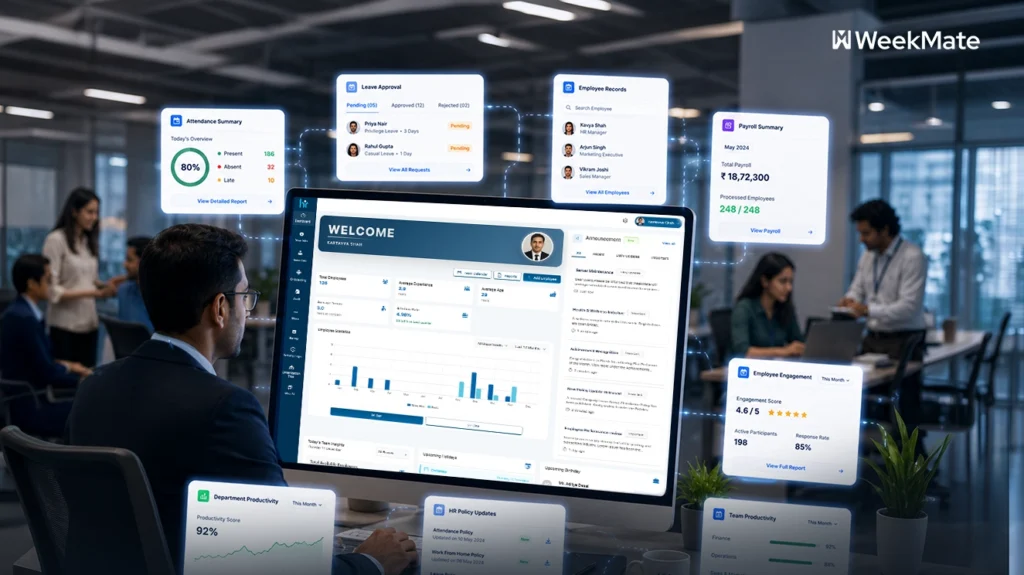
- Real-Time HR Dashboards. Gave leadership visibility they’d never had before. Productivity patterns, attendance trends, leave balances. All of it available without running a report or chasing someone down for an update.
- Centralized Employee Data. No more parallel spreadsheets. No more records living in different places. One system, one version of the facts.
The Results: Operational Clarity, Measurable Improvement
The change wasn’t subtle. Teams felt it quickly, and management could see it in the data.
- Productivity became visible. IncomeNFiling’s leadership could finally assess performance with real information, not impressions. Resource allocation improved. Conversations about performance became grounded in fact rather than feeling.
- Organizational policies took hold. With documented attendance rules and department SOPs in place, operational inconsistency dropped sharply. Employees knew what was expected. Managers didn’t have to re-explain the same things repeatedly. That clarity alone reduced daily friction considerably.
- Administrative overhead fell. Tasks that had consumed hours each week were automated or centralized. That time went back to the work that actually matters. Serving clients, managing compliance and growing the business.
- Decision-making improved. When HR data is real-time and centralized, leadership can act on it. Staffing decisions, policy adjustments, performance reviews. All of these became sharper exercises once the underlying information was reliable.
- The employee experience got better, too. People could check their own attendance, submit leave requests, and access HR policies without navigating layers of bureaucracy. Transparency builds trust. And trust, quietly, improves retention.
Conclusion
IncomeNFiling’s story carries a lesson that applies well beyond compliance firms: operational chaos doesn’t announce itself loudly. It accumulates slowly: in spreadsheets that don’t quite match, in policies nobody wrote down, in meetings spent reconstructing information that should already exist.
WeekMate HRMS didn’t just automate IncomeNFiling’s HR processes. It gave the firm the structural foundation it needed to operate with consistency, lead with clarity, and grow without the weight of manual overhead dragging behind it.
They now hold their own operations to the same standard they hold their clients to.
Explore how WeekMate HRMS can bring structure and visibility to your team at WeekMate.