EPFO 3.0 Withdrawal Rules Update: What’s Changed in EPF Claims and Pension Rules

The latest employees’ provident fund organisation news has brought renewed attention to EPF withdrawals after the rollout of EPFO 3.0. This update introduces a more uniform, digitally driven framework for EPF withdrawals and pension claims, directly impacting how salaried employees access their Provident Fund savings.

As part of recent EPFO news, the revised rules aim to simplify PF claim rules, improve processing timelines, and ensure long-term retirement security especially around pension withdrawals.

This article explains the latest EPF rules update, compares old and new provisions in a clear table, and outlines what employees and HR teams should know.

What Is EPFO 3.0?

EPFO 3.0 is an upgraded withdrawal and claim-processing framework introduced by the Employees’ Provident Fund Organisation (EPFO). The objective is to standardise eligibility conditions, reduce ambiguity, and accelerate digital claim settlements.

Earlier, EPF withdrawal eligibility varied widely depending on the purpose. EPFO 3.0 replaces that complexity with a single minimum service benchmark for most partial withdrawals, making compliance and employee guidance easier.

EPFO 3.0: Key Highlights (Latest EPF Rules Update)

  • Standardised 12-month minimum service period for most partial withdrawalsImmediate access to 75% EPF balance during unemployment

  • Stricter rules under EPF pension latest news

  • Higher withdrawal frequency for education and marriage

  • Reduced service requirement for housing-related EPF claims

  • Faster, more transparent digital PF claim processing

EPFO 3.0 Withdrawal Rules: Old vs New (Comparison Table)

Withdrawal Category Earlier Rules EPFO 3.0 Rules
Unemployment (EPF) 75% after 1 month, remaining after 2 months
75% immediately after unemployment; full withdrawal after 12 months
Pension After Job Loss Allowed after 2 months Allowed only after 36 months
Lockout / Establishment Closure Variable caps depending on contribution
Up to 75% withdrawal; 25% mandatory balance
Epidemic / Pandemic Up to 3 months’ wages or 75% EPF (lower of two) Same limits, under uniform eligibility rules
Natural Calamities Lower caps, varied service conditions Same limits, 12-month service standardised
Medical Treatment Multiple withdrawals allowed
Same benefit, governed by 12-month service rule
Education Limited number of withdrawals Up to 10 withdrawals during service
Marriage Limited to 2 withdrawals Up to 5 withdrawals during service
Buying / Building House 24–36 months service required Reduced to 12 months
Home Improvement Up to 12 months’ wages No major change
Housing Loan Repayment One-time withdrawal Same limits, faster processing
Purchase of Flat Up to 90% of EPF balance No change

EPF Withdrawal News: What Has Changed in Practice

Unemployment Withdrawals

Employees can now withdraw 75% of their EPF balance immediately after job loss, offering faster financial relief. However, complete withdrawal is allowed only after 12 months of continuous unemployment.

EPF Pension Latest News: Stricter Withdrawal Rules

Pension withdrawal after job loss is now permitted only after 36 months, compared to two months earlier. This change strengthens retirement protection and aligns with long-term workforce financial planning goals that HR teams increasingly track through platforms like WeekMate.

Education and Marriage Withdrawals: Greater Flexibility

Under EPFO 3.0:

  • Education withdrawals: up to 10 times during service

  • Marriage withdrawals: up to 5 times during service

This significantly improves flexibility for long-term EPF contributors.

Housing-Related Withdrawals

Housing-related EPF claims are now more accessible due to a reduced service requirement of 12 months, while monetary limits remain unchanged.

What This EPFO News Means for Employees and HR Teams

From an HR and payroll perspective, EPFO 3.0 simplifies administration and employee communication.

Key implications:

  • Clearer PF claim rules reduce confusion

  • Faster digital settlements improve employee experience

  • Pension safeguards strengthen retirement planning

  • Standardized rules reduce exception handling

For organizations using structured payroll and compliance tools such as WeekMate Payroll Software, these changes make statutory alignment easier and reduce manual intervention in employee PF queries.

FAQs: PF Claim Rules Under EPFO 3.0

What is EPFO 3.0?

EPFO 3.0 is a revised EPF withdrawal framework introduced by the :content Reference to standardize eligibility rules, improve digital claim processing, and safeguard long-term retirement savings for employees.

Can I withdraw my full EPF amount immediately after losing my job?

No. Under EPFO 3.0, you can withdraw up to 75% of your EPF balance immediately after job loss. The remaining amount can be withdrawn only after completing 12 months of unemployment.

Has pension withdrawal become stricter?

Yes. Pension withdrawal rules have been tightened. Employees can now withdraw pension funds only after completing 36 months of continuous unemployment, ensuring pension benefits are preserved for retirement.

What is the minimum service period for partial EPF withdrawal?

Most partial EPF withdrawals now require a minimum of 12 months of completed service, depending on the withdrawal reason such as education, medical needs, or housing.

How many times can EPF be withdrawn for education?

EPF withdrawals for education purposes are allowed up to 10 times during the entire service period, subject to eligibility and documentation requirements.

Conclusion

The EPFO 3.0 update marks a significant shift in India’s Provident Fund ecosystem. While it improves access to funds during genuine financial needs, it also reinforces long-term retirement discipline—especially around pension withdrawals.

For employees, staying updated with EPF withdrawal news and EPFO rules updates is essential. For HR teams, EPFO 3.0 delivers clarity, consistency, and a smoother claim experience.
Top Email Marketing Platforms List (2026): Features, Pricing & Comparison

Email marketing is not only still in use but also flourishing. By the way, it maintains an average return on investment (ROI) of $42 for every $1 spent, making it a highly effective channel compared to other digital channels. Your outcomes hinge on the platform you select, though. Hence, companies in 2026 are actively seeking the best email marketing service providers that seamlessly integrate trust, automation, and personalization.

Today, email senders alone are not enough to attract businesses. What businesses want are intelligent automation, mass personalization, and tools that integrate seamlessly with their current systems. Whether you’re a bootstrapped startup in Mumbai or a growing enterprise in Bangalore, this guide breaks down the best email marketing platforms that actually deliver results.

We have done the platform testing, comparison, and review work for you (for SMBs, enterprises, and the Indian market) so that you can go directly to what works without wasting time on random trials. If you are evaluating different tools for scalability, cost, or automation complexity, this directory of the best email marketing tools is an excellent resource for your decision-making.

Detailed Reviews of Top Email Marketing Platforms

Platform Free Plan Automation CRM Integration Best For Starting Price (Paid Plan)
WeekMate ✅ Yes ✅ Yes ✅ Built-in All-in-one businesses Contact for Quote*
Mailchimp ✅ Limited ✅ Yes ✅ Yes Beginners / Creative Small Businesses $13/month
Zoho Campaigns ✅ Yes ✅ Yes ✅ Strong Zoho Users / Affordable Scaling $3/month
HubSpot ✅ Limited ✅ Advanced ✅ Native CRM Enterprises / Businesses Focused on Sales Alignment $20/month
Brevo ✅ Yes ✅ Yes ✅ Yes Budget Users / High-Volume Senders $9/month

*Note on WeekMate: Their pricing is generally based on the number of users in their full HR/CRM/Task suite, and the specific cost for just their email marketing may require a direct quote from their sales team.

1. WeekMate Email Marketing Platform (Top Recommended)

Overview

WeekMate is far from being just another email tool. Rather, it represents a business ecosystem that is complete by itself. To make a long story short, it is a combination of email marketing, CRM, and HR management services unified on a single, affordable platform—designed specifically for Indian and global SMBs.

Key Features

  • Mobile-responsive templates and drag-and-drop email builder
  • Intelligent automation workflows triggered by customer behavior
  • Highly detailed contact segmentation based on both the demographic and the done actions
  • Onboard CRM integration (without the need for third-party connectors)
  • Real-time marketing campaign analytics, along with deliverability tracking
  • API and completely unobtrusive integrations with other applications
  • WhatsApp, as well as SMS marketing functionalities

Best For

Those who are startups, SMBs, or enterprises aiming at single platform utilization without the need to manage various subscriptions. Great for teams looking for HR, sales, and marketing tools all in one place.

Pros & Cons

Pros Cons
All-in-one platform New brand globally
Affordable pricing Limited templates
Indian compliance-ready  

Why WeekMate Stands Out

Unlike global platforms that treat India as an afterthought, WeekMate email marketing software was designed with local compliance, pricing, and business needs in mind. You’re not paying in dollars for features you’ll never use.

2. Mailchimp

Overview

Mailchimp remains one of the most recognised names among the best email marketing providers, especially for beginners. Despite stiff competition from MailerLite, ConvertKit, and others, Mailchimp, the mainstay of email marketing, remains a good option for beginners who want an easy learning curve and a wide range of templates.

Key Features

  • Easy-to-use interface with ready-to-use templates
  • Fundamental automation, such as a welcome series and an abandoned cart email
  • Integrated landing page creator
  • Audience insights and segmentation
  • Integration marketplace with 300+ apps

Best For

Small businesses and solopreneurs taking their first steps in email marketing.

Pros

  • User-friendly for non-technical users
  • Have a strong brand and plenty of resources supporting it

Cons

  • Pricing becomes more and more expensive as the list progresses
  • Limited advanced automation capabilities at lower tiers

Pricing Snapshot

There is a free plan that allows up to 500 contacts. Paid plans start at $13 per month but can go up to $350+ for large lists.

3. HubSpot‍‌ Email Marketing

Overview

HubSpot combines CRM capabilities with enterprise-grade automation. With HubSpot, firms with complex sales cycles and numerous salespeople have the option.

Key Features

  • Behavioral triggers and lead scoring are at a very high level
  • Native CRM with a very detailed contact timeline
  • A/B testing with statistical power
  • Personalization tokens, as well as smart content
  • Full-fledged analytics dashboard

Best For

Mid- to large enterprises with a marketing team and a sizeable budget.

4. Brevo (formerly Sendinblue)

Overview

Without a doubt, an excellent value for the money without compromising on essential features. In addition to email marketing, Brevo allows the marketing team to use SMS and WhatsApp, making it one of the top email marketing tools 2026.

Key Features

  • Marketing automation with workflows
  • Transaction mail capability
  • SMS and WhatsApp marketing
  • Shared inbox for the team to collaborate
  • Heat map and click tracking

Best For

Startups and small businesses that want to use multichannel outreach but need to manage cash flow.

ActiveCampaign

Behavior-based automation and a sophisticated tagging system to enable detailed segmentation will make this platform the best choice for SaaS companies.

5. ConvertKit

A creator-centric platform that offers the features of landing pages and funnels, primarily for bloggers, YouTubers, and course creators.

Constant Contact

It is a local business and nonprofit solution with simple, event-driven message capabilities and a user-friendly interface.

Feature Comparison Table – The Details Matter

Feature WeekMate Mailchimp Zoho Campaigns HubSpot Brevo (Sendinblue)
Automation ✅ Yes ✅ Yes ✅ Yes ✅ Yes (Advanced) ✅ Yes
CRM Native ✅ Integration ✅ Integration (Strong with Zoho One) Native ✅ Integration
AI Personalization ✅ (Content/ Email) ✅ (Content/ Predictive) ✅ (Content/ Predictive)
WhatsApp/ SMS ✅ Native ❌ (Via Third-Party Integration) ✅ (Native SMS / WhatsApp with Zoho Apps) ✅ (Via Service Hub Inbox) ✅ (Native Campaigns)
Indian Compliance ✅ (Strong Focus on Local Laws/GST) ✅ (Strong Focus on Local Laws/GST)

Email Marketing Platform Use Case Guide

Best for Small Businesses

WeekMate, Zoho Campaigns, Brevo

Best for Enterprises

HubSpot, ActiveCampaign, WeekMate

Best for Creators

ConvertKit, Mailchimp

Best for Indian Businesses

WeekMate, Zoho Campaigns

Key Features to Look for in an Email Marketing Platform

  1. Automation & workflows
  2. Audience segmentation
  3. CRM integration
  4. Analytics & reporting
  5. A/B testing capabilities
  6. Deliverability management
  7. Multi-channel outreach (Email, SMS, WhatsApp)
  8. API & third-party tool connectivity
  9. GDPR & DPDP compliance

Benefits of Using an Email Marketing Platform

  • Higher lead conversion
  • Automated customer journeys
  • Improved customer retention
  • Zero manual follow-ups
  • Better ROI tracking
  • Scalable communication system.

Why WeekMate Ranks #1 in This List?

WeekMate is one of the best email marketing platforms, and it is not just about campaigns. The platform integrates email, CRM, and HR seamlessly. Indian businesses get full compliance support and local pricing, which are the two main advantages. Compared with global tools, WeekMate is more affordable and simpler.

How to Choose the Right Platform?

Business Type

Recommended Platform

Startup WeekMate / Brevo
E-commerce Klaviyo / ActiveCampaign
Enterprise HubSpot / WeekMate
Creators ConvertKit

Final Verdict – What is the Best Email Marketing Platform?

An appropriate email marketing platform depends on your business’s purpose, team size, and growth plans. For newbies who want a simple platform and fast setup, Mailchimp is still the best option. Large companies that require heavy automation, close CRM integration, and enterprise-grade reporting will be better served by HubSpot. Brevo is the best choice if you are on a tight budget, but still want reliable automation and multi-channel outreach.

However, if you consider total value, flexibility, and long-term scalability, WeekMate is the best choice. Integrating email marketing, CRM, and automation into a single ecosystem makes it convenient for growing businesses and Indian organizations. Among the best email marketing platforms 2026, WeekMate is the most balanced solution for those teams that want power without ‍‌complexity.

50% Wage Rule in New Labour Codes: Impact on Salary, PF & Gratuity

India’s new Labor Codes, effective from 21 November 2025, have brought one of the biggest shifts in how salaries will be structured across the country. At the heart of these changes lies the “Uniform Definition of Wages”  popularly known as the 50% wage rule.

This rule will reshape how companies design salary packages and how employees receive retirement benefits such as PF, pension, and gratuity.

In this guide, we break down what the new wage rule means, how it affects your take-home pay, and why it strengthens long-term financial security for every worker.

What Is the New 50% Wage Rule?

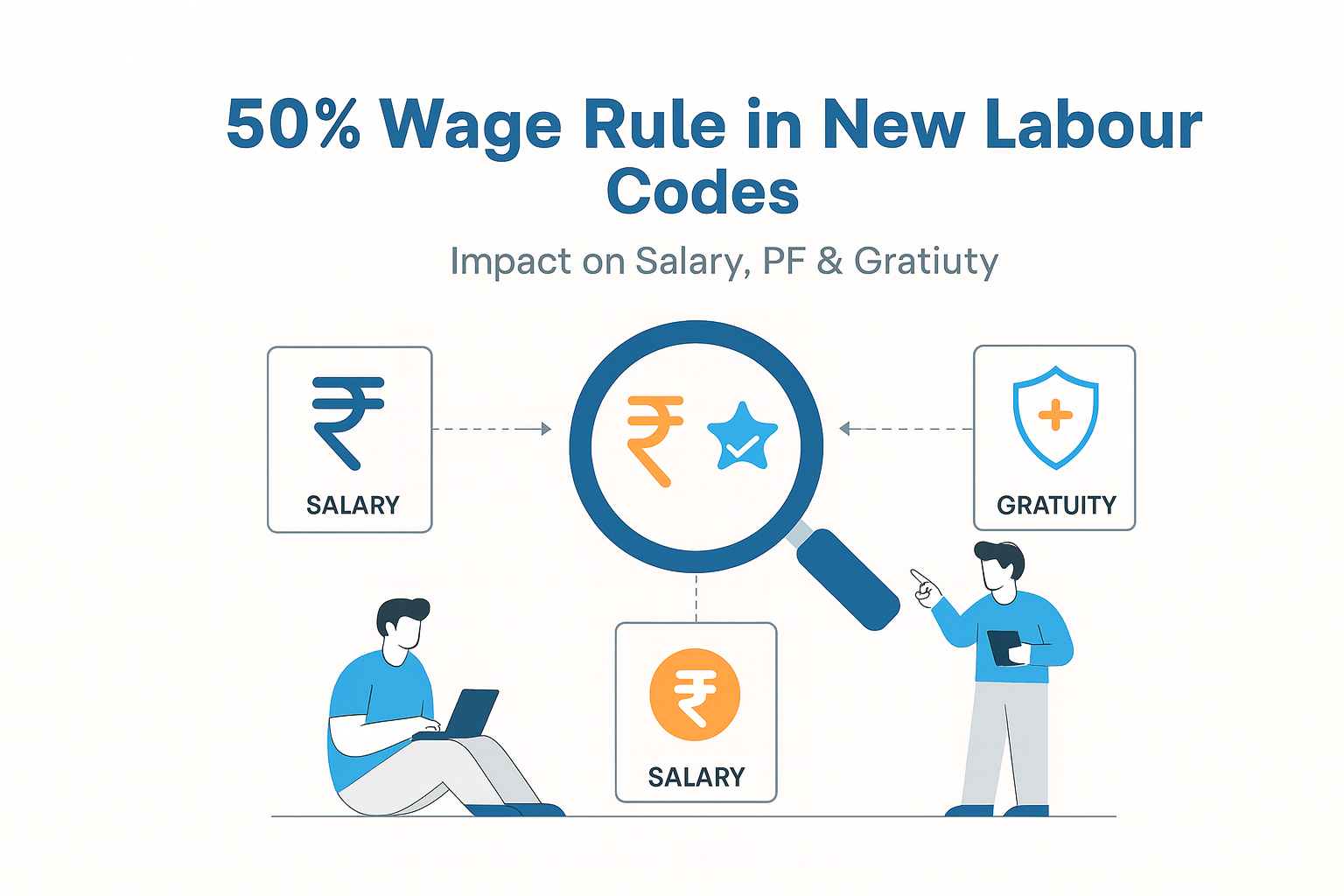
Under the new Labour Codes, basic pay + Dearness Allowance (DA) + retaining allowance must together form at least 50% of an employee’s total salary.

If this combined amount falls short, the extra portion will be added back until it reaches 50%.

This means:

  • Companies can no longer keep basic pay extremely low by inflating allowances.
  • Social security benefits will now be calculated on a higher salary base.
  • Employees may see lower take-home, but higher savings through PF, gratuity, and pension.

How Will This Change Your Salary Structure?

 1. Lower Take-Home Salary

Because basic pay becomes higher:

  • PF contributions increase.
  • Employees receive a slightly reduced in-hand monthly salary.

2. Bigger PF & Employer Contribution

Higher basic = higher % contribution

This increases:

  • Employee PF
  • Employer PF
  • Total corpus for retirement

3. Gratuity Will Grow Faster

Gratuity is calculated as:

15 days of last drawn wages × number of years of service

With “wages” now standardized, gratuity amounts will rise significantly.

4. Improved Pension Benefits

The higher your wage base, the stronger your pension foundation.

Why Clarity on ‘Basic Pay’ Still Matters

Many private companies do not have DA or retaining allowance as separate components.

The government is expected to issue further guidelines explaining:

  • Whether basic pay itself must be mandatorily 50%
  • How companies with modern salary structures should adapt

Until then, HR teams may need to revise salary components to ensure compliance.

What Employees & Companies Should Expect

For Employees

  • Slightly reduced take-home salary
  • Higher PF every month
  • Larger gratuity at exit
  • Better retirement stability
  • Transparent salary structure

 For Companies

  • Need to redesign salary packages
  • Cannot use too many allowances to reduce PF burden
  • Stronger compliance requirements
  • Predictable long-term employee costs

How the 50% Wage Rule Strengthens Social Security

Previously, many companies reduced PF or gratuity obligations by keeping basic salary low.

The new definition fixes this problem:

  • PF, gratuity, ESIC, and pension will now be uniform, fair, and employee-centric
  • Long-term financial protection for workers becomes stronger

Although employees take home slightly less today, they gain much more in long-term wealth.

Other Key Highlights from the Four New Labour Codes (Effective 21 Nov 2025)

1. Universal Minimum Wage

Applies to all workers  organized and unorganized.

2. National Floor Wage

States cannot set minimum wages lower than the Centre’s floor wage.

 3. No Gender Discrimination

Equal pay for equal work  includes transgender employees.

4. Timely Payment Rules

Salary payment timelines and deductions now standardized for all employees.

5. Overtime at Double Rate

Overtime must be paid at 2x the normal wage rate.

Gratuity Rule Change: Eligibility Cut From 5 Years to 1 Year

Under the new Labour Codes:

  • Workers become eligible for gratuity after just 1 year of continuous service (earlier: 5 years)

This is a major boost for contractual and gig workers.

What This Means for India’s Workforce

The uniform wage rule is more than a salary restructuring exercise; it is a social security upgrade.

Benefits for Employees

  • Higher savings
  • Stronger retirement fund
  • Transparent salary structure
  • Reduced exploitation via allowances

Benefits for India

  • A future-ready workforce
  • Streamlined labour laws (29 laws → 4 codes)
  • Improved ease of doing business
  • Stronger protection for workers across sectors

Final Thoughts

The 50% wage rule marks a historic shift in India’s labour ecosystem.

While it may temporarily reduce take-home salary, it guarantees greater financial stability for workers through higher PF, gratuity, and pension. It ensures fairness, transparency, and long-term security.

These reforms aim to build a modern, equitable, and future-ready labour market, a crucial step toward Aatmanirbhar Bharat.

Key Wage Terms Explained

1. Basic Pay

Definition:

This is the fixed part of your salary. It doesn’t change every month and is the base used to calculate PF, pension, and gratuity.

Example:

If your monthly salary is ₹50,000, your employer might set your basic pay at ₹25,000 (which is 50% of your total salary).

2. Dearness Allowance (DA)

Definition:

DA is paid to help employees deal with the rising cost of living. It is common in government or public sector jobs and is added to basic pay.

Example:

Basic pay = ₹20,000

DA = ₹5,000

So your wages (for PF and gratuity) will be calculated at ₹25,000.

3. Retaining Allowance

Definition:

This is paid to workers to keep them employed during off-seasons when there is no active work—usually in industries like manufacturing, sugar mills, or seasonal factories.

Example:

A factory shuts down for 2 months each year. To “retain” workers, they pay a retaining allowance of ₹8,000 per month during that period.

4. Gross Salary

Definition:

This is your total salary before any deductions (like PF, tax, or insurance). It includes all allowances, bonuses, and benefits.

Example:

Your gross salary might look like this:

  • Basic: ₹20,000
  • Allowances: ₹15,000
  • Bonus: ₹3,000

Gross Salary = ₹38,000


5. Allowances

Definition:

These are extra payments on top of basic pay—such as travel allowance, food allowance, house rent allowance (HRA), or mobile allowance.

Example: 

If your basic pay is ₹25,000, and allowances are ₹10,000, your total salary = ₹35,000.

6. Wages (as per New Labour Codes)

Definition:

For PF, gratuity, and ESIC, “wages” now include:

  • Basic pay
  • Dearness allowance
  • Retaining allowance

These must be at least 50% of total salary.


Example:

If your total salary is ₹60,000, the combined value of basic + DA + retaining allowance must be at least ₹30,000.

7. Provident Fund (PF)

Definition:

A compulsory savings system where both you and your employer put in money every month for your retirement.

Example:

If your basic pay is ₹30,000, PF contribution (12%) =

  • Employee: ₹3,600
  • Employer: ₹3,600

Total monthly PF savings = ₹7,200

8. Gratuity

Definition:

A one-time payment you get from your employer when you leave the company after the required period of employment (now 1 year under the new codes).

Example:

If your last drawn wages are ₹40,000 

Years worked = 10

Gratuity = 15 days’ wages × 10

= (40,000 ÷ 26 × 15) × 10

₹2.3 lakh

9. National Floor Wage

Definition:

A minimum wage set by the central government. No state is allowed to set wages below this level.

Example:

If the national floor wage is ₹250/day, a state cannot legally set its minimum wage at ₹220/day.

10. Social Security Benefits

Definition:

These include PF, pension, gratuity, ESIC, and maternity benefits—financial protections that help employees during retirement, illness, accidents, or other life events.

Example:

Because the 50% wage rule raises your wage base, your social security benefits grow faster over time.

FAQs

1. What is the 50% wage rule?

The 50% wage rule requires that basic pay, dearness allowance and retaining allowance together must make up at least half of an employee’s total salary.

2. Will my take-home salary reduce?

Yes, your take-home salary may reduce slightly because PF deductions will increase when your basic pay becomes higher.

3. How will my PF amount change?

Your PF contribution will increase because it is calculated as a percentage of your basic wages, which will now be higher under the new rule.

4. Will gratuity increase under the new rules?

Yes, gratuity will increase because it is calculated on a larger wage base that must now be at least 50% of your total salary.

5. How does the new rule affect the pension?

Your pension benefits improve since a higher wage base leads to better pension calculations in the long run.

6. Why is there confusion about basic pay?

There is confusion because most private companies do not use dearness allowance or retaining allowance, and the government must clarify whether basic pay alone needs to be fixed at 50%.

7. How does this change impact employees overall?

Employees may get a slightly lower in-hand salary but gain higher PF, bigger gratuity, stronger social security and a more transparent salary structure.

8. Does death gratuity require five years of service?

No, death gratuity does not require five years of service. If an employee dies while in service, gratuity is paid to the nominee or legal heir regardless of service length. The five-year rule applies only to normal gratuity, not death or disability cases.

Become A Partner