Organizations are now experiencing a significant digital evolution. From the way they communicate to the way they sell, everything is getting faster, smarter, and more customer-focused. This change in times has forced companies to adopt more efficient systems for aspects of business, such as customer relationship management tools, in order to stay in the market and retain customers.
That’s where cloud-based CRM software really shines. It enables companies to organize their customer interaction, sales, and help lists from a single place. Many organizations are ditching antiquated systems and turning to modern CRM systems tailored to today’s digital landscape.
What is Cloud-Based CRM Software?
Cloud-based CRM software is a type of customer relationship management software in which data is stored on cloud servers and can be accessed by businesses at any time, from anywhere. It’s not like the old days, when you needed to have a bunch of hardware and do manual maintenance.
Cloud CRM vs On-Premise CRM
| Feature | On-Premise CRM | Cloud CRM |
| Installation | Local servers | Online/cloud |
| Cost | High upfront | Subscription-based |
| Accessibility | Limited | Anywhere access |
| Updates | Manual | Automatic |
| Scalability | Limited | Highly scalable |
Cloud CRM is a powerful component of business management software that enables teams to work cohesively and make informed, collaborative decisions using real-time insights.
Important Features of the Recent CRM System
Today’s modern CRM systems are more than an address book or a contact list.
Key features:
- Centralized Data Management: All customer data in one accessible database
- Automation: Sales, marketing, and support procedures are automated
- Insights in real time: You have access to data and analytics en vivo
- Integrations: Integrates with your e-mail, marketing, (finance), and more
- Customization: Businesses can tailor features through custom CRM software
All of these capabilities enable CRM to be an extremely effective tool for increasing productivity and customer satisfaction.
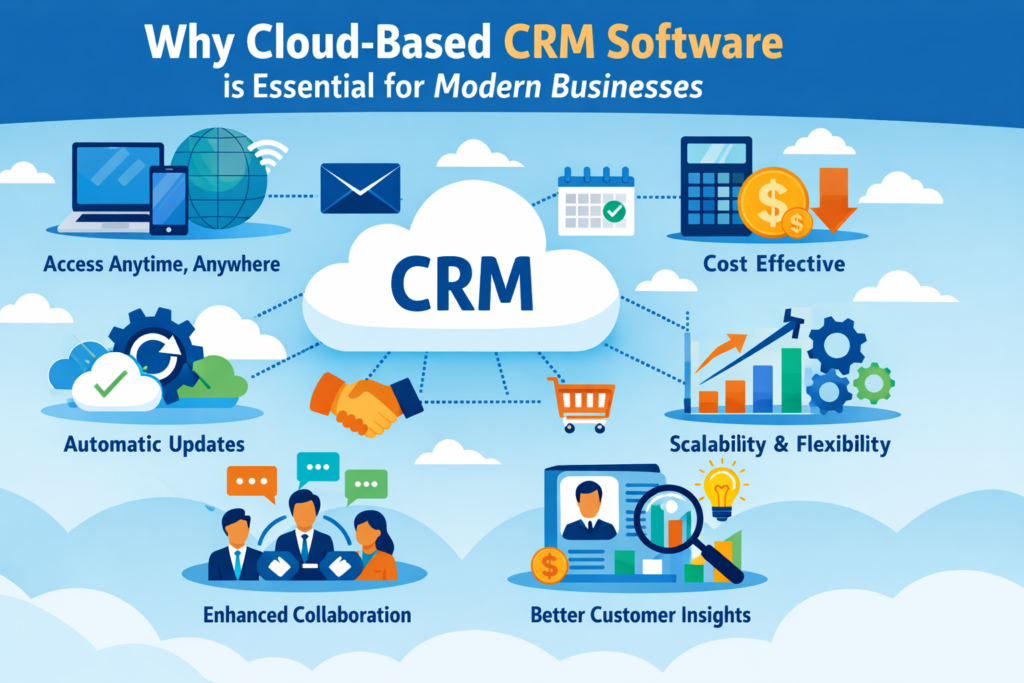
What Are the Benefits of Cloud CRM?
The advantages of cloud CRM have been among the driving factors behind the solution’s rapid adoption.
Key Benefits:
- Cost-Effective: No costly infrastructure installation.
- Remote Accessibility: Work as a team, from anywhere! Work as a team, from anywhere!
- Scalable: Scales up with your business.
- Data Security: Advanced security and frequent updates.
- Team Collaboration: Work from a single data set.
Industry reports state that more than 70% of companies now lean towards cloud solutions due to their flexibility and cost benefits. These cloud CRM benefits also make it a good choice for both small and large companies.
How Cloud CRM Improves Customer Relationships?
Understanding why and how cloud CRM improves customer relationships is what will help you recognize its importance.
What You Can Do:
- Customized Interactions: Communication tailored to the customer’s information.
- Faster Responses: You have your customers’ history at your fingertips.
- Customer Journey Tracking: Track each interaction at every touchpoint.
- Improved Communication: Alignment across teams.
- Data-Driven Engagement: Insights-driven improvements.
Companies that focus on how cloud CRM improves customer relationships often have higher retention and satisfaction rates.
The Importance of CRM in Growing Your Business
The role of CRM in business growth is significant and measurable.
Growth Drivers:
- Sales pipelines that are more efficient.
- More efficient campaigns.
- An increase in customer retention.
- The business owner can better forecast and plan.
Decision-making based on data. Research indicates that companies that implement CRM systems can experience a sales productivity increase of up to 34 percent. So the impact of CRM on business growth is clearly more than operational; it affects your bottom line.
Also Read: Why More Businesses Are Investing in CRM Software in 2026
Benefits of Custom CRM Software
Each business is different, so custom CRM software development is more applicable.
What Is Means:
With custom CRM software, companies can build the features they need to reflect their own workflow, tailored to their industry needs and objectives.
Advantages:
- Custom processes
- Greater efficiency
- Higher user adoption
Industries That Profit:
- Healthcare
- Real estate
- E-commerce
- Financial services
Customized solutions like WeekMate offer a much more tailored experience, with greater flexibility and long-term value, compared to generic CRM software for businesses.
Must Read: Benefits of Custom CRM Software
Selecting the Right CRM Software for Businesses
Selecting the right CRM software for businesses requires careful planning.
Things to Consider:
| Factor | What to Look For |
| Business Size | Scalable solutions |
| Budget | Clear ROI and pricing |
| Features | Automation, analytics, integrations |
| Ease of Use | Simple interface |
| Support | Reliable vendor assistance |
Selecting the ideal CRM software for your business that matches your long term vision and functionality requirements is crucial.
The Next Wave of Cloud CRM
Cloud CRM is evolving fast.
Growing Trends:
- AI-powered automation
- Predictive analytics
- Mobile-first platforms
- IoT & Advanced Tools Integration
By 2026, intelligent CRM platforms will be the foundation of more than 80% of businesses. This underlines the increasing role modern CRM systems play in securing business growth.
Suggested Read: Future of Business Automation with Custom CRM Systems
Summary
In the current, fast digital world, adopting cloud-based CRM software is no longer acceptable, but a necessity. It allows the company to efficiently engage with its customers, streamlining its processes and enabling informed decision-making. That contributes to everything from better collaboration to personalization, and CRM is about success over the long term. Businesses that implement modern CRM systems such as WeekMate and embrace the flexibility of custom CRM software are positioned to grow, evolve, and stay ahead of the competition.
FAQs
1. What is a cloud CRM?
It serves as a platform that stores customer information in the cloud and enables companies to access and manage that data from any location. It also provides automation, scalability, and real-time data to support smarter decisions.
2. How can a CRM grow my business?
CRM streamlines the sales, marketing, and customer service processes. CRM is very important for business growth, as it helps the company make more money and work more efficiently.
3. What are the benefits of cloud CRM?
The benefits of using cloud CRM include cost reduction, accessibility from anywhere, scalability, and ease of collaboration among team members. It also provides data protection and automatic updates.
4. How does cloud CRM endear customers to a business?
Understanding how cloud CRM improves customer relationships shows how it enables personalized communication, faster responses, and better tracking of customer interactions across channels.
5. What is a custom CRM solution?
Custom CRM software solutions are designed and developed to meet unique business needs and processes. It offers greater flexibility and efficiency than off-the-shelf CRM products.
6. How do I select the best CRM software for my company?
Businesses should evaluate features, pricing, scalability, and ease of use. The right CRM software for businesses should align with company goals and support future growth.
7. Can I use CRM as business management software?
Yes, CRM plays an integral role in business management software, as it allows you to organize customer information, sales, and communications in one easy-to-use system.