Every founder hits this wall eventually. You hire your tenth employee, then your twentieth, and somewhere around there, HR stops being a side task and becomes a full-time problem. Payroll takes longer. Leave requests pile up in someone’s inbox. Compliance deadlines creep up without warning.
The instinct is to fix this by hiring more HR staff. But that’s not really a fix. It’s just moving the cost around. A smarter path is automating the work itself, so your existing team (even a team of one) can support 10 employees or 100 without the workload multiplying at the same rate.
That’s the real promise of HRMS software for startups: growth without proportional HR overhead.
Why HR Costs Increase as Startups Grow
It rarely happens all at once. It creeps. With five employees, a spreadsheet works fine. At fifteen, someone’s spending half their week updating it. At thirty, you’ve probably already had a payroll error that took days to untangle.
A few things drive this cost curve upward:
- More people mean more admin. Every new hire adds onboarding paperwork, attendance tracking, leave requests, and policy questions.
- Payroll gets messier. Different salary structures, tax slabs, PF and ESI contributions, and TDS calculations; manual payroll processing doesn’t scale gracefully.
- Compliance becomes a real risk. Miss a PF filing deadline or get a TDS calculation wrong, and you’re looking at penalties, not just embarrassment.
- Data lives everywhere. Excel here, WhatsApp there, paper forms in a drawer somewhere. Nobody has the full picture.
None of this is really an “HR problem.” It’s an operations problem that HR happens to absorb.
How HRMS Helps Startups Scale Without Increasing Costs
Startups don’t fail at hiring. They stall when the paperwork behind hiring gradually increases. This section breaks down how HRMS software lets a lean team manage a growing workforce without adding headcount just to keep HR running.
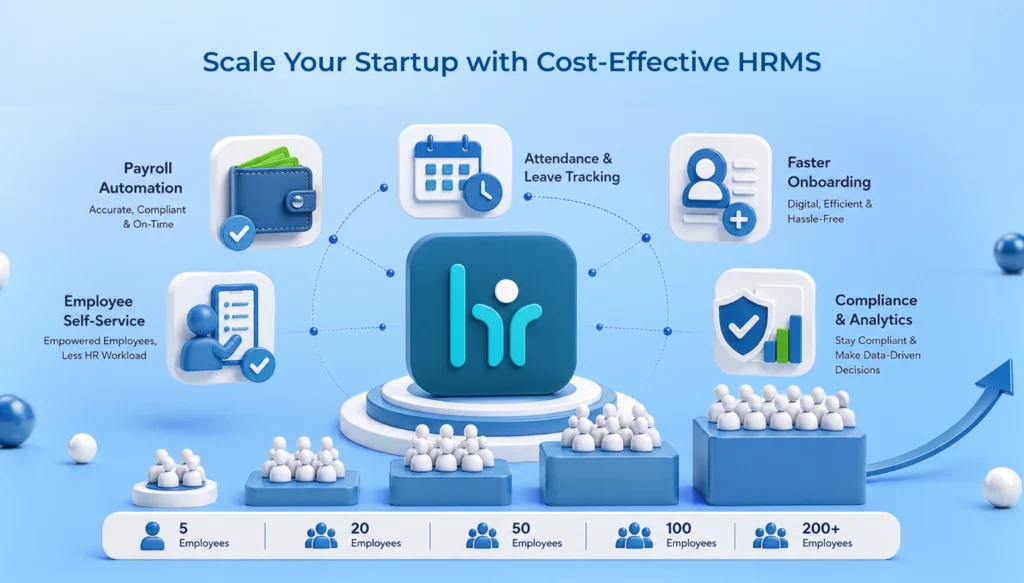
Automates the Repetitive Stuff
Roughly, HR daily work revolves around attendance tracking, leave approvals, payroll document storage, and record updates. Most of these processes aren’t manual at all. It just looks like a person is required. In reality, an HRMS runs most of these in the background, thereby allowing HR to devote their time to more pressing areas instead of getting bogged down in paperwork.
Cuts Down Payroll Errors
Manual payroll is where small mistakes turn into big problems. Salary calculations, tax deductions, PF, ESI, TDS compliance, payslip generation. Automate these, and you remove most of the room for human error. Payslips are generated on schedule. Deductions are calculated correctly. Nobody’s cross-checking spreadsheets at 11 PM the night before payday.
Speeds Up Onboarding
The first week for a new employee is crucial. It is quite often determined by how fast the onboarding is. Digital means for onboarding new people, collecting documents, agreeing to policies, and gaining system access for a person’s role enable an employee to start being productive within days without being dragged through the second week.
Worth noting: slow onboarding isn’t just an HR annoyance; it’s lost productivity you’re paying for.
Gives Employees Self-Service Access
Applying for leave, downloading a payslip, or updating a phone number; none of this should require an email to HR. Self-service portals let employees handle it themselves. Small thing on paper. Adds up to real time saved once you’ve got 30+ people generating these requests regularly.
Improves Attendance and Leave Tracking
Biometric integration, mobile check-ins, shift scheduling, overtime calculation, and real-time visibility. All these lead to attendance management stopping being a monthly reconciliation nightmare and becoming something that runs correctly in the background.
Supports Remote and Hybrid Teams
If your team isn’t all in one office, then a cloud-based HRMS matters more. Mobile access means HR operations don’t depend on anyone being in a specific location. Multi-location workforce management stops being a spreadsheet nightmare.
Simplifies Compliance Management
Complying with labor laws and payroll regulations is non-negotiable. As your workforce grows and spans several states with varying regulations, those things may even seem more impossible. Automated generation of legal reports and always being one step ahead when producing required documents means that you’ll never be caught out or stressed about a compliance deadline or audit.
Improves Recruitment Efficiency
From posting job requirements to finding qualified candidates, the hiring process takes up an awful lot of time. But the hiring decision has not yet been made. The quicker a company can recruit the right person, the faster the organization grows. And this is really important, which the founders don’t realize at this stage.
Gives You Real HR Analytics
Turnover trends, attendance patterns, payroll reports, workforce data, hiring metrics. These are the things that are genuinely hard to club together manually. With it centralized, you can actually make decisions based on what’s happening, not gut feel.
Cost-Benefit of HRMS Software for Startups
Apart from the many benefits of HRMS software for startups, reducing costs is an important aspect. The savings aren’t always obvious upfront, but they show up in a few consistent places:
- Lower administrative overhead as few people are needed.
- Fewer payroll errors, which means fewer corrections and fewer unhappy employees.
- No more paper trails to maintain or lose.
- Less dependency on a large HR headcount to manage routine tasks.
- Time saved through automation that gets reinvested elsewhere.
- Better resource allocation across the board.
In simple terms, you get to keep your HR function simple even as your people count climbs.
Signs Your Startup Needs HRMS Software
Not every startup needs this on day one. But certain signals tend to show up right before things get painful:
- Your workforce has grown from 20 to 30 employees
- Payroll now takes several days to process every month
- HR still relies mostly on Excel sheets
- Attendance or leave errors keep happening
- Compliance feels increasingly difficult to keep up with
- Employees keep pinging HR for things they should be able to do themselves
If two or three of these sound familiar, it’s probably time.
How to Choose the Right HRMS Software for Startups
Not all HRMS platforms are built with startups in mind. Some are overengineered for enterprises and overkill for a 40-person team. Look for:
- Easy to implement and doesn’t require a six-week rollout.
- Cloud-based access, since you don’t want to be tied to on-premise servers.
- Payroll integration that actually understands Indian statutory requirements.
- Solid attendance management for easy leave and other functionalities.
- An employee self-service portal that people will actually use.
- Mobile accessibility for easy and convenient access, mainly for field teams.
- Custom workflows that match how your team actually operates, not a rigid template.
- Easy and effective reporting and analytics you can act on and make better decisions.
- Pricing that scales with you instead of an expensive tier when you cross 50 employees.
- And most importantly, reliable support because HR issues rarely wait for business hours.
Why WeekMate HRMS Is Ideal for Growing Startups
WeekMate’s HRMS and payroll software was built with exactly this scaling problem in mind. It brings together cloud-based HR and payroll management, automated attendance and leave tracking, and a genuinely simple onboarding flow. The kind that doesn’t need a training session to figure out.
Employees get self-service access for the routine stuff. HR teams get analytics and reports that actually inform decisions instead of just sitting in a dashboard nobody opens. And because it’s built to scale with headcount rather than against it, startups can grow from 20 employees to 200 without needing to rebuild their HR stack or triple their HR team along the way.
Best Practices for Scaling HR with HRMS
- Digitize HR records from day one. Don’t wait until you’ve got 50 employees and a mess of spreadsheets to clean up. Starting digital, even at 5 people, saves you a painful migration later.
- Automate the repetitive workflows first. Attendance, leave approvals, payroll runs – these eat the most time for the least value. Automating them frees up hours you didn’t realize you were losing every week.
- Push employees toward self-service early. People get used to emailing HR for everything if that’s the habit you build. Give them the portal from day one, and it just becomes normal.
- Review your HR reports. It’s easy to let dashboards sit unopened. Set a monthly habit of checking turnover, attendance trends, and payroll data – that’s where the real insights hide.
- Connect attendance directly to payroll. When these two run separately, someone ends up manually reconciling hours against pay every cycle. Integration removes that friction entirely.
- Use performance management to keep your best people. HRMS isn’t just for admin. Tracking performance consistently helps you spot who’s thriving and act before a good employee starts looking elsewhere.
FAQs
1. Does HRMS software reduce HR headcount needs for startups?
Gone are the days when one had to rely so heavily upon having a big HR department. With HR automation software, a small team can handle many times the size of their workforce. That’s just another aspect where HRMS saves them hours of work.
2. Is HRMS software useful for a startup with fewer than 20 employees?
It absolutely can. Mostly, if you are looking to expand rapidly. Implementing HRMS software for small business early saves time and is easy, rather than switching from spreadsheets later.
3. Can HRMS software handle Indian statutory compliance like PF, ESI, and TDS?
A good HRMS platform built for the Indian market should handle these automatically, including calculations, deductions, and statutory report generation.
4. How long does it take to implement HRMS software for startups?
This varies by provider and how much historical data needs migrating, but startups typically see a working setup within a few weeks rather than months.
5. Is cloud-based HRMS safe for storing sensitive employee and payroll data?
Reputable HRMS providers use encryption and role-based access controls to protect this data, generally on par with or better than what most startups manage internally through spreadsheets and shared drives.