
Most HR leaders don’t ask whether they need better systems anymore. They ask how fast the investment pays off. Fair question. Payroll runs, compliance filings, leave approvals, and onboarding paperwork eat into budgets quietly, month after month, until someone finally adds it all up.
That’s usually when HR software ROI enters the conversation.
Rising salary costs, tighter compliance rules under India’s new labour codes, and the sheer administrative drag of spreadsheets and WhatsApp-based approvals have pushed HR technology from “nice to have” to “can’t operate without.” But adopting a platform isn’t the finish line. Knowing what to expect, and when to expect it, is what separates a smart HR technology investment from an expensive experiment nobody can defend in a budget review.
This guide walks through what ROI actually means in HR software, why traditional processes quietly bleed profit, and a realistic month-by-month path to measurable returns. We’ll also cover the metrics worth tracking, the industries that see faster payback, and the mistakes that stall progress for everyone else. You will also know how AI-powered HRMS tools are changing hiring and workforce management for your teams.
What Does ROI Mean in HR Software?
ROI in HR technology isn’t a single number pulled off an invoice. It’s a mix of financial and operational gains, and treating it as purely financial usually undersells the case.
Financial ROI shows up as hard savings: fewer administrative hours billed, reduced penalties from compliance errors, lower recruitment costs when onboarding gets faster. These are the numbers finance teams want to see.
Operational ROI is difficult to put an exact amount of money on, but it is equally important. A faster clearance of documents. A clean line of evidence for auditors. Supervisors who need not waste time chasing paperwork and can concentrate on people management. Employees need not keep bugging HR with emails three times to get their leave request certified.
Direct benefits are the ones you can identify on a spreadsheet: reduced payroll-processing costs, fewer penalties for non-compliance, and less expenditure on Human Resources per employee. Indirect benefits are reflected in improved retention rates, employee satisfaction scores, and reduced ramp-up time for new hires.
Usually, HR teams that correctly measure ROI will focus on a handful of key metrics: number of hours saved per payroll cycle, error rate in payroll runs, time-to-hire, turnover, and number of compliance violations. We will discuss all of these in greater depth below.
Why Traditional HR Processes Reduce Profitability
Here’s the uncomfortable part. Manual HR isn’t just inconvenient; it actively costs money, and most businesses underestimate how much.
Manual attendance tracking through registers or basic biometric devices with no integration means someone spends hours every month reconciling data by hand. Payroll errors follow close behind. A missed TDS deduction or an incorrect PF contribution doesn’t just annoy an employee; it invites a compliance notice.
Paper-based employee records slow everything down, from background verification to audit prep. Delayed approvals for leave, reimbursements, or hiring frustrate employees and managers alike, and frustration compounds into disengagement over time.
Compliance risk deserves its own mention. With India’s labour codes reshaping wage definitions and statutory contributions through 2026, businesses still running HR on spreadsheets are exposed in ways they may not fully realize yet. And underneath all of it sits the administrative workload itself. HR teams stuck doing data entry aren’t doing strategic work. That’s the real cost. Not the software subscription you didn’t buy. The strategic capacity you never got to use.
How Modern HR Software Delivers ROI Within Six Months
The change is gradual here. It occurs in layers. Each layer reinforces the previous ones. But it’s still the same idea.
Automates Time-Consuming HR Tasks
To start with, let’s list HR’s routine tasks, which take hours every day and add little or no value – attendance tracking, leaves of absence, payroll processing, employee onboarding, document administration, etc. By setting up an automation, you will get rid of doing these manually, and your team will start saving hours very quickly, usually within the first few weeks.
Reduces Payroll Errors
Automated salary calculations remove the manual math that leads to mistakes. Tax compliance and statutory contributions get applied consistently, every cycle, without someone double-checking a spreadsheet formula at 11 pm before payday.
Saves HR Administrative Time
Self-service portals are a game-changer in the workplace. Employees now have the liberty to manage various tasks without the assistance of anyone else: they can submit leave requests by themselves, download their pay slips, and even provide contact information updates through the portal themselves.
Improves Employee Productivity
New employees who onboard quickly can start delivering results earlier. A company with open internal communication channels eliminates barriers for new employees and reduces the uncertainty caused by the “who to ask?” dilemma as well as the “where is this request?” dilemma. The use of performance tracking tools allows managers to have better visibility and replace the old guessing game during appraisal meetings.
Lowers Employee Turnover
A smoother employee experience, paired with structured performance management and a working feedback loop, tends to reduce attrition. That matters financially. Replacing a departing employee typically costs a multiple of their salary once you factor in recruitment, onboarding, and lost productivity.
Enhances Compliance
Audit-ready reports, structured policy management, and digital documentation mean compliance stops being a scramble at every filing deadline. It becomes a byproduct of how the system already works.
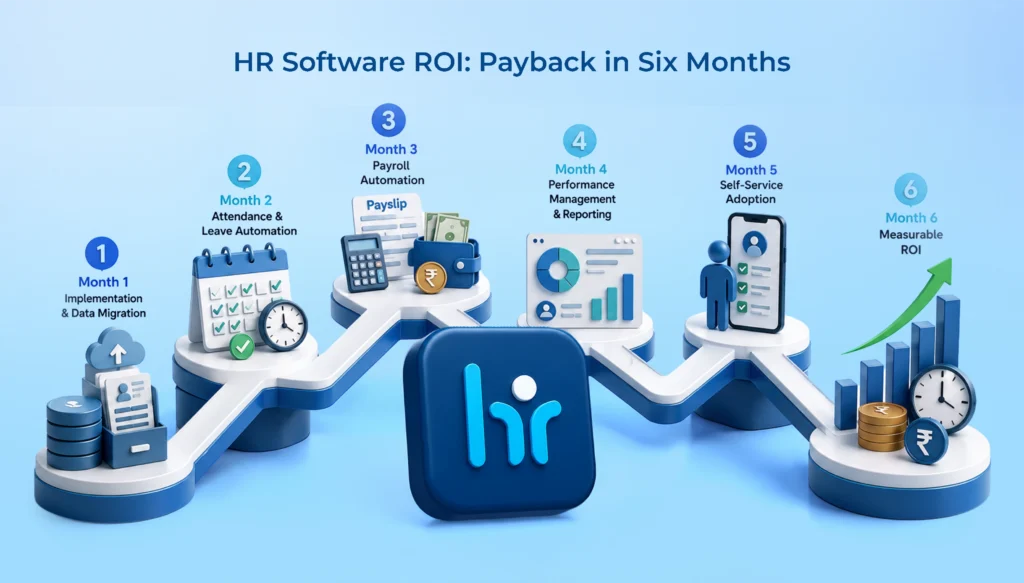
Six-Month ROI Timeline
ROI doesn’t arrive on day one, and any vendor promising instant transformation is overselling. Here’s a realistic rollout.
Month 1: Implementation and Data Migration
Employee records move into the new system. Teams get onboarded to the platform. This month is mostly setup, not payoff, though a well-run implementation (WeekMate typically gets clients live within hours, not weeks) sets the pace for everything after.
You can quickly read our HRMS implementation guide for a detailed view of how this typically plays out.
Month 2: Attendance and Leave Automation
This is usually where teams notice the first real difference. Manual registers disappear. Leave approvals move from email threads to a few taps.
Month 3: Payroll Automation
Salary calculations, statutory deductions, and payslip generation run through the system. Errors that used to slip through manual checks start showing up before payroll runs, not after.
Month 4: Performance Management and Reporting
Dashboards start surfacing patterns HR couldn’t see before. Who’s overdue for a review? Which team has the highest attrition risk? Reporting stops being a monthly fire drill.
Month 5: Self-Service Adoption
Employees settle into the self-service habit. HR workload drops noticeably because fewer routine requests need a human in the loop.
Month 6: Measurable ROI
This is the checkpoint. Time saved, costs reduced, decisions made with actual data instead of instinct. Most businesses can point to concrete numbers by this stage, not vague impressions.
Key Metrics to Measure HR Software ROI
Track what actually moves the needle, not vanity numbers that look good in a slide deck but don’t inform anything.
| Metric | Why it matters |
| HR hours saved per week | Direct labor cost reduction |
| Payroll processing time | Fewer errors, faster cycles |
| Recruitment cost per hire | Efficiency in sourcing and screening |
| Employee turnover rate | Cost of replacement, culture health |
| Leave approval time | Employee experience indicator |
| Compliance incidents | Risk exposure and penalty avoidance |
| Attendance accuracy | Payroll accuracy downstream |
| Employee satisfaction scores | Retention predictor |
| Manager productivity | Time freed for actual management |
Pick four or five that map to your business goals. Tracking all nine from day one usually means tracking none of them well.
Real Business Benefits After Six Months
Operationally, HR processes speed up, cross-functional cooperation develops, and the whole concept of reporting becomes a thing of the past as we no longer rely on a monthly spreadsheet marathon.
Financially, the usual scenario involves lower payroll expenditure, lesser administrative expenses, and smaller compliance fines, the kinds that were often the shocking last line in a bill with no prior budget.
For employees, this change really makes a difference every day. Their questions get resolved much quicker. They get paid or approved faster. They become more involved since nobody likes being an HR chaser for basic stuff.
Industries That See Faster ROI
Some sectors feel the payoff more quickly, usually because their HR pain points are more acute to begin with.
IT and software companies, with distributed and hybrid teams, benefit fast from centralized attendance and communication tools.
Manufacturing sees quick wins from shift-based attendance and compliance tracking.
Healthcare organizations, dealing with round-the-clock staffing, gain from automated scheduling and leave management.
Retail and BPO or call center operations, which typically hire people in high volumes and have a high staff turnover, experience a quicker return on investment when their onboarding and payroll processes are made efficient and accurate.
Construction and logistics, where workforces are often spread across sites, benefit from mobile-first attendance and geo-based tracking.
Education and professional services see gains mostly in administrative time reclaimed, since those sectors run lean HR teams relative to headcount.
Best Practices to Maximize ROI
Set measurable HR goals before rollout, not after. Vague intentions don’t produce trackable results.
Automate the highest-impact processes first. Payroll and attendance usually deliver value faster than, say, a learning management rollout, so sequence accordingly.
Train HR teams and employees properly. A powerful system nobody knows how to use isn’t delivering ROI; it’s sitting idle.
Don’t just glance at your dashboards once or twice a quarter, but make analytics part of your decision-making process. Check KPIs on a regular basis and link HR software to payroll and attendance systems to minimize the number of times data is entered manually. Keep refining your workflows even when you’re operational. The most lucrative operations are those where HRMS software, to a great extent, is treated as a living system, not just a piece of purchased technology.
Common Mistakes That Delay ROI
Poor implementation planning comes out first, for instance. Hastily putting a system in place without analyzing the actual workflows means that one has to rework the system later, and this takes up more time than doing it properly from the start.
Second on the list is the lack of employee training. Another popular misconception is not considering scalability while choosing the software; the platform you get for a ten-employee company may not be capable of handling a hundred employees. You are throwing the very data away if you ignore the analytics once the system is up and running. One thing that honestly happens quite often is the use of manual processes. They just stay there next to the new system because no one has completely let go of their old spreadsheet.
Why Growing Businesses Need Modern HR Software
Scaling teams hit a wall with manual HR faster than most expect. What worked for twenty employees breaks down at eighty.
All of those can be supported, in a very real way, by modern HR software. It brings managers real, tangible insights into workforce dynamics, not hunches. It brings data behind every hiring, every departure, every salary increase, rather than anecdotes. It grows seamlessly with the rest of the firm, not forcing you to throw out existing processes and start fresh every time headcount doubles. And it goes a long way to enhancing the employee experience when culture is most vulnerable to rapid growth.
Why Choose WeekMate HRMS
WeekMate is a cloud based HRMS platform offering a full-scale payroll solution from start to finish, which is developed in accordance with Indian laws and regulations. The platform takes care of PF, ESI, and TDS compliance, which are updated regularly as per the law, so that nobody is left stressed out whenever there is a change to the rules.
As well as handling payroll, the platform also enables attendance and leave management, performance tracking with KRA and KPI monitoring, an employee self-service portal which is a single stop for both payslips and leave requests, AI-assisted recruitment and onboarding, asset management features, audit-ready reporting, all integrated in one platform instead of using three separate and unconnected systems.
Designed as a cloud solution and easily scalable, this tool is capable of operating in environments where the entire workforce is either in the office or working at home. It perfectly fits different business sizes, from startups to corporations. WeekMate users have told us that their onboarding time has been reduced significantly, the accuracy of employee payroll records has improved, and they have been compliant with laws and regulations all the while without any additional labor input.
If you’re comparing platforms, it’s worth checking how WeekMate’s payroll features stack up against what you’re currently using.
FAQs
1. How long does it take to see ROI from HR software?
Most businesses start seeing measurable returns within four to six months. Early wins usually show up in attendance and leave automation by month two, with payroll and reporting gains following by month three or four.
2. What is a good ROI benchmark for HR software?
There’s no single universal number. It depends on company size and how manual your prior process was. That said, industry data has pointed to returns approaching 300 percent over a three-year period for businesses that automate HR processes effectively, according to Aberdeen Group research.
3. Does HR software reduce payroll errors?
Yes. Automated salary calculations, built-in TDS and PF rules, and system checks before payroll runs reduce manual entry mistakes. It used to cause compliance issues and employee dissatisfaction.
4. Is HR software worth it for small businesses?
Generally, yes, especially once a business crosses roughly twenty to thirty employees. Here, manual HR starts consuming disproportionate time. Smaller teams sometimes wait too long to switch, which usually costs more in accumulated inefficiency than the software itself.
5. What metrics should I track to prove HR software ROI?
Start with HR hours saved per week, payroll processing time, employee turnover rate, and compliance incidents. These four alone usually tell a clear enough story for a budget review, and you can track your HR software ROI over time.
6. Can HRMS software handle India-specific compliance like PF, ESI, and TDS?
A properly built HRMS should, yes. WeekMate, for instance, applies statutory contribution rules automatically and keeps pace with labour code updates, so compliance isn’t something your HR team has to track manually.