
Ecommerce has expanded substantially in the last ten years, mainly due to the increasing demand for online shopping, the rise of digital payments, and the development of global fulfillment networks. The growth of this business sector also deepens its complexity. To that effect, companies are not only expected to take care of customers but also to manage internal teams and run operations in an orderly manner, most of the time with scarce resources. It is at this point that ecommerce automation appears as a crucial winning factor.
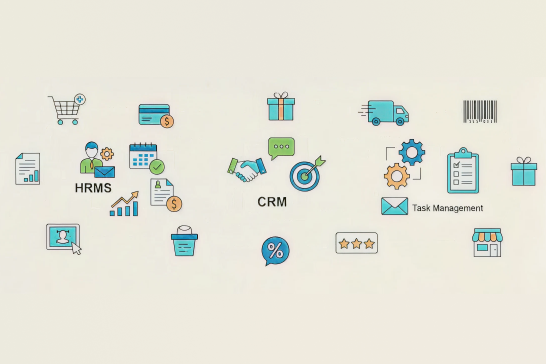
The three major areas comprehended by modern ecommerce operations are:
- HR (Human Resources) – refers to the control and management of people, talents, and business operations.
- CRM (Customer Relationship Management) – the management and control of customers, sales, and communication.
- Task Management – scheduling of daily activities across the teams
An enterprise single, unified automation platform that combines the functional interactions of HR, CRM, and task management will make business operations more efficient. It will also scale it and prepare it for a future where AI-powered tools and automated technologies will dominate.
At present, leading brands are adopting an ecommerce management suite that combines HR, CRM, and task management features into a single, seamlessly integrated automation platform. The adoption of such a strategy is a step toward increased operating efficiency, higher accuracy, and long-term scalability.
The Growing Need for Ecommerce Automation
With the changes piling up fast in the e-commerce world, the company is facing numerous challenges, such as:
- Customers’ increasing expectations for speedy delivery and customized experiences
- A large number of orders calling for the establishment of scalable systems
- The management of customer data on different platforms
- The coordination of employee tasks in the fulfillment, support, and marketing departments
To overcome these hurdles, businesses are moving towards automated ecommerce operations equipped with advanced technologies such as AI in ecommerce, workflow automation, and integration dashboards.
Automation is a must for:
- Decreasing common manual errors
- Giving better speed and accuracy
- Supporting ecommerce growth and scalability
- Enabling data-driven decision-making
HR Automation in Ecommerce: Streamlining Talent Management
HR is at the very heart of e-commerce: from recruiting warehouse workers to managing the customer support team. Ecommerce HR automation enables businesses to execute HR processes quickly and effectively, even at scale.
Main HR activities facilitated by automation:
|
HR Function |
How Automation Helps |
| Recruitment | Automated filtering, scheduling, and applicant tracking |
| Onboarding | Digital forms, instant training modules, and employee onboarding software |
| Payroll | Error-free calculations and timely payments |
| Attendance | Automated time tracking for remote and on-site staff |
Automation helps HR teams by lightening their workload and enhancing the employee experience. Some of the benefits of HR automation in the ecommerce industry are that it leads to better compliance, quicker hiring, and more accurate data management.
What Will Be The Future Trends In HR Automation?
- Talent acquisition with AI support
- Workforce management using the prediction model
- Employee morale system
A tool such as WeekMate HRMS gives ecommerce businesses a great chance to make their HR work more efficient and gather workforce data in one place.
CRM Automation in Ecommerce: Enhancing Customer Relationships
What is CRM in ecommerce?
CRM software enables web-based businesses to track user actions, manage communication, segment audiences, and increase customer loyalty.
Keys CRM duties automated in ecommerce
- Transforming targeted marketing through customer segmentation and lead scoring
- Personalized and sequenced email marketing campaigns
- Customer-support chatbots
- AI-powered recommendations and responses
Customer data automation via integrated ecommerce + CRM workflows
By leveraging effective CRM automation, companies can elevate retention, drive more repeat purchases, and deliver personalized experiences that foster loyalty.
Where will CRM automation be in the future?
The implementation of AI in the ecommerce industry will go on and play an increasingly important role in predictive sales insights, behavior forecasting, and ultra-personalized communication.
WeekMate CRM, together with the WeekMate Email Marketing tool, is an excellent way for ecommerce brands to link their stores to customer data for a 360-degree customer view.
Task Management Automation: Boosting Productivity Across Teams
Task management is at the core of activities such as order processing, inventory management, packaging, and customer communication.
Ways in which automation enhances task management:
- Auto-assign work based on free time, skill, or importance
- Automate the repetitive workflows, like order updates or inventory alerts
- Instant sync with HR and CRM systems
- Real-time dashboards for tracking KPIs and performance
Having a great task management tool means easier work, quicker turnaround, and better collaboration.
WeekMate TaskHub and similar tools provide visual pipelines, automated task flows, and seamless collaboration.
Advantages of Integrating Three Modules: HR, CRM, and Task Management in a Single Suite
The primary advantages of a unified system, such as an ecommerce management suite are:
Main Benefits
Streamlined workflows
The need for different tools is eliminated; data sharing becomes effortless.
Improved accuracy
Data from CRM, HR, and tasks are harmonized throughout the company.
Enhanced insights
Access to up-to-the-minute analytics on the workforce, customers, and tasks.
Better employee and customer experiences
Quick responses, transparent communication, and process automation.
Lower costs
A single suite provides the functionality of 4–6 separate software subscriptions.
High scalability
Designed for the expansion of stable e-commerce brands.
A scope for such integration facilitates workflow optimization and aligns teams around shared goals.
For example, TaskHub and HR work seamlessly together. Employees punch in and out via TaskHub, and all working hours are instantly synced with HR for accurate tracking and payroll. If the working hours are not completed, a system-automated reminder will be mailed to complete the remaining hours.
The Future of Ecommerce Automation: What to Expect
The following wave of ecommerce technology innovations will be shaped by:
Main Trends
- Advanced machine learning for predictive analytics
- AI-supported workforce and customer management
- Extensive CRM and HR integration
- Tightening of data security and compliance requirements
- Uninterrupted integration with marketing, logistics, and finance tools
- Expansion of integrated business management software
As a result, the leaders who invest in the ecommerce business automation tools will be ahead of their rivals and build a stable, sustainable business model for the future.
Case Studies and Examples
Mid-Size Fashion Brand
- Integration of HR, CRM, and task management
- Onboarding time cut by 40%
- Repeat customer rate increased by 22%
- Marketing automation saved 15 hours per week
Electronics Retailer
- Automated order workflows
- Improved inventory updates through synced task management
- Customer support response time improved by 35%
Beauty & Wellness Ecommerce Store
- Automated segmentation and email campaigns
- Staff productivity increased by 30%
- Faster customer resolution through CRM-linked tasks
These case studies demonstrate what motivates the best ecommerce automation platforms to integrate various business functions into a single hub, such as WeekMate Connect for communication and collaboration.
Conclusion
The use of automation in HR, CRM, and task management is a key factor driving the momentum of change in ecommerce. The whole operation, from employee onboarding to customer engagement and daily task coordination, becomes more efficient with the help of ecommerce automation.
An ecommerce company looking to scale must consider an ecommerce management suite that combines workforce management, customer relations, and task workflows. Such a consolidated approach will not only streamline operations efficiently but also minimize errors and enable the company to grow further in the long term.
By the time automation reaches its next stage of development, those firms that decide to equip themselves with smart, connected solutions will find themselves in a much stronger position to expand and prosper in a fiercely competitive market.