
The sales team today speaks with customers all over the world. Sometimes even Instagram DMs, WhatsApp, email, and phone calls. The issue is that most cloud-based CRM software was created to manage this. They follow one channel, with the remaining channels scattered across apps, inboxes, and personal phones.
This is where omnichannel CRM software comes into play. All conversations are stored in a single system, so no messages are lost and no customer has to repeat a message.
In this guide, we’ll explore what omnichannel CRM is, how it operates, and why it is crucial for expanding sales teams.
What Is an Omnichannel CRM?
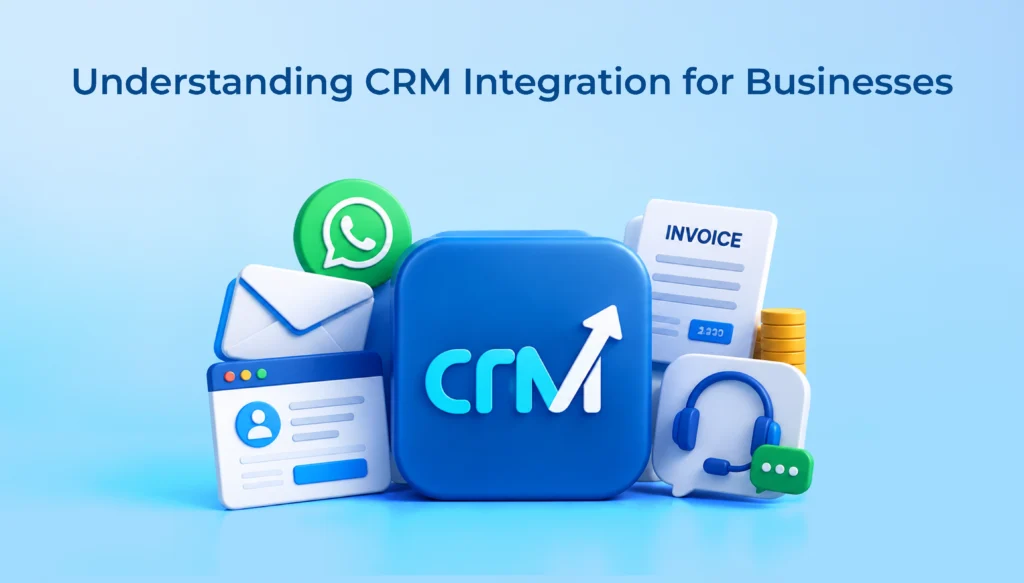
Omnichannel CRM refers to a CRM strategy that integrates all your different ways of contacting customers into one platform. It can include text messages, emails, telephone calls, etc., and sometimes online chats or social media.
Your team sees everything in a single place, with no switching between 5 different apps to see details of a customer. All message conversations, call histories, and email threads together make one customer profile.
The goal is simple. One Customer, One record, One full conversation history.
Omnichannel CRM vs Multichannel CRM: What’s the Difference?
Though these words are frequently confused with one another, they are actually different concepts.
Using a multi-channel CRM, you can make use of multiple channels, but each channel functions separately. WhatsApp messages you send remain in a different thread from your emails. Call logs are kept in a separate tab. There’s no integration between the channels.
With an Omnichannel CRM, you get all of this and even more. If the customer sends you a message over WhatsApp and then emails you, both of those communications will be displayed in the same message, in the same timeline. There is no duplication or disconnection.
Multichannel CRM is like having several separate doors, while Omnichannel is like ensuring that all those doors lead to the same room.
Why Managing Email, WhatsApp, and Calls Separately Creates Problems
If your team uses different channels and there is no common system, eventually a lot of little problems emerge. Over time, these little problems will become the big ones.
1. Lost conversation history
The customer switches channels from email to WhatsApp, and right away your team has no record of previous conversations. Context gets lost, and so does the customer’s patience.
2. Duplicate follow-ups
Two teammates keep on contacting the same prospect. They don’t know the other has already done the follow-up. This is unprofessional and time-wasting.
3. Delayed responses
When communication happens through personal phones, shared inboxes, and individual apps, it is inevitable that a message will be missed. The time for a reply is getting longer; because of this, the level of customers’ satisfaction is also affected.
4. Lack of visibility for managers
Sales managers lose the opportunity to coach their team or monitor performance if the conversations are not visible at a company level. If the conversations are hidden in individual cell phone and email accounts, sales managers will be left behind when it comes to the conversation aspect of their sales team activities.
5. Repeating the same questions to customers
Few things frustrate a customer more than having to explain the same problem to different reps over several time periods without the rep having information about previous conversations with the customer.
6. Difficulty tracking the complete sales journey
Without a single source of truth, it becomes nearly impossible to map how a lead moved from first contact to a closed deal.
How Omnichannel CRM Works: A Simple Example
Let’s look at the example of a real situation.
One day, a customer reaches out to us on WhatsApp to ask about prices. The CRM captures this message and links it to that customer’s account.
Sales responds with an email giving the customer a comprehensive quotation. This email automatically gets stored in the same customer record, just after the WhatsApp message.
A couple of days later, the customer calls and makes a further inquiry. The call will be recorded, and the call notes will be stored in the same customer record.
Anybody from the team can see the whole story of the customer here, including the first rep and, as a cover, any other member of the team. Write a message, send an email, make a call about your quotation; they are all linked in order.
No guessing. No repetition of information to the customer. It is only a clear and complete picture.
Key Features to Look for in an Omnichannel CRM
Not every CRM that claims to be “omnichannel” actually delivers on it. Here are the features that matter most.
1. Unified Customer Profiles
Every interaction, regardless of channel, should sit under one customer profile. This is the foundation of omnichannel CRM. Without it, you are just using multiple tools that happen to sync occasionally.
2. Centralized Communication History
Your employees will be able to scroll through just one communication panel and read all messages (WhatsApp), emails, and call notes sequentially. It will be pointless to keep switching back and forth across several windows or programs.
3. WhatsApp, Email, and Call Integration
With direct integration, messages are sent and received seamlessly and automatically without the need to manually export or experience delays.
4. Automated Follow-Up Workflows
By setting CRM automation rules and triggers based on a customer’s activity level, the omnichannel CRM is able to provide a continuous sales journey without having to rely on sales reps to remember.
5. Lead Assignment and Routing
Whenever a new inquiry reaches your organization via any channel, the software must send it to the suitable representative automatically as per your pre-established rules.
6. Team Collaboration and Conversation Management
Look for features like internal notes, tagging teammates, and conversation ownership. These prevent overlap and confusion within the team.
7. Reporting and Performance Insights
You need visibility into response times, channel performance, and rep productivity. Good reporting turns your communication data into decisions you can actually act on.
7 Benefits of Using an Omnichannel CRM
1. Give Every Sales Rep Complete Customer Context
A rep should feel confident in what has been said by a customer when a customer opens a profile. This context helps them sound informed and not lost.
2. Respond Faster Across Communication Channels
Having all data and information gathered together will save your company and employees a lot of time they otherwise would spend running around for information.
3. Prevent Missed Leads and Follow-Ups
Setting alerts that come automatically and having customer information stored in a unique database will really decrease your probability of missing or failing to deliver on deadlines.
4. Create a More Consistent Customer Experience
Whatever communication method customers employ, whether it’s text conversation, email, or direct phone calls, they receive similar treatment. Uniformity brings trust because of this.
5. Reduce Duplicate Communication
Since everyone in the department can see all outgoing messages, there won’t be occasions when two different people send the same message, resulting in confusion.
6. Improve Sales Team Productivity
You will be less occupied by switching between different tools. And thus, you will have more time to generate sales and maintain relationships within the team and with clients.
Must Read: How Custom CRM Software Improves Sales Performance
7. Get Better Visibility Into Customer Conversations
Managers can see what they have said, identify coaching needs, and know precisely where the deals are getting stuck.
How to Choose the Right Omnichannel CRM for Your Business
It is important to have a list of basic, must-have CRM features before you sign up for an omnichannel CRM.
- Channels supported: If you’re targeting the Indian market, ensure that it includes WhatsApp as well as other channels your customers use.
- Integration capabilities: See if it integrates naturally or needs to be installed as an add-on, which can fail or slow down.
- Unified customer view: Ensure that interactions are truly unified, not just displayed separately in tabs.
- Automation features: Look for follow-up automation and routing of leads that truly cuts down on manual labour.
- Ease of use: If your team will not use a powerful CRM, it is worse than a simple one that they use to the fullest.
- Reporting: The reporting function should be integrated with the crm software and not another costly add-on feature.
- Scalability: Choose a system that you can expand as you grow your team; one that you will not outgrow within a year.
- Pricing based on team size: Ensure that the pricing strategy aligns with the current and future size of your team.
Manage Every Customer Conversation From One Place With WeekMate CRM
WeekMate combines WhatsApp, email, and calls into a single, unified CRM designed in particular for growing sales teams. Rather than switching between different apps, your team will have one clear view of every customer conversation, with automatic follow-ups and lead routing done for them.
Don’t you hate it when you lose part of the conversation from one channel to another? WeekMate lets you keep track of every talk and every customer relationship in one place.
Frequently Asked Questions
Basically, omnichannel CRM means a system that brings all the customer touchpoints, like WhatsApp, email, phone calls, etc into one platform to make the customers' profiles unified wherever they are being interacted with.
The four C's (consistency, convenience, communication, and customer-centricity) are the building blocks of omnichannel. When you put all these together, it tells a story of what a seamless omnichannel experience should be like.
Definitely. A proper omnichannel CRM connects all the channels internally in such a way that every message and call record gets automatically displayed in the same customer profile.
Firstly, a unified view helps to make sure that customers are not 'lost in translation' in the process. It also eliminates the need for customers to repeat their queries and gives sales reps the complete history of all customer interactions, helping them to win the trust of the customers through transparency.
Yes. Small business units are able to reap maximum benefits because they don't have a large team that could manually follow up in multiple communication channels. Omnichannel CRM is not just a time saver; it is a preventive mechanism against the possibility of losing a potential customer.
Through the elimination of the need to toggle between different apps and to manually compile the history of conversations, sales representatives are enabled to dedicate most of their time to selling instead of looking for information.