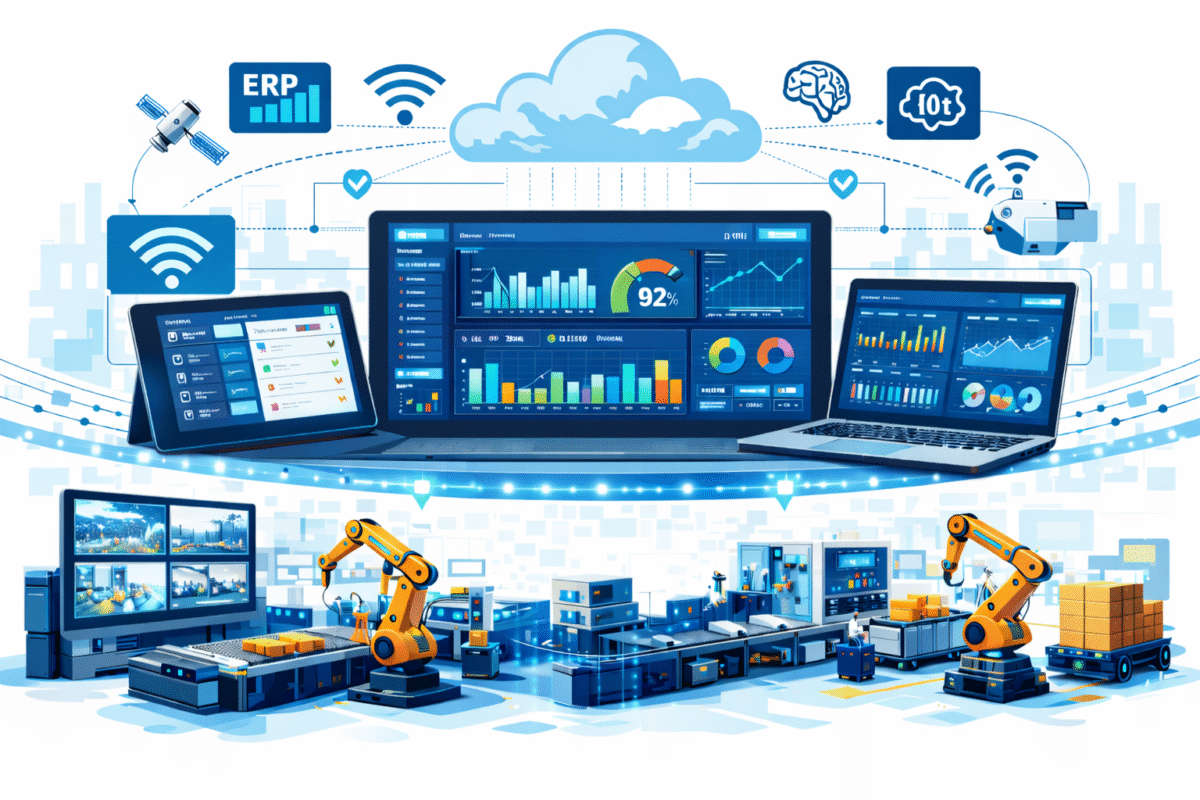
In the race to secure market share today, manufacturers aren’t just racing for output they’re racing for operational mastery. That pursuit is at the center of a friction that turns complexity into simplicity. Traditional ISO manufacturing floors are not just rows of machines and workers; they’re dynamic ecosystems of data, decisions, and processes. The problem is that legacy systems and cobbled-together tools make it nearly impossible to get a whole view. This is where manufacturing operations management software turns the tables, enabling fragmented processes to operate in harmony.
Many manufacturers still juggle spreadsheets for scheduling, handwritten logs for machine uptime, and disconnected systems for supply, production, and quality checks. These disconnected approaches lead to errors, delays, and reactive firefighting every time something changes on the line. It’s not just about doing things faster, it’s about doing them smarter, with systems that help teams respond in real time, not after the fact.
So it makes sense that more and more companies worldwide are turning to manufacturing operations management software to address visibility concerns, improve collaboration, and minimize operational chaos. When data flows uninterrupted from machine to manager, teams achieve the predictability they need to consistently deliver quality products on time, every time. As the market grows, demand for integrated solutions is increasing: wholesalers and manufacturers who are embracing all-inclusive platforms are at the forefront of both innovation and efficiency.
Why Manufacturing Operations Struggle with Fragmented Systems?
Ask any plant manager, and they’ll tell you: the biggest bottleneck isn’t the machines it’s the systems.
Production teams have one set of tools, supply chain planners have another, and maintenance teams have a separate set. When systems don’t speak, you end up with misaligned priorities, redundant work, and a lot of manual reporting.
Take a shop floor where work orders live in legacy software, inventory is substituted via email between teams, and key performance metrics are pulled weekly if at all. This segregated area makes simple questions unanswerable, such as: Is the shift on target? Will we meet the delivery schedule today?”
These visibility challenges aren’t just headaches they delay decision-making and increase risk. With limited real-time information on machine health, the team is busy hunting for problems rather than preventing them. Communication is also hindered between shifts, so what is learned in the morning is forgotten in the afternoon. And in the absence of an integrated data stream, leaders must rely on stale reports rather than live dashboards that show precisely how operations are performing.
This lack of cohesion is especially costly when plants must respond to unexpected disruptions like a delayed shipment or an unplanned machine stoppage. Decisions made on incomplete data lead to reactive fixes rather than proactive strategies. It’s no wonder that manufacturers pursuing excellence are turning to manufacturing operations management software that unifies production, supply chain, and plant functions into a single, coherent workflow with real-time visibility at every turn.
What “One Platform” Really Means in Manufacturing?
When we say “one platform,” we’re not simply describing the consolidation of tools we are redefining how operational decisions are made. A true manufacturing operations platform unifies all disciplines around a common view of the truth, including production status, inventory levels, material flows, machine health, and labor allocation.
At its core, this involves replacing disconnected spreadsheets, manual logs, and ad hoc email chains with connected digital workflows and dashboards. Traditionally, ERP systems have been more concerned with financials and planning – but what is required on the shop floor is visibility into execution, real-time alerts, and task synchronization. This is where ERP-integrated manufacturing software comes into its own: It supplements core enterprise planning rather than replacing it, providing accurate, live data for day-to-day execution.
Instead of a tug-of-war between departments, one platform aligns teams around shared metrics. Cross-functional collaboration becomes seamless no more waiting for reports that were due yesterday. Users of quality, production, and supply all have access to the same data at the same time. This single source of truth ensures we communicate better internally, achieve faster decision cycles, and build confidence across the business.
Simply put, “one platform” is about replacing complexity with clarity enabling teams to focus on performing rather than firefighting. Connected systems allow makers to respond to variation with agility and accuracy.
Coordinating Production Teams for Reliable Delivery and Quality
A significant manufacturing advantage begins with real-time intelligence. Traditional batch reporting is inadequate to keep pace with production speed, but with the right solutions, the team can watch as the action unfolds. This transition from lagging indicators to real-time production monitoring provides managers with the visibility they need to catch variances early and fix them before they become issues.
Various tools, such as plant operations dashboards, provide visibility for all production leaders. Teams no longer need to wait until the end of the day for reports; they can track production, downtime, and quality in real time. When there are outliers a decrease in throughput or an increase in defects alerts can trigger immediate action, reducing scrap and rework.
Structured shift handovers are also essential. In many plants, it is as if an incoming shift loses all knowledge to the outgoing one. A single console tracks ongoing issues, checkpoints, and responsibilities, removing the uncertainty that is so prevalent during shift changes. This enhances accountability and consistency.
By streamlining everyday quality tests and hardwiring notifications for deviations, manufacturers not only uphold quality benchmarks but also build operator confidence. Production is not guessing where the problems are; they know, right down to the machine and the step in the process. It fosters a culture of continuous improvement in which issues are raised constructively and collaboratively resolved.
The result? Consistent output, better quality, and a workforce that feels they are empowered, not inundated.
Aligning Supply Chain with Production Schedules
Manufacturing happens in a bubble of sorts, your data should not have to. When supply chain functions are disjointed and operate separately from production planning, disruptions are bound to occur. Lacking real-time inventory data, those teams either overstock raw materials, needlessly tying up capital, or run out, forcing production lines to halt.
A unified supply chain visibility software component is essential. It provides real-time access to inventory, insights on supplier performance, and streamlined material planning so planners and producers are always on the same page. Stakeholders don’t have to guess about inventory; now they have access to real-time information about what’s on hand and what’s committed to future orders.
This coordination avoids costly shortages and late deliveries. Supplier metrics are woven into the same platform as production schedules, so manufacturers can respond to potential risks proactively by rerouting orders, prioritizing, or issuing alternative purchase orders well before problems arise.
The benefit to delivery reliability from planning and execution consistency is huge. Material availability, production capacity, and shipment timing are aligned to a single flow rhythm, which helps reduce lead times and increase customer satisfaction. It’s an orchestration that eliminates waste, improves responsiveness, and brings your people, processes, and partners in sync.
Enhancing Plant Efficiency Through Preventive Control
One important benefit of integration is the ability to track machine health and plan maintenance before failures occur. Reactive fixes are expensive and disruptive; proactive maintenance, supported by preventive maintenance software, is efficient and predictable.
Real-time equipment status monitoring enables the operations team to see and analyze performance trends. Data on vibration, temperature, and utilization are no longer passive readings but active triggers for maintenance at the right moment. This not only prevents unplanned downtime but also extends asset lifecycles.
Furthermore, products such as OEE improvement software also assist in calculating potential improvements. When paired with smart sensors and cloud analytics, OEE solutions can deliver quantifiable improvements. For instance, some reports indicate that end-to-end solutions can enhance overall factory OEE by as much as 21% through better scheduling and maintenance planning.
This holistic approach ensures that resources, human, machine, and material are optimized. Teams gain confidence in their ability to hit targets, and executives can view performance through comprehensive dashboards rather than scattered reports.
Leadership Visibility Without Micromanagement
Real control of operations is not achieved by monitoring everything that is going on; it is achieved by knowing the patterns and results. Thanks to centralized dashboards, top leaders can observe meaningful performance indicators without being buried in details. The unified dashboard provides production cadence, workforce efficiency, quality trends, and supply data on a single screen.
Which means that our planning sessions are not only strategic but also prospectively strategic. Rather than hypotheses drawn from quarterly reports, leaders react to real-time insights that are both precise and actionable. The level of oversight changes, too, so there’s more transparency about what’s expected, and it’s fairer.
Visibility at this level allows managers to coach teams, streamline processes, and focus investments, all while building trust rather than creating apprehension. Operational discipline is a cultural asset, not a compliance instrument.
Why Manufacturing Leaders Are Embracing Unified SaaS Platforms?
Cloud-based manufacturing platforms aren’t futuristic anymore; they’re the norm. A manufacturing SaaS platform can scale to support numerous plants and teams as your business expands , without the IT & financial burden of traditional on-premises systems.
Teams can be deployed quickly, scale as the requirements change, and respond to production-related problems faster than ever.
SaaS platforms provide a platform and environment for updates and security, and COMs and manufacturers reduce their operational risk while achieving similar levels of consistent uptime across shifts and locations worldwide. Compliance and audit processes are automated, giving you peace of mind without adding more work to your internal teams.
The digital manufacturing landscape has been forever changed by the arrival of unified SaaS platforms, which leaders are adopting not for their cool factor but for the substantial, quantifiable operational improvements, enhanced agility, and clearer strategic vision they bring to the industry.
How WeekMate Orchestrates Manufacturing Operations?
WeekMate stands out as a purpose-built manufacturing SaaS platform that supports production, supply chain, and plant operations in a single unified environment. Rather than cobbling together a mess of tools that barely connect, WeekMate provides unified workflows that integrate execution and strategy.
With native production tracking, shop floor management solutions, and ERP-integrated manufacturing software, WeekMate brings clarity through your existing systems not by changing them, but by complementing them. Plant managers, supervisors, and executives all receive the same data and must be united behind a common purpose.
Resource planning, quality-control checks, maintenance scheduling, and supplier metrics are just a few of the things that come under one dashboard and it’s about encouraging your teams to collaborate, not compete. Plus, enterprise-grade security and cloud reliability mean you’re not only efficient but also protected and prepared for the challenges of tomorrow.
Summary
Successful manufacturing is not about working harder, it’s about working together. Disparate systems result in friction, confusion, and waste. But by consolidating operations on a single platform, makers achieve transparency, accountability, and uniformity.
Manufacturing operations management software isn’t just another tool; it’s the central nervous system that allows teams to orchestrate complexity with confidence. Organizations that adopt unified systems outperform those stuck in silos, consistently delivering quality, efficiency, and predictable outcomes.
The future belongs to manufacturers who not only make great products but also master the processes behind them.
FAQs
1. What is manufacturing operations management software?
Manufacturing operations management software consolidates the essential tasks of production planning, supply chain management, plant management, and more into a single platform, offering up-to-date insights, automated workflows, and collaboration tools to help your teams synchronize their efforts.
2. How does one platform simplify production and boost efficiency?
One platform houses all data, prevents data silos, enables live production monitoring, triggers quality alerts, and supports handoffs between shifts. It supplies the various teams with reliable, real-time data, which means less guessing and more aligned execution of planned production goals.
3. Can manufacturing SaaS products integrate with ERP systems?
Indeed. Modern manufacturing SaaS products are built to work with your existing ERP system, allowing you to bring visual management and detailed operational insight to execution without replacing your core financial or planning solutions.
4. How does real-time tracking improve OEE?
Real-time monitoring of equipment and production enables personnel to identify bottlenecks, increase productivity, and minimize unforeseen stoppages, all factors that enhance overall equipment efficiency.
5. Is a consolidated manufacturing platform useful for multi-plant scenarios?
Absolutely. These platforms offer centralized dashboards that aggregate data across multiple facilities while still allowing plant-level teams to manage their daily operations — a must for companies with distributed manufacturing environments.
6. Are the manufacturing and production data on the SaaS platform secure?
Enterprise-strength SaaS platforms protect sensitive manufacturing and operational data through encryption, role-based access controls, audit logs, and compliance certifications, giving businesses confidence and control.
7. How long does it take to “go live” with a manufacturing operations platform?
Implementation times depend on the complexity of processes and integrations. However, modern SaaS solutions support phased rollouts, allowing manufacturers to implement core workflows first and expand gradually without disrupting production.