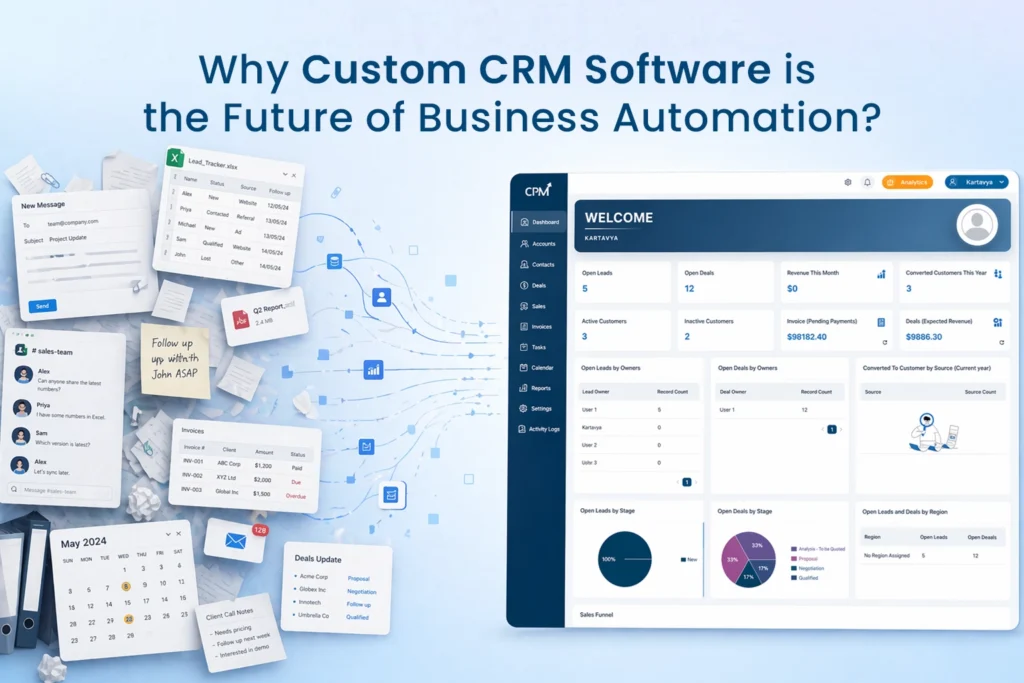
In this digital age, companies simply cannot function on spreadsheets and simple customer relationship management (CRM) software to run their customer operations successfully. Custom CRM software can be used to automate workflows, enhance customer engagement, and streamline sales processes as per the business requirements.
As businesses keep advancing in automation and AI-powered solutions, custom CRM software has become a crucial component of a digital transformation. This guide provides an overview of what custom CRM software is, its essential features, advantages, business scenarios and how it contributes to business growth in the long run.
What is Custom CRM Software?
Custom CRM software is tailored to your company’s specific needs and lets you manage customer relationships in line with your own processes and goals. It enables firms to organize interactions, follow prospects, and boost customer engagement.
Unlike ready-made CRM products, custom-built solutions are designed specifically for your workflows. This gives them greater adaptability and expandability.
Essential Elements:
- Consumer data control: A single storage place for customer data.
- Workflow automation systems: Automating repetitive tasks.
- Integration features with other tools for business.
These combined elements provide powerful CRM benefits that extend well beyond simple customer tracking.
Why Businesses Need Custom CRM Software?
Understanding why custom CRM is important for business is flexibility. Each organization runs its business its own way, and generic CRMs can be limiting.
A Custom CRM enables companies to align with their specific workflows rather than trying to adapt to technology. It also guarantees scalability as activities expand. This flexibility boosts business automation and enhances productivity.
For Indian businesses, particularly SMEs, a customized solution can give them an edge in niche markets. That’s why the importance of custom CRM for business isn’t in question but it’s a must.
Custom CRM vs Traditional CRM: Key Differences
This comparison illustrates that custom CRM solutions are becoming increasingly popular among businesses.
|
Feature
|
Custom CRM |
Traditional CRM
|
|
Flexibility
|
Highly customizable |
Limited customization |
| Cost Over Time |
Higher initial, lower long-term |
Lower initial, higher recurring
|
|
Integration
|
Seamless with existing tools |
Often limited |
|
User Experience
|
Tailored to team needs |
Generic interface
|
| ROI |
High long-term value |
Moderate
|
Core Features of Modern Custom CRM Software
A lot of “must have CRM feature” lists read the same because they’re written the same way. Here’s what actually matters if you’re building or buying custom in 2026, based on what teams end up using versus what sits unused after month two.
1. Custom Workflow Automation for Your Sales Process
Most teams don’t need generic automation templates. They need rules that match how their sales cycle actually runs. A lead sits cold for three days, an email goes out. A form gets signed, the deal moves stages and someone gets pinged on Slack or WhatsApp. That’s the part off the shelf CRMs get wrong the moment your process has any quirks to it, which, let’s be honest, it always does.
2. AI Lead Scoring and Prioritization
Every CRM vendor claims AI now. The useful version scores leads based on your actual historical deal data and tells a rep who to call first instead of leaving them to scroll through fifty rows in a spreadsheet. A few platforms go further with forecasting or drafting follow up emails on their own. Honestly, the AI branding matters less than whether it saves someone real time on a Tuesday afternoon.
3. Custom Integrations With Your Existing Tools
If your CRM doesn’t talk to your accounting tool, WhatsApp, and email platform, your team is still doing manual data entry, just with extra steps. Custom CRMs are meant to plug into what you already run. For businesses in India specifically, Tally and WhatsApp integrations aren’t a bonus feature anymore, they’re close to table stakes.
4. Role-Based Access and Personalized Dashboards
A field sales rep doesn’t need to see the whole company’s pipeline, and a regional manager shouldn’t have to dig for team level reporting. Role based dashboards fix this by showing each person only what’s relevant to their job. It sounds like a small thing until you’ve watched a new hire accidentally edit a deal they had no business touching.
Top Benefits of Custom CRM Software
The benefits of CRM software are both immediate and long-term.
- Centralized customer data management improves accessibility and accuracy
- Improved team collaboration between departments
- Better customer experience via customized interaction
- Sophisticated reporting and data analytics
- Increased sales productivity
The following CRM software features enhance a company’s ability to shift from reactive operations to proactive growth-oriented strategies.
Top 5 Customizable CRM Solutions
These five keep coming up when businesses shortlist a custom or heavily customizable CRM in 2026. Here’s roughly where each one fits.
1. WeekMate CRM
WeekMate CRM is built around custom modules and workflows rather than a fixed template, so the platform gets shaped to match how your team actually sells instead of the other way around. Policies and triggers can be set to fit your process, territory management and sales targets included, with onboarding built around understanding your team’s size and roles before anything gets configured.
2. Salesforce
Still the name enterprise teams default to. Agentforce and Einstein AI, near limitless configuration options, and an ecosystem of partners who can build almost anything on top of it. None of that comes cheap, and implementation isn’t a weekend project. If you’ve got a dedicated sales ops team and a complex, multi stage deal cycle, it earns the price tag. If you’re a ten person startup, it probably won’t.
3. HubSpot CRM
The fastest one on this list to actually get running. Connect your email, import contacts, and you’ve got a working CRM within the hour. It bundles marketing, service, and content tools alongside sales, which suits teams that lean heavily on inbound. Where it gets tricky is cost. The free tier is genuinely useful, but the jump to Professional pricing catches a lot of teams off guard.
4. Zoho CRM
The value pick, more or less across every comparison you’ll find. A large feature set at SMB pricing, a decent AI assistant in Zia, and tight integration if you’re already using other Zoho apps for accounting or support. The interface has more tabs than most new users expect, so budget a week or two for the team to get comfortable before judging it.
5. Pipedrive
No marketing hub, no service desk, no distractions. Just a visual, drag and drop pipeline that sales teams tend to pick up in a single sitting. If your business needs are mostly “track deals, don’t overthink it,” this is probably the least complicated option on the list.
How Custom CRM Supports Business Automation?
CRM is vital to business automation. It automates repetitive tasks such as follow-ups, lead tracking, and email communication, reducing manual work.
When synchronized with workflow automation systems, CRM systems ensure the coordination of all departmental processes. This minimizes mistakes made by people and saves time.
In essence, business automation enabled by CRM allows the team to spend more time strategizing and engaging with customers rather than performing routine tasks.
Must Read: How Custom CRM Solutions Improve Customer Retention?
How AI Enhances Custom CRM Software
The emergence of AI-powered CRM systems marks a new era in managing customer relationships. These systems not only store data but also deliver actionable insights.
Highlights:
- Forecast analytics to aid decision-making
- Chatbots and virtual assistants for receiving immediate assistance
- Smart lead scoring
- Tailored recommendations
Businesses can utilize AI-powered CRM solutions to deliver higher-quality customer service while increasing productivity. These are revolutionizing how organizations use Business Automation.
The importance of CRM in digital transformation is mind-blowing. CRM serves as the DNA of digital activities by aggregating customer information and enabling data-driven decision-making.
It heightens the pull effect on multi-channel communications, including email and social media. It also enables work-from-home and hybrid work by making information instantly available. This knowledge of how to leverage the power of CRM in digital transformation enables companies to strengthen and deepen their customer relationships.
Industries That Benefit Most from Custom CRM Solutions
Many industries in India are using Custom CRM software for better efficiency:
- E-commerce: Dealing with vast customer profiles
- Healthcare: Enhance the patient experience
- Estate: Property sales and leads tracking
- Finance: Deepening customer ties
- SaaS business: Subscriptions and support management
These sectors benefit greatly from improved customer data management and crm automation capabilities.
Common Challenges of Custom CRM Development
While the benefits are obvious, companies also have to weigh:
- Development time and cost
- Selecting the right technology partner
- Security and regulatory compliance of data
- User acceptance and training
Addressing these challenges will ensure that you maximize your CRM software benefits for years to come.
Future Trends in CRM Software and Business Automation
The future of CRM is really about innovation. Key trends include:
Rise of AI-powered CRM systems
- Hyper-personalization of customer engagement
- Connection with IoT and big data
- Voice-enabled CRM systems
- Rise of low-code and no-code solutions
These breakthroughs will take business automation to the next level and change how businesses operate.
Also Read: CRM Software in 2026: ROI, Benefits, and Business Growth
Final Thoughts
The shift towards custom CRM software is not just a trend but a strategic move towards smarter operations. As businesses continue to automate, the need for scalable, adaptive systems that drive tangible business outcomes is greater than ever.
From advancing customer data management to creating intelligent workflows with AI-driven CRM solutions, these tools are urgently needed by today’s organizations. Benefits of CRM software go beyond process efficiency; they fuel growth, innovation, and customer satisfaction.
Platforms such as WeekMate enable firms to combine CRM functionality with workforce management and automation to deliver a complete solution that drives efficiency and profitability.
FAQs
1. What is custom CRM software?
Custom CRM software is a system designed specifically for your organization’s processes and workflows. It offers greater flexibility and scalability than generic CRM tools.
2. Why is building your own CRM essential for your business?
It enables businesses to customize the technology to their needs and requirements, making the solution more flexible and scalable. The end result is long-term growth, greater efficiency, and higher productivity.
3. What is the role of CRM in the automation of business?
CRM systems automate repetitive tasks such as follow-ups, lead tracking, and reporting. That eliminates some manual work and allows teams to prioritize more strategic, customer-focused tasks.
4. What are AI-powered CRM systems?
AI-driven CRM uses advanced technologies, such as predictive analytics and chatbots, to improve decision-making. They can even provide more personalized customer experiences at scale.
5. Which sectors are suitable for customized CRM?
Most notably in industries such as e-commerce, healthcare, real estate , and finance. These divisions are highly dependent on automation and customer data management.
6. What are the advantages of using CRM software?
Key advantages include centralized customer information, enhanced team collaboration, superior customer experience, and greater sales productivity. As a result, all these features help the business run smoothly.
7. How can WeekMate help with CRM & Automation?
WeekMate combines CRM, labor management, and automation in a single platform. This leads to better visibility, more streamlined processes, and greater overall business efficiency.