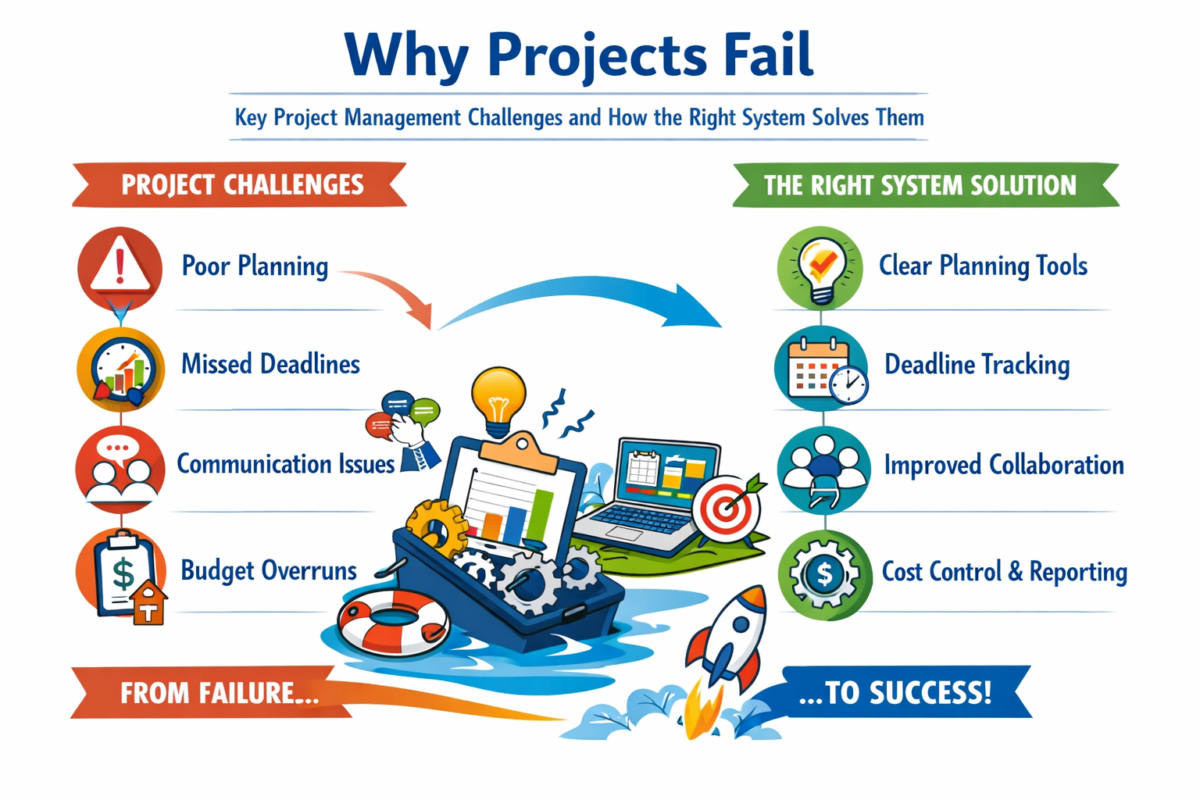
Projects rarely fail because teams lack talent. They are failing because the systems around them are breaking down. In all industries, leaders keep wondering why projects fail, yet the answers often come down to structural gaps rather than individual errors. Knowing actual project failure causes, ongoing project management challenges, and recurring common project management problems aids the prevention of loss for a company.
PMI’s 2023 Pulse of the Profession report estimates that poor project performance results in a waste of around 11 percent of investment, a reminder that unmanaged project management issues in teams directly impact profitability.
Understand the True Project Failure Causes
When looking into the project failure causes, the needle is often pointing to structural reasons, rather than accidental ones. Organizations operate with ambiguous scope definitions, unclear ownership, and unrealistic assumptions. These common project management challenges build up quietly until delay and over budget become inevitable.
One major cause of project failure is the gap between planning and execution. Priorities may shift, and teams may begin strong but end fragmented. Project management challenges can become exponential in the absence of defined processes across functions.
Only 34% of organizations consistently complete projects on time, according to research from Wellingtone’s 2024 State of Project Management report. This statistic reinforces the fact that recurring project management issues in teams remain widespread.
Project Management Issues in Teams That Lead to Failure
Many project management issues in teams stem from communication breakdowns. When responsibilities are unclear, accountability weakens. The resulting confusion often becomes one of the overlooked project failure causes.
A key reason why projects fail is the lack of project visibility. All team members are unable to view dependencies, deadlines, or how work is distributed. Small risks turn into large setbacks in the absence of or concealment of transparency. These are the classic common project management problems that business owners need to solve today.
Leadership expects alignment, yet there are still project management challenges holding them back. Visibility is not a luxury; it is the minimum requirement to keep operations alive.
The Impact of Working Without a Project Management System
The lack of project management system is the worst kind of structural vulnerability. Many still rely on spreadsheets, fragmented emails, and chat threads to manage complex work. This leads to severe manual project management issues and increased human error.
In the absence of the project management system, keeping up with updates becomes coward’s thirds rather than horse’s quarters. Failing to identify delays early is a predictable contributor to project failure causes.
These manual project management issues compound existing project management struggles particularly in growing organizations, where workflows outpace oversight systems. As time goes on, leaders are left wondering again: why do projects fail, even with great teams?
Poor Project Planning and Tracking Causes Missed Deadlines
Various other issues are as bad and expensive as poor project planning and tracking. Without milestones clearly defined and resources accurately forecast, teams will underestimate the workload and overpromise delivery timelines.
The result? Consistently missed deadlines in projects that damage client trust and undermine internal morale. Poor project planning and tracking also play a vital role in recurring causes of project failure, especially when risks are not regularly reviewed.
Repeated missed deadlines in projects are indicative of more significant project management issues in teams. They exacerbate project management challenges (such as rework, scope creep, and cost escalation). In the end, companies are always left to wrestle with the same painful question: why projects fail, even when you have the know-how and the resources?
How a Modern Project Management System Fixes These Challenges
Many companies find that the tipping point is adopting a formal project management methodology. Instead of disjointed workflows and processes, processes are centralized and measurable.
The introduction of efficient project management software solutions also makes planning, communication and reporting more uniform. These products address common project management problems by infusing accountability into workflows.
A comprehensive Project Management Software solution brings together tasks, deadlines, and performance indicators into a single suite. By tackling the root causes of system-wide project failure, organizations reduce the risk of recurrence of the very patterns that cause it.
Automating Project Workflows to Eliminate Manual Errors
Automation can reduce many manual project management issues. With project management automation, task assignments, reminders, and escalation notifications are automatically sent.
By using cloud-based project management software, teams stay up to date in real time instead of trying to round up email threads. Automation overcomes longstanding project management problems by continuously tracking progress.
These systems reduce reliance on memory and on chasing people, both big project failure causes. Without the overhead of repetitive coordination, organizations reduce the operational frictions that underlie project failure.
Achieving Project Visibility, Accountability, and Control
The lack of project visibility is one of the most preventable barriers to success. Advanced dashboards and reports provide a single, unified view of schedules, costs, and resource usage.
Upgraded project management software solutions also provide real-time data analytics, helping to eliminate confusion among teams. As a result of greater visibility, team members are less likely to have project management issues in teams because they now have expectations to work towards.
Having a clear system for monitoring common project management problems, such as miscommunication and rework, eliminates them. Visibility is not about control. It’s about enabling teams to address project control issues before they become problems.
When Project Challenges Intersect with HR Operations
Workflows in a project are rarely linear. In many companies, payroll management challenges in small businesses cross over into scheduling and resource management. Budgeting predictions fail if time sheets are submitted inaccurately.
Similarly, employee attendance and leave management issues directly impact delivery timelines. Without project tracking, disconnected HR systems result in unexpected absences and, for projects, missed deadlines.
Seamlessly connect your projects to your human resource software for small business to keep attendance, payroll and task tracking on the same page. The integration aims to reduce rates of structural project failure and to increase the compounding of project management dilemmas.
Business Advantages of Cloud-based Project Management Software
A cloud based project management software platform provides the scale, the remote collaboration, and the centralized control. It’s different from traditional setups in that it grows with evolving teams, without the need to recreate infrastructure.
Implementing a modern project management system enables organizations to move from reactive firefighting to proactive oversight. These systems directly address poor project planning and tracking, minimize manual project management issues, and eliminate the lack of project visibility.
A long-term reward is a reliable delivery. By cutting down on recurring project management issues in teams, organizations attain strategic clarity and operational certainty.
Conclusion - Planning System to Overcome Project Management Problems
To understand the causes of project failure, systemic inadequacies must be faced honestly. The majority are traced back to avoidable project management challenges such as inadequate planning, insufficient visibility, and outdated processes.
The real cause of the project failures must be addressed with more than enthusiasm it must be confronted head-on with discipline. When you remove common project management problems and issues that hold a team back, that team can move from chaos to control.
Platforms such as WeekMate offer full project visibility, with HR alignment, automation, and compliance management all in a single platform. Instead of endlessly questioning “why projects fail,” companies that implement rigorous methodologies find clarity, accountability, and sustained performance.
The best system doesn’t simply organise projects; it changes the way teams work.
FAQs
1. What percentage of business projects fail?
Poor planning, missed deadlines, and a lack of visibility are the main causes of project failure. These structural deficiencies give rise to cyclical project management problems that culminate in delays and cost overruns.
2. What is the effect of project management software on reducing deadlines?
Modern tools include features for automated tracking, notifications, and real-time dashboards. It will lead to less under-planning and under-tracking, and to more accountability within teams.
3. Is it good to use cloud-based project management software for small businesses?
Yes. Cloud-based solutions are scalable, cost-effective, and easier to deploy, making them well-suited for expanding teams seeking flexibility and centralized management.
4. How does WeekMate avoid project failure?
WeekMate combines project management, HR management, automation, and compliance application solutions into one robust platform. This minimizes human error, enhances clarity, and proactively addresses frequent sources of project failure head-on.