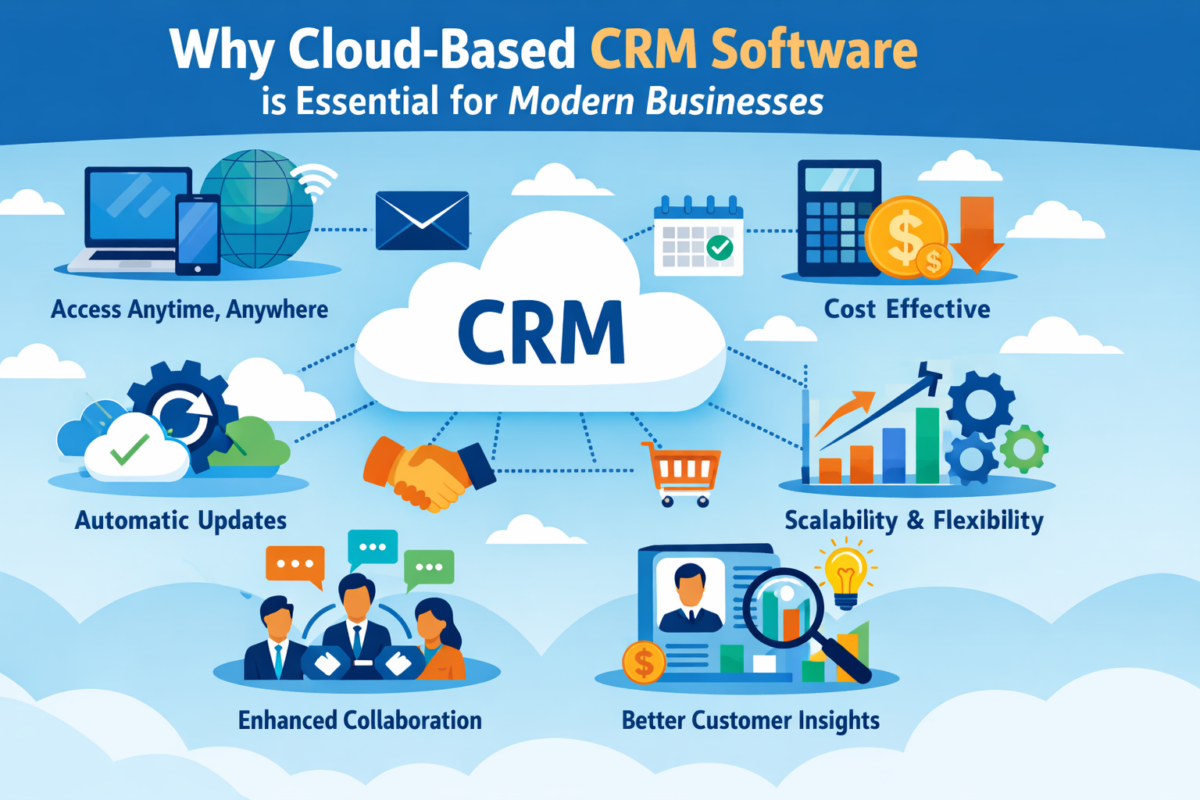
Why Cloud-Based CRM Software is Essential for Modern Businesses

Organizations are now experiencing a significant digital evolution. From the way they communicate to the way they sell, everything is getting faster, smarter, and more customer-focused. This change in times has forced companies to adopt more efficient systems for aspects of business, such as customer relationship management tools, in order to stay in the market and retain customers.

That’s where cloud-based CRM software really shines. It enables companies to organize their customer interaction, sales, and help lists from a single place. Many organizations are ditching antiquated systems and turning to modern CRM systems tailored to today’s digital landscape.

What is Cloud-Based CRM Software?

Cloud-based CRM software is a type of customer relationship management software in which data is stored on cloud servers and can be accessed by businesses at any time, from anywhere. It’s not like the old days, when you needed to have a bunch of hardware and do manual maintenance.

Cloud CRM vs On-Premise CRM

Feature On-Premise CRM Cloud CRM
Installation Local servers Online/cloud
Cost High upfront Subscription-based
Accessibility Limited Anywhere access
Updates Manual Automatic
Scalability Limited Highly scalable

Cloud CRM is a powerful component of business management software that enables teams to work cohesively and make informed, collaborative decisions using real-time insights.

Important Features of the Recent CRM System

Today’s modern CRM systems are more than an address book or a contact list.

Key features:

  • Centralized Data Management: All customer data in one accessible database
  • Automation: Sales, marketing, and support procedures are automated
  • Insights in real time: You have access to data and analytics en vivo
  • Integrations: Integrates with your e-mail, marketing, (finance), and more
  • Customization: Businesses can tailor features through custom CRM software

All of these capabilities enable CRM to be an extremely effective tool for increasing productivity and customer satisfaction.

Benefits of Cloud CRM

The advantages of cloud CRM have been among the driving factors behind the solution’s rapid adoption.

Key Benefits:

  • Cost-Effective: No costly infrastructure installation.
  • Remote Accessibility: Work as a team, from anywhere! Work as a team, from anywhere!
  • Scalable: Scales up with your business.
  • Data Security: Advanced security and frequent updates.
  • Team Collaboration: Work from a single data set.

Industry reports state that more than 70% of companies now lean towards cloud solutions due to their flexibility and cost benefits. These cloud CRM benefits also make it a good choice for both small and large companies.

How Cloud CRM Improves Customer Relationships?

Understanding why and how cloud CRM improves customer relationships is what will help you  recognize its importance.

What You Can Do:

  • Customized Interactions: Communication tailored to the customer’s information.
  • Faster Responses: You have your customers’ history at your fingertips.
  • Customer Journey Tracking: Track each interaction at every touchpoint.
  • Improved Communication: Alignment across teams.
  • Data-Driven Engagement: Insights-driven improvements.

Companies that focus on how cloud CRM improves customer relationships often have higher retention and satisfaction rates.

The Importance of CRM in Growing Your Business

The role of CRM in business growth is significant and measurable.

Growth Drivers:

  • Sales pipelines that are more efficient.
  • More efficient campaigns.
  • An increase in customer retention.
  • The business owner can better forecast and plan.

Decision-making based on data. Research indicates that companies that implement CRM systems can experience a sales productivity increase of up to 34 percent. So the impact of CRM on business growth is clearly more than operational; it affects your bottom line.

Benefits of Custom CRM Software

Each business is different, so custom CRM software development is more applicable.

What Is Means:

With custom CRM software, companies can build the features they need to reflect their own workflow, tailored to their industry needs and objectives.

Advantages:

  • Custom processes
  • Greater efficiency
  • Higher user adoption

Industries That Profit:

  • Healthcare
  • Real estate
  • E-commerce
  • Financial services

Customized solutions like WeekMate offer a much more tailored experience, with greater flexibility and long-term value, compared to generic CRM software for businesses.

Selecting the Right CRM Software for Businesses

Selecting the right CRM software for businesses requires careful planning.

Things to Consider:

Factor What to Look For
Business Size Scalable solutions
Budget Clear ROI and pricing
Features Automation, analytics, integrations
Ease of Use Simple interface
Support Reliable vendor assistance

Selecting the ideal CRM software for your business that matches your long term vision and functionality requirements is crucial.

The Next Wave of Cloud CRM

Cloud CRM is evolving fast.

Growing Trends:

  • AI-powered automation
  • Predictive analytics
  • Mobile-first platforms
  • IoT & Advanced Tools Integration

By 2026, intelligent CRM platforms will be the foundation of more than 80% of businesses. This underlines the increasing role modern CRM systems play in securing business growth.

Summary

In the current, fast digital world, adopting cloud-based CRM software is no longer acceptable, but a necessity. It allows the company to efficiently engage with its customers, streamlining its processes and enabling informed decision-making. That contributes to everything from better collaboration to personalization, and CRM is about success over the long term. Businesses that implement modern CRM systems such as WeekMate and embrace the flexibility of custom CRM software are positioned to grow, evolve, and stay ahead of the competition.

FAQs

1. What is a cloud CRM?

It serves as a platform that stores customer information in the cloud and enables companies to access and manage that data from any location. It also provides automation, scalability, and real-time data to support smarter decisions.

2. How can a CRM grow my business?

CRM streamlines the sales, marketing, and customer service processes. CRM is very important for business growth, as it helps the company make more money and work more efficiently.

3. What are the benefits of cloud CRM?

The benefits of using cloud CRM include cost reduction, accessibility from anywhere, scalability, and ease of collaboration among team members. It also provides data protection and automatic updates.

4. How does cloud CRM endear customers to a business?

Understanding how cloud CRM improves customer relationships shows how it enables personalized communication, faster responses, and better tracking of customer interactions across channels.

5. What is a custom CRM solution?

Custom CRM software solutions are designed and developed to meet unique business needs and processes. It offers greater flexibility and efficiency than off-the-shelf CRM products.

6. How do I select the best CRM software for my company?

Businesses should evaluate features, pricing, scalability, and ease of use. The right CRM software for businesses should align with company goals and support future growth.

7. Can you use CRM as business management software?

Yes, CRM plays an integral role in business management software, as it allows you to organize customer information, sales, and communications in one easy-to-use system.
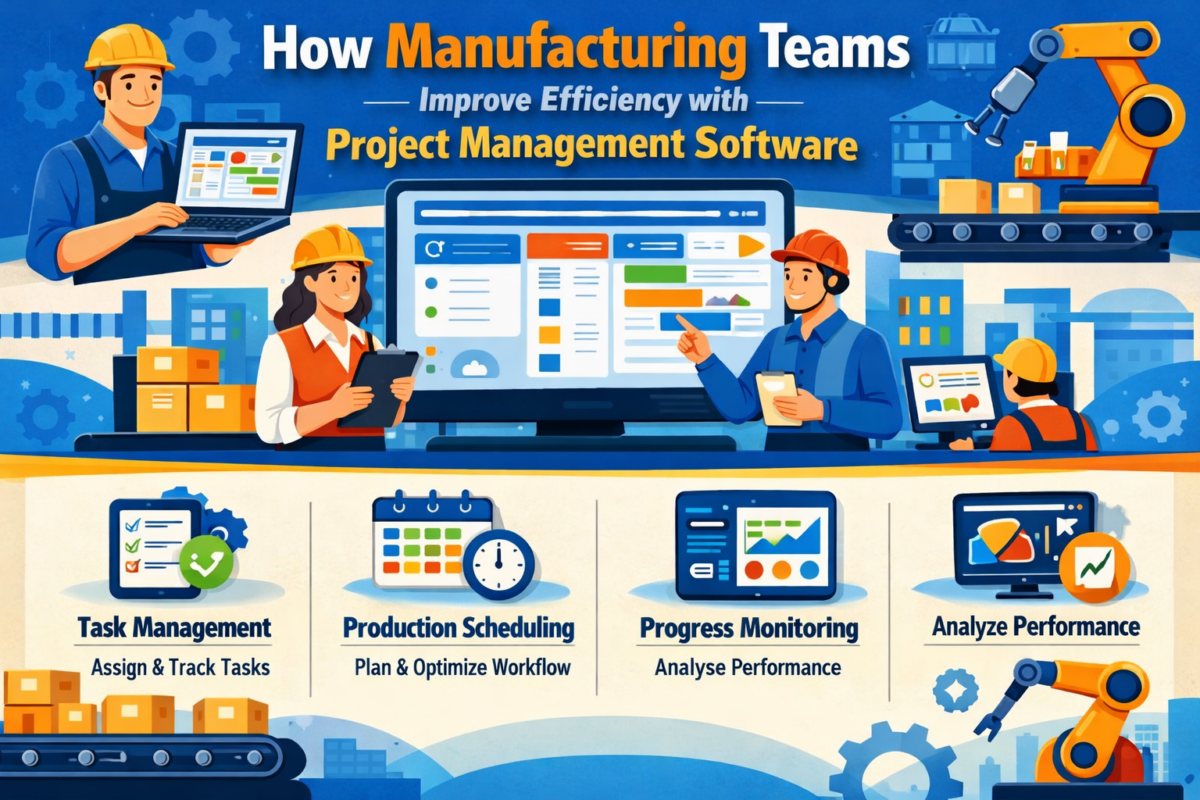
How Manufacturing Teams Improve Efficiency with Project Management Software

Manufacturing is now faster, more complex, and more data-driven than ever before. Teams are to manage a production schedule, work across departments, and maintain a consistent level of quality, all while controlling expenses. That’s the role of project management software.

For the modern manufacturer, achieving manufacturing efficiency improvement means more than the machines; it means better coordination, visibility and planning. Thanks to modern business tools, companies can automate workflows, prevent delays, and enable better team collaboration.

And by enabling manufacturing workflow optimization and better task management for manufacturing teams, digital tools are driving the factory to work smarter, not harder.

What is Project Management Software in Manufacturing?

In a manufacturing environment, project management software helps you to plan, monitor, and control production work and workflows associated with production schedules. It enables groups to plan workflows, delegate duties, and track progress in real time.

Key activities include:

  • Allocation and tracking of tasks.
  • Production scheduling.
  • Resource planning.
  • Workflow coordination.

Unlike traditional manufacturing project management software like spreadsheets and paper-based manual tracking, contemporary manufacturing project management software brings automation to your processes and real-time visibility. This transition from manual to digital is critical to boosting efficiency and eliminating operational bottlenecks.

Why Manufacturing Teams Need Project Management Software?

Manufacturing products is becoming more complicated. Keeping track of multiple production lines, teams, and deadlines manually can lead to delays, errors, and inefficiencies.

Here’s why businesses are adopting project management software:

  • Increasing operational complexity.
  • Need for real-time coordination.
  • Increased necessity for faster production cycles.
  • Improved control over manufacturing operations.

As businesses grow, they need to be able to scale with control and consistent results, which is why tools like production planning software and project management software for production teams are necessary.

How Project Management Software Increases Efficiency

One of the largest benefits of project management software is automation. It eliminates the need for manual monitoring and redundant administrative work.

Here’s how it drives manufacturing efficiency improvement:

  • Automates task assignments and updates
  • Speeds up production planning
  • Better team communication
  • Reduces reliance on manual processes

Manufacturing workflow optimization allows teams to quickly identify bottlenecks and take corrective action. This leads to smoother operations and more effective resource utilization.

Accuracy Through Digital Workflows

Manufacturing requires precision. Small mistakes can cause delays, waste, or quality problems.

With task management for manufacturing teams, you can:

  • Reduce human errors
  • Accurate scheduling and tracking of work
  • Consistent quality in production

With more sophisticated tools, such as real-time production tracking tools, teams can track progress on the fly. This way, it promotes good habits and makes sure the work is done.

Features You Should Look For That Can Help Your Business Run Better

Time and Task Tracking

Accurately tracking tasks and events is necessary for running smoothly. Built-in systems also help track progress and verify the completion of deadlines and commitments.

Production Planning

With the help of production planning software, tasks can be prioritized effectively and team members assigned wisely. This improves productivity by minimizing downtimes.

Workflow Automation

Automation eases the monotony of repetitive tasks and ensures uniformity in processes. This is an important aspect of manufacturing workflow optimization.

Reporting & Analytics

With data-driven insights, managers are able to make informed decisions. Reports expose running inefficiencies and potential areas for improvement.

Benefits of Project Management Software for Manufacturing

The following are the benefits of using project management software:

  • Time efficiency benefits due to automation.
  • Decreases in overhead.
  • Better teamwork.
  • Better visibility into manufacturing operations.
  • Enables scalability for organizational growth.

They also enhance manufacturing efficiency improvement by means of each particular process with process harmonization and process optimization.

Result in Reality: Before and After Application

Aspect

Without Software

With Project Management Software

Task Tracking

Manual and error-prone Automated and accurate

Communication

Disconnected teams Centralized collaboration

Production Planning

Reactive approach Proactive scheduling

Visibility

Limited Real-time insights

Efficiency

Inconsistent Improved and measurable

This contrast clearly demonstrates how streamlining a manufacturing workflow can be made simple with the help of tools.

Integration With Other Manufacturing Tools

Current manufacturing project management software will automatically integrate with other solutions, such as:

  • ERP platforms
  • Inventory management tools
  • Workforce management systems

This integration facilitates coordination and helps with task management for manufacturing teams by allowing them to work with a comprehensive view of their operations. For example, integrating with real-time production-tracking tools enables managers to monitor progress and adjust plans in real time.

Common Mistakes to Avoid

While implementing project management software, businesses should avoid:

  • Teams not properly trained
  • Bad data migration from legacy systems.
  • Selecting a software that doesn’t quite meet the business requirements.
  • Overlooking integration options.

To sum up the advice from all these experts: Avoiding these missteps sets the stage for a much smoother rollout and better outcomes.

The Future of Manufacturing Efficiency

The future of manufacturing is in automation and data-driven decision-making.

Important trends are:

  • AI-driven production planning
  • Remote access via cloud-based systems
  • Predictive power with advanced analytics

Smarter project tracking software for production teams:

These discoveries will bring a new level to manufacturing efficiency improvement and the profitability of the business.

To learn more about how to make workforce and task management even more productive, you can also check out this excellent guide on BPO Operations management from Weekmate. It offers tips on how to effectively lead teams, which are directly applicable to task management in manufacturing teams.

Summary

In an era of fierce competition, manufacturers cannot rely on traditional machines for speed; they need smarter systems. Project management software allows you to simplify processes, foster teamwork, and eliminate roadblocks.

By facilitating manufacturing workflow optimization and enhancing task management for manufacturing teams, they enable businesses to run more efficiently.

From planning through to real-time monitoring, the advantages are evident. Choosing the right solution to invest in is no longer a nice-to-have. It is a must-have for success and growth in contemporary manufacturing.

FAQs

1. What is the best project management software for manufacturing?

It is a digital platform for scheduling, organizing, and tracking production jobs and workflows. It enables teams to assign responsibilities, track progress, and manage deadlines from within a single system. This leads to more communication between departments and less manual work.

2. How does it increase production efficiency?

It promotes manufacturing efficiency by automating repetitive tasks and providing real-time visibility into operations. Teams can immediately see where the delays are, address bottlenecks, and streamline processes. This results in quicker production runs and improved resource utilization.

3. Can a small manufacturing company use these tools?

Some project management software solutions are designed to be scalable and affordable for small businesses and SMBs. They help smaller groups keep track of things, become more productive, and compete on an even playing field. Even simple options can make a significant impact on daily workflow.

4. Would it be complex to deploy?

With the right approach ahead of time, team training, subsequent rollout, and implementation can be a pretty smooth ride. Most contemporary software provides intuitive visuals and onboarding assistance. With the system in place, companies can quickly realize efficiency gains.

5. Does it connect with other systems?

Yes, the majority of manufacturing project management software can be integrated with other software suites, including ERP, inventory management, workforce management, and more. This enables a seamless workflow and eliminates the barrier of scattered data. Integrations allow teams to have up-to-date information at their fingertips without having to toggle between tools.

6. What role does real-time monitoring play?

Real-time production monitoring software enables production managers to track progress in real time. This leads to rapid decision-making, scheduling adjustments, and delay prevention. It also increases responsibility and guarantees production remains steady.

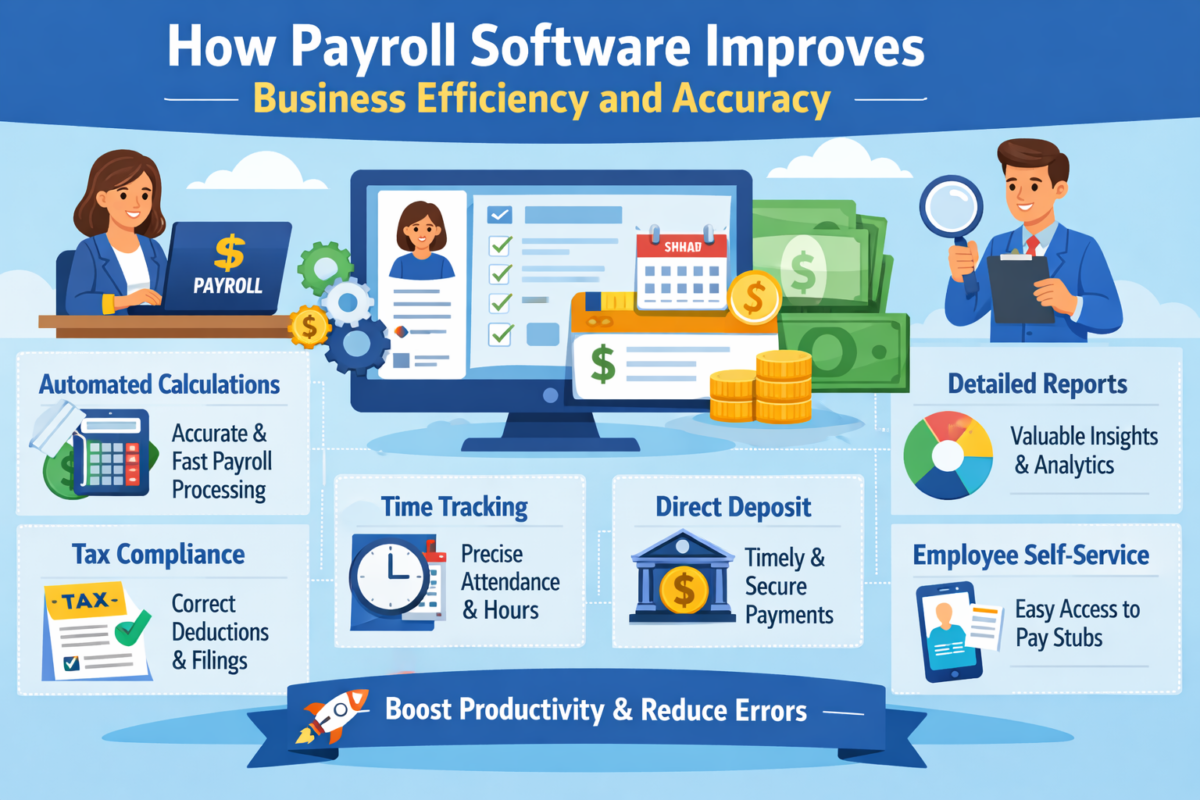
How Payroll Software Improves Business Efficiency and Accuracy?

There are times in your company when you feel like payroll will be easy, and then there are times when it’s not. As businesses scale, tracking employee salaries, taxes, compliance, and records of employment can become more difficult. Even a small mistake can result in an unhappy workforce, fines for noncompliance, or financial loss.

That is why the need to be precise and efficient in payroll processing is more important than ever. This is where payroll management software comes in. It helps companies simplify procedures, minimize mistakes, and save time.

For SMEs and startups, choosing the best payroll management software in India can be truly transformative. Payroll systems, when integrated with workforce management software and supported by business efficiency software, make the heart of an organization a robust, intelligent machine that enables you to operate smarter and make smarter decisions.

What is Payroll Management Software?

Payroll management software is an automation tool used to handle all the activities related to payroll of a company. It eliminates spreadsheet work and manual calculations by introducing well-organized, automated workflows.

Core Functions:

  • Employee salary management, such as wages, bonuses, and deductions
  • Tax computations and filings are automated.
  • Statutory compliance management
  • Generation of payslips and reporting

Where manual payroll and automated payroll systems differ most is in speed and accuracy. While manual processes are slow and prone to errors, software applications ensure consistency and accuracy.

To understand how payroll software improves efficiency, you first need to recognize how it frees you from performing menial tasks and from making complex computations.

The Importance of Payroll Software for Businesses

Payroll has become far more complex than it used to be. Companies have to deal with various pay scales and tax laws, and the list keeps growing.

Compounding the complexity for companies doing business in India is the need to comply with PF, ESI, and TDS regulations. This is why many organisations are turning to the best payroll management software in India to stay compliant and efficient.

As teams double and triple in size, manual systems don’t scale. A good payroll system for SMEs is essential for businesses to grow without increasing the admin burden.

How is Efficiency Increased in Payroll through Software?

Automation is recognised as one of the major benefits of payroll management software. Things that used to take hours, such as calculating salaries, deducting taxes, and generating reports, are now done in minutes.

Here’s how payroll software improves efficiency:

  • Automates repetitive payroll tasks.
  • Less reliance on manual calculations.
  • Accelerates the pace of payroll processing.
  • It works well with workforce management software.

When used in conjunction with business efficiency software, the entire organization will have a better experience, as payroll systems also improve workflow.

Improving Accuracy through Payroll Automation

Precision is very important in payroll. Even the smallest of mistakes can cause compliance problems and employee disgruntlement.

Such companies can utilize automation to solve the problem of workforce management by:

  • Human error is significantly reduced. 
  • Automatically calculate taxes and deductions.
  • Performing real-time validation of data.
  • Offering audit trails for transparency.

Many organizations wonder how to minimize payroll errors with software, and the answer is automation. By removing manual intervention, companies can ensure consistent and accurate payroll processing.

Essential Elements for An Effective Organization

Time and Attendance Monitoring

Embedded time and attendance tracking offers true payroll calculations. Whether it is a biometric system or any other digital hardware, this feature allows for the capture of work hours, overtime, and leave information in real time.

Managing Employees’ Income

Efficient employee salary management ensures timely and accurate payments. plays a vital role in timely payments. Through simple automation of many of the repetitive tasks, a finger can be saved from the payroll slip generation to the bonus calculations.

Management of Compliance

Regulations are hard to keep up with. Today, payroll processing software includes built-in monitoring features  that ensure compliance rules are updated in a timely manner, enabling companies to keep pace with changes in the law.

Reports and Analytics

Payroll reports provide valuable insights into costs and workforce trends. This is where business efficiency software plays a big role in turning raw data into actionable insights.

Benefits of Payroll Automation for Businesses

The benefits of payroll automation for businesses extend beyond convenience:

  • Huge time savings.
  • Save operational costs.
  • Increased employee satisfaction.
  • Better security of data.
  • More scalability.

Automation enables companies to focus on growth rather than  administrative duties.

Small Business Payroll System: Why It’s Important?

The reality is that small- to medium-sized businesses are busy with less to go around. You can’t keep track of everything in your head and on paper at the same time.

A solid payroll system for SMEs will have:

  • Cost-effective and flexible solutions.
  • Simplified HR processes.
  • Added accuracy and compliance.
  • Competitive advantage in workforce management.

To sum up, purchasing the best payroll management software in India is the best way to go if you are an SME/SMB and want to set your company up for success.

How to Select the Best Payroll Software in India?

Making the right software choice is vital to long-term success. Here is a brief checklist:

Feature Why It Matters
Ease of Use Ensures quick adoption by teams
Compliance Features Keeps business legally compliant
Integration Works with Workforce management software
Customer Support Resolves issues quickly
Scalability Supports business growth

The advantages of selecting the best payroll software in India are that it helps you work efficiently and accurately, and you get long-term value from it.

For more information, please visit this useful resource on payroll management.

Integration with Workforce Management Software

Workforce management software payroll integration brings collaboration to the HR processes.

Here are the advantages:

  • Consolidated employee information
  • Increased efficiency
  • More effective workforce planning

This integration enhances the overall impact of business efficiency software by providing end-to-end solutions that seamlessly align with payroll best practices.

Mistakes to Avoid in Executing Payroll Software

You can have the best systems, and they can still be undermined by poor execution. Don’t make these mistakes:

  • Not training enough
  • Inadequate data migration
  • Not attending to the required updates on compliance
  • Purchasing the wrong software

Understanding how to reduce payroll errors using software also involves avoiding these pitfalls during implementation.

Future of Payroll Systems

Rapid advancements are being made in payroll technology. Here are some of the major ones:

  • AI-driven automation
  • Payroll systems on the cloud
  • Real-time payroll processing

These innovations will further enhance employee salary management and improve business efficiency.

Summary

Payroll has evolved from being purely an administrative task to a business essential. Accuracy and efficiency directly impact employees and their performance.

By implementing payroll management software, organizations can simplify processes, reduce errors, and enhance compliance. Along with workforce management software and business efficiency software, payroll is a powerful tool for development.

Investing in the best payroll management software in India, such as WeekMate, ensures long-term success and helps businesses stay competitive in an increasingly complex environment.

FAQs

1. What is payroll management software?

This includes salary processing, tax calculations, challan submission and other compliance related to salary. It replaces manual processes, enabling faster, more accurate, and better payroll management.

2. How does payroll software contribute to efficiency?

It eliminates the need to manually run repetitive processes, such as calculations and reporting. This is how payroll software can make an organization more efficient by saving time and increasing overall productivity.

3. Why should businesses automate their payroll?

Benefits of payroll automation for business include reduced errors, faster processing, and better compliance. It also enhances employee satisfaction by paying them on time.

4. What is the SME payroll system?

A SME payroll system is tailored to the needs of a small business. It provides cost-effective, scalable solutions to streamline HR and payroll processes.

5. How to minimize payroll errors with software?

By automating calculations, validating data in real time, and maintaining audit trails, companies can avoid manual errors in payroll. This guarantees that payroll is run consistently and accurately.

6. Can payroll software be integrated with other systems?

Yes, the majority of today’s payroll solutions are integrated with HR and workforce management software. With this, you gain a smooth process flow and improved data integrity.

7. What are some benefits of automated payroll for companies?

Among the many advantages of automating payroll for business are time savings, reduced costs, enhanced data security, and scalability. It enables organizations to bring in more business rather than deal with paperwork.

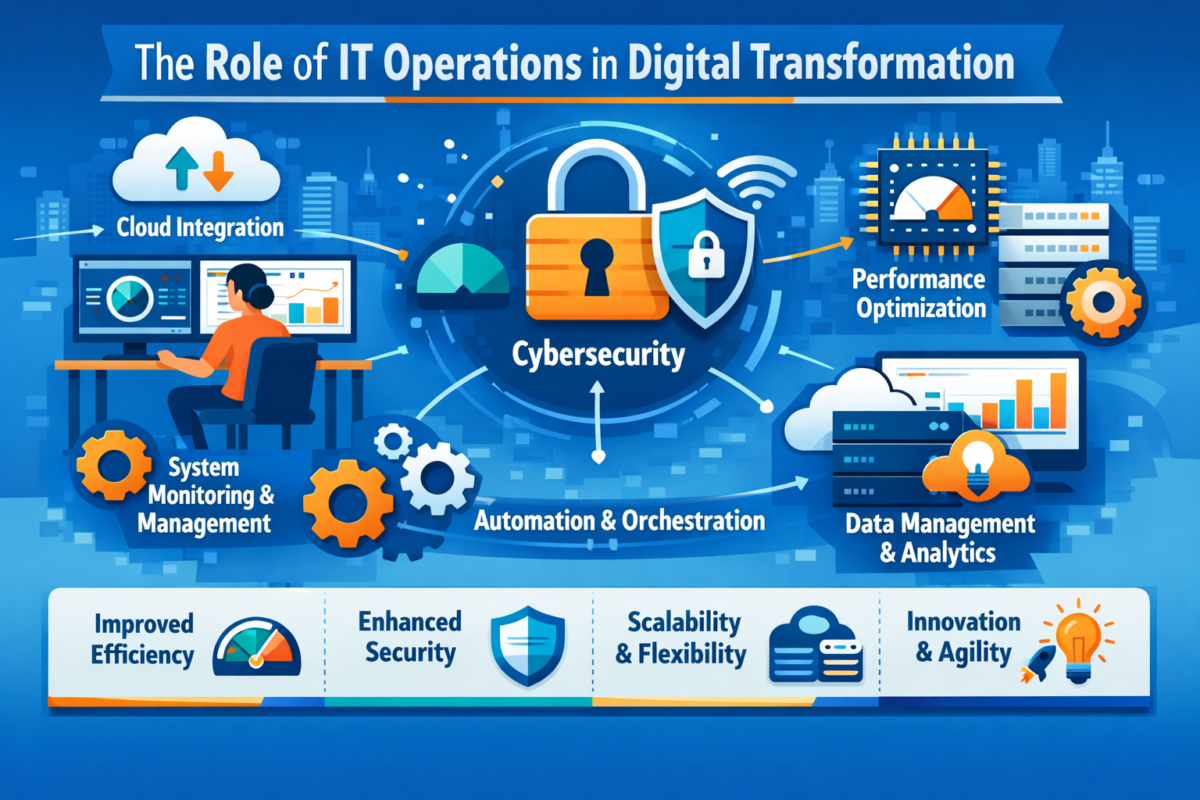
The Role of IT Operations in Digital Transformation

Going digital is not a future objective. Businesses must be working towards it now in order to be competitive, responsive, and customer-focused. Whether it is cloud computing or AI-enhanced decision-making, the most successful business ventures are reassessing their business models, value delivery, and innovation. At the core of this transformation lies a crucial yet rarely noticed process: IT Operations Management.

Policies and tools take the headlines, yet it is IT operations that help these strategies to work in production environments. They guarantee the reliability, scalability, and agility required to provide transformation across all levels. As organizations increasingly depend on digital platforms, demand for automated, sustainable, and scalable IT ecosystems is growing.

In this context, IT Operations Management is not just a support function; it is a strategic enabler of successful digital transformation.

What is Digital Transformation in Enterprise?

Enterprise Digital Transformation is the application of digital technology to all areas of an enterprise, fundamentally changing how you operate and deliver value to customers. It has stretched from basic digitization to comprehensive transformation, touching on culture, processes, and technology.

Key Drivers of Transformation

  1. Cloud adoption: Enterprises are shifting toward hybrid and multicloud environments to enhance flexibility and scalability.
  2. Data-Driven Decisions: Live analytics inform strategic decisions.
  3. Customer Experience Needs: Personalized, frictionless digital experiences have become the norm.
  4. Competitive innovation: You need rapid innovation cycles to stay ahead in the market.

According to a recent report, more than 70% of organizations have accelerated their digital agendas since 2023, highlighting the pressure to transform.

Technology teams not only contribute to business outcomes, but this has become the dominant driver of business outcomes, positioning IT operations as a critical enabler of transformation.

What is IT Operations Management?

IT Operations Management is the discipline responsible for managing an organization’s IT infrastructure. It is ensuring systems operate efficiently, securely, and consistently.

Core Components

  • Infrastructure Monitoring: Servers, databases, and applications are monitored continuously
  • Network Management: Delivering consistent connectivity and performance
  • Incident Response: Detecting and remediating threats rapidly
  • Performance Optimization: Speed, reliability and efficiency of the systems

Relationship with IT Service Management

In contrast to IT Service Management, which focuses on providing IT services to users, IT operations ensures the back-end systems that run these services are up and running. They combine to form an integrated structure that enhances user experience and system deliverability.

Why IT Operations is So Important in Your Digital Transformation Strategy?

A successful digital transformation strategy depends heavily on the efficiency and reliability of IT operations. 

  • Alignment with Business Goals: IT operations straddle balancing between business goals and how to technical execution
  • Guaranteeing Availability: Digital services need to be up around the clock to satisfy users
  • Enabling Innovation: Stable infrastructure gives teams the freedom to test and innovate
  • Accelerated Deployment Cycles: Efficient operations facilitate faster deployment of new features and services

Without strong IT operations, even the most ambitious transformation strategies fail to deliver results.

Desirable Features Of Modern IT Operations

Automation and Intelligent Monitoring

It is integral to IT operations automation that organizations adopt a different approach to managing their IT environments. By eliminating manual handling, the automated process also enhances productivity.

  • With AI monitoring, anomalies are detected before they become a problem
  • Predictive maintenance reduces downtime
  • Automated workflows decrease response time

Infrastructure As a Scalable Service

A growing company needs an infrastructure that can grow with it.

  • Hybrid and multi-cloud operations provide flexibility
  • Automation in IT Infrastructure delivers uniformity in separate environments

Security and Compliance

The expansion of digital ecosystems is bringing increased security risks.

  • Protection of digital assets is paramount
  • Governance models enforce adherence to industry standards

Benefits of IT Operations in Modern Businesses

The benefits of IT operations in modern businesses go far beyond just efficiency in technology.

Benefit Impact on Business
Improved Efficiency Streamlined workflows and reduced manual effort
Reduced Downtime Higher system availability and reliability
Faster Delivery Quicker product and service launches
Better Customer Experience Seamless digital interactions
Cost Optimization Lower operational and maintenance costs

How Automation is Transforming IT Operations?

There has been a dramatic increase in the importance of Automation in IT Infrastructure in recent times.

  • Self-Healing Systems: Automatically identify and fix problems
  • Automated Incident Management: Faster response and resolution
  • Less manual work: teams can specialize in strategic work
  • Continuous Operations: Run systems without interruption

Recent industry data shows that organizations that utilize automation in IT operations have achieved up to a 30 percent cost reduction and incident resolution times that are 40 percent faster.

IT Operations as a Source of Technology-Driven Innovation

Technology-driven innovation flourishes when IT operations are high-quality and responsive to the business’s needs.

  • It’s compatible with DevOps and agile methodologies
  • Shortens product development cycles
  • Experiments without risk can be undertaken
  • Uses data and analytics to get insights

By striking a balance between stable and flexible systems, IT operations enable high-functioning teams to innovate with confidence.

Implementing an Efficient Digital Transformation Strategy

To construct a winning Digital Transformation Strategy, businesses must execute a series of actions:

Evaluate IT Maturity

Know your current infrastructure and capability.

Upgrade Legacy Systems

Swap existing systems for more scalable alternatives.

Take an Automation-First Approach

Embed IT Operations Automation in the core business processes.

Map IT to Business KPIs

Be sure IT priorities are aligned with business needs.

Invest in Tools and Expertise

Pick platforms that allow for growth and scalability.

Take WeekMate’s tools for business owners seeking simplified workforce and operations management, for example. A useful resource is in this guide on workforce and operations efficiency.

Selecting The Right IT Operations Partner Or Solutions

Choosing an IT operations platform or partner is key.

What to Look For:

  • Grow to scale with.
  • Powerful automation features.
  • Built-in security.
  • Easily integrate with your systems.

A provider of IT Operations Management services can also enable organizations to focus on core business matters while still meeting the need for operational efficiency.

Reasons Why Enterprises Are Spending on IT Operations Automation

The incentives for implementing IT Operations Automation are largely the positive impact it can have on a business:

  • Improved return on investment due to increased efficiency.
  • Lower costs as a result of less work.
  • Enhanced agility to make decisions more quickly.
  • Edge in fast-moving markets.

Automation isn’t just a nice-to-have anymore; it’s essential to scale success.

Trends Future IT Operations and Digital Transformation

Enterprise digital transformation will be influenced over the coming years by these emerging trends:

  • AIOps Adoption: Towards smarter IT operations leveraging AI.
  • Autonomous Infrastructure: Self-managing infrastructure.
  • Edge Computing Operations: Data Processing Near the Source.
  • Hyper Automation: the integration of several automation technologies.

The trends indicate that the need for advanced IT operations is rising.

Final Thoughts

IT functions have moved past being a back-end mechanism to an innovation growth engine. With a solid background in IT operations management, businesses can proceed with their digital transformation strategy with confidence, making it reliable, scalable, and efficient throughout.

As organizations continue to adapt to enterprise digital transformation, the importance of automation, resiliency, and intelligent infrastructure is more critical than ever. Companies that invest in strong IT operations not only enhance performance but also realize long-term competitive benefits.

Platforms such as WeekMate are crucial for meeting contemporary operational requirements, enabling organizations to streamline operations, improve productivity, and align IT initiatives with business performance. The right tools and strategies can make a difference in the fast-changing digital world.

FAQs

1. What is IT Operations Management?

IT Operations Management is the process of managing an organization’s IT infrastructure and services to ensure computer systems run smoothly, securely, and efficiently. It addresses performance, uptime, and reliability.

2. How do IT operations enable digital transformation?

IT operations serve as the enabler of digital transformation, but that foundation must be scalable, stable, and responsive. This means organizations can introduce new technologies and innovations without disrupting anything.

3. What is IT Operations Automation?

IT Operations Automation is the use of technology to automate recurring processes, including monitoring, incident response, and system updates. It offers greater efficiency at lower cost and fewer human errors.

4. Why is automation important in IT infrastructure?

Automation provides faster, more accurate, and more consistent IT processes. It enables continuous operations, faster issue resolution, and allows the team to concentrate on strategic initiatives.

5. What are the benefits of IT operations to modern businesses?

IT operations enhance productivity, decrease downtime and accelerate service delivery. They also have a positive impact on customer experience and business cost optimization.

6. How is IT Service Management different than IT operations?

IT Service Management concerns the provision of IT services to end-users, while IT operations concerns the day-to-day running of the infrastructure that supports those services.  They also collaborate for seamless performance.

7. What are the key trends that will drive IT operations into the future?

Leading trends are: AIOps, hyper automation, autonomous infrastructure, and edge computing. They are bringing greater intelligence, speed, and predictability to IT operations.

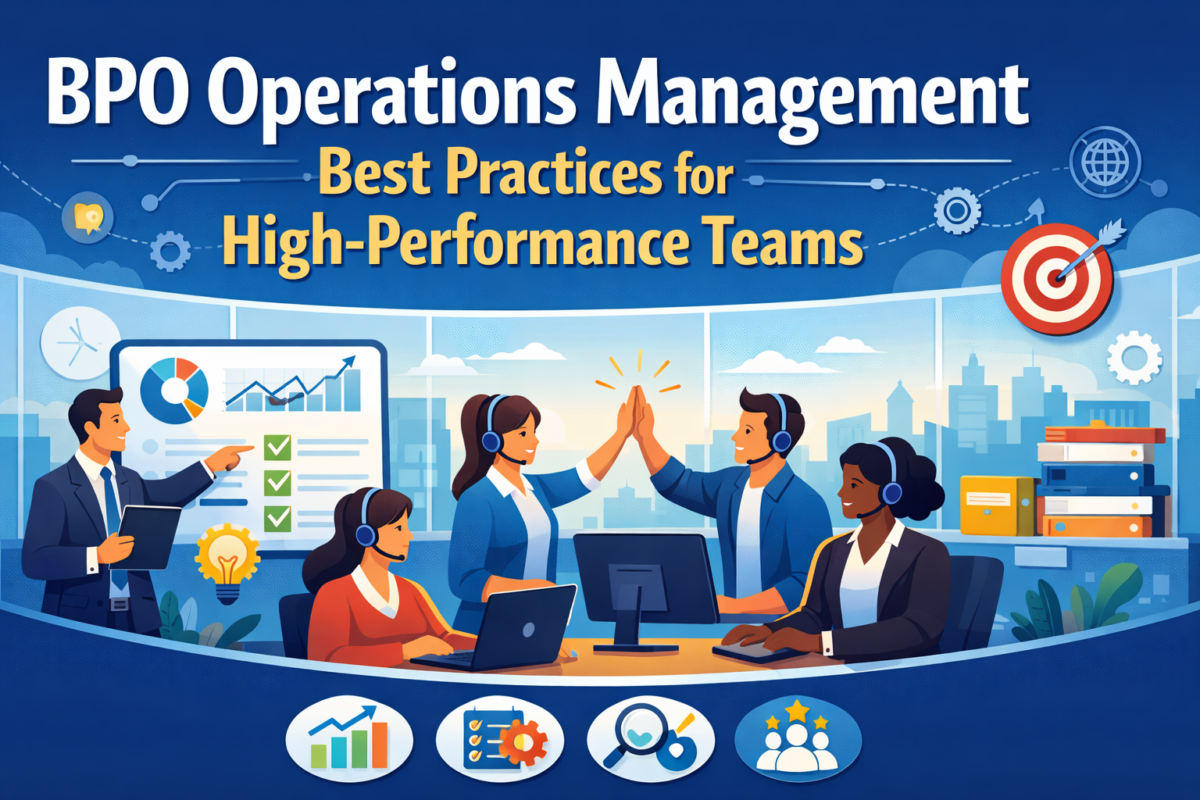
BPO Operations Management Best Practices for High-Performance Teams

In the era of instant everything, BPO operations management has evolved into a vital aspect for companies that want to scale effectively while preserving quality of service. The demand for organized workflows, strong leadership, and intelligent technology in business process outsourcing management is becoming apparent as businesses are more dependent on the model than ever.

The global outsourcing market is rapidly expanding. It is anticipated that the global BPO market will exceed $414 billion by 2027. Another survey states that 70 percent of companies outsource to reduce expenditures while improving efficiency. These figures demonstrate the growing importance of process optimization in outsourcing and in continual BPO performance improvement.

This blog post talks about a few proven, real-world tactics for hiring and building solid BPO teams that deliver measurable results and drive business growth.

Business Process Outsourcing Management Explained

Definition and Scope

Business process outsourcing management comprises of monitoring the outsourcing operations, delivering the agreed level of service, and ensuring business goals alignment through the output. It also covers everything from front-office activities, such as customer service, to back-office functions, such as payroll and data processing.

This happens because several elements need to be managed. Clients, vendors, team leaders, and workforce managers must be appropriately coordinated for BPO operations management to succeed.

Core Functions of BPO Operations 

BPO service delivery management is based on:

  • Workforce planning and forecasting
  • Quality control and compliance
  • Performance monitoring and reporting
  • Client communication and escalation handling

Effective KPI management in BPO operations enables performance to be quantifiable and in line with client expectations.

Challenges in Managing BPO Teams

Although it has benefits, business process outsourcing management is challenging:

  • Significant staff turnover
  • Consistency of quality control
  • Meeting global client expectations
  • Communication gaps across time zones

These challenges directly impact BPO performance improvement if not managed proactively.

Strengthening the BPO Operations Model

Strategic Planning

Successful BPO operations management starts with outsourcing objectives that support the entire organization’s goals. As demand increases, the model can be easily upscaled.

Process Standardization

Standardization is key to process optimization in outsourcing. This includes:

  • Clear documentation
  • Developing SOPs
  • Finding opportunities to automate

Tech Stack for the Modern BPO

A modern BPO model consists of the following:

  • CRM platforms
  • BPO workforce management solutions
  • Analytic performance results system

Such technology enables continuous BPO performance improvement.

BPO Workforce Management

Smart Hiring Practices

Good BPO workforce management starts with recruiting and hiring the right people for your team, based on skills, adaptability, and culture fit.

Training and Upskilling Program

Continuous learning is vital in BPO productivity strategies. Teaching along the way enhances the quality of service and makes your employees more confident.

Scheduling and Capacity Planning

Estimating workload and adjusting shifts accordingly are very important in BPO operations management. Planning poorly often leads to burnout or too little work.

Employee Engagement and Retention

Retention schemes such as fortunes, career progression, and recognition programs have been shown to impact BPO performance.

Process Optimization in Outsourcing

Current Processes Mapping

Process optimization in outsourcing begins with analyzing workflows and identifying inefficiencies through audits.

Automation and AI Integration

Automation is key to process optimization in outsourcing. Solutions such as chatbots, RPA, and intelligent routing systems improve accuracy & speed.

Lean and Six Sigma Application in BPO

Applying Lean principles eliminates waste and improves turnaround time, the two most significant factors in BPO performance improvement.

BPO Productivity Strategies

Data-Driven Decision Making

Strong BPO productivity strategies depend on real-time dashboards and analytics to support informed decision-making.

Smart Task Allocation

Skill-based routing also plays an important role in resource utilization and BPO service delivery management.

Performance Coaching

Ongoing constructive criticism and support of the supervisor are critical BPO productivity strategies that enhance the team’s production.

Remote and Hybrid Productivity

As more and more people work from home or remotely, there are many monitoring tools and communication frameworks to maintain stable BPO operations management standards.

KPI Management for BPO Engagements

Important Metrics to Monitor

Good KPI management in BPO operations at a minimum includes the monitoring of:

  • Average Handle Time (AHT) 
  • Customer Satisfaction (CSAT)
  • Fairest Call Resolution (FCR) 
  • SLA conformance

Building Effective KPI Frameworks

Aligning KPIs with business outcomes is crucial for meaningful KPI management in BPO operations. Avoid vanity metrics that don’t drive results.

Real-Time Performance Tracking

Dashboards and alerts enable early detection of risks, facilitating continuous improvement in BPO performance.

BPO Service Delivery Management

SLA Management

Transparent SLAs are the foundation of BPO service delivery management. They set expectations and provide accountability.

Communication With The Client

Consistent reporting and structured escalation matrices strengthen BPO service delivery management.

Quality Assurance Programs

Call monitoring, audits, and feedback loops are critical to upholding standards in BPO management.9. Tactics to enhance BPO performance

Benchmarking Against Industry Standards

Measure performance indicators such as AHT, CSAT, and SLA compliance against sector standards to pinpoint performance gaps and define value-driven enhancement objectives.

Culture of Continuous Improvement

Encourage continuous learning, consistent feedback, and process improvements to increase productivity without sacrificing service quality.

Predicting Problems with Analytics

Utilize data analytics and live reporting to anticipate bottlenecks and implement preventive measures.

Customer Feedback Implementation

Gather and review customer feedback to identify service weaknesses, improve processes, and enhance overall customer service.

What Not to Do in BPO Operations Management

  • Low-quality leading to erratic service quality.
  • Ambiguity in KPIs leads to misguided expectations.
  • Not paying attention to employee experience – higher attrition.
  • Old technology- slows down process optimization in outsourcing

Selecting the Right BPO Management Partner Or Tools

What to Look for in a BPO Provider?

  • Industry experience
  • Effective technology capabilities
  • Scalability for future growth

Questions to Ask Before Outsourcing

  • Is your data security compliant?
  • How do you report?
  • Do you offer performance guarantees?

Advantages of Experienced BPO Management Solutions

  • Lower operating costs.
  • Rapid scaling options.
  • Access to subject expertise.

A prime example of a well organized project management software solution it simplifies processes and holds team members accountable. For additional meaningful insights on workforce and operations optimization, check out the views and advice shared on this WeekMate’s blog.

Future Trends in BPO Operations

Management of BPO operations in the future will be virtualised and innovative:

  • AI-powered outsourcing models
  • Predictive BPO workforce management
  • Outcome-based pricing model
  • Hyper-automation of workflows

These emerging trends will shape the future of business process outsourcing management in a big way.

Final Words

Managing BPO operations effectively is no longer a choice; it is what will allow you to continue providing your services in a competitive environment. Whether it’s process improvement within outsourcing or BPO in talent, in everything an organisation does, it has to have everything working for it within a unit.

Companies that invest in technology, workforce planning, and strong governance models sustain BPO improvement. Services such as WeekMate have enabled the integration of workforce management, performance monitoring, and automation into a single platform, giving organizations greater control and increased scalability.

If you want to future-proof your outsourcing strategy, now is the time to assess and enhance your business process outsourcing management model.

FAQs

1. What is BPO process management?

It is the coordination of outsourced business activities to maintain cohesive execution, while remaining directly linked to services and non-core business objectives. It includes performance management, workforce planning, and quality management elements through well-defined processes.

2. How to Increase BPO Productivity?

It can be improved through automation, better workforce management, and data-driven KPIs. Periodic training and process reengineering also contribute significantly to efficiency.

3. Why is workforce management important in BPO?

Workforce management helps ensure the right number of agents are available at the right time. It improves productivity, reduces employee burnout, and maintains consistent service quality.

4. What are some of the BPO operational problems?

Common problems include a high turnover rate, communication breakdowns between teams, varying levels of service quality, and the absence of uniform processes. These problems might affect the overall results if they are not addressed in time.

5. What is the role of automation in BPO operations?

Automation reduces human errors and speeds up repetitive tasks such as ticket routing or reporting. This enables the team to focus more on the customer experience and strategic work.

6. Which KPIs are crucial in BPO operations?

The key KPIs include AHT (Average Handle Time), CSAT (Customer Satisfaction), FCR (First Call Resolution), and SLA compliance. These figures aid in monitoring the efficiency and quality of service.

7. How does WeekMate support BPO operations?

WeekMate simplifies workforce management, automates workflows, and delivers intelligent, real-time performance insights. It enables organizations to enhance collaboration, transparency, and productivity.

How Pharmacists Improve Patient Care in Modern Healthcare

The world’s healthcare systems are changing at a fast pace. With increasing numbers of patients, more sophisticated treatment plans, and more chronic illnesses, healthcare professionals must be more collaborative than ever. Physicians, nurses, technicians, and pharmacists are part of multilevel care teams committed to better patient outcomes.

In this changing landscape, the importance of pharmacists in healthcare has grown significantly. Pharmacists no longer simply dispense medications. They actively participate in patient care, including reviewing prescriptions, overseeing drug therapy, and providing drug information to patients and the general public.

In the meantime, healthcare providers are developing solutions to support the pharmacy function. Solutions like pharmacy management systems and HRMS / workforce management systems enable the hospital to manage its pharmacy employees, limit human mistakes in operational processes, and increase efficiency in work processes.

This article discusses the clinical pharmacist role in patient care and the evolving responsibilities of the pharmacist in healthcare system, and the impact of technology on the provision of pharmaceutical care services in today’s healthcare settings.

Significance of Pharmacists in Healthcare

The Expanding Role of a Pharmacist

A substantial change in the role of pharmacists has taken place in the past decades. Traditionally, pharmacists had a limited role in patient care and were mainly involved in the dispensation of medicines.

Now, pharmacists have a role in patient care and medication safety decisions. This change illustrates the increasing importance of pharmacists in healthcare sector, which is becoming more patient-centred.

Today’s pharmacists are responsible for:

  • Check the accuracy of the prescriptions
  • Evaluating drug effectiveness
  • Recommend doctors on drug interactions
  • Assist in treatment planning

With this increased role, pharmacists become crucial members of clinical teams in the pharmacists in healthcare system.

Pharmacists in the Healthcare System

In hospitals and clinics, pharmacists collaborate with physicians and nurses to promote safe and effective use of medications.

Their pharmacological knowledge enables them to identify potential risks in treatment plans before they are handed to patients.

Such coordination assists pharmacists to:

  • Enhance patients safety
  • Optimize treatment outcomes
  • Promote evidence-based medicine

Healthcare organizations are increasingly valuing pharmacists’ contributions to patient care in the clinical setting, underscoring their significance in contemporary healthcare delivery.

Accessibility of Pharmacists

Pharmacists are among the most readily available health-care providers. Community pharmacies are also the first port of call for many seeking medical advice on minor ailments or information on medicines.

This access empowers pharmacists to: 

  • Give rapid consultations on health matters
  • Supervise chronic diseases
  • Advice on preventive care

Together with these suggestive points, pharmacists in the healthcare system play an essential role in preventive medicine and patient education.

The Clinical Pharmacist Role in Patient Care

The clinical pharmacist role in patient care is to contribute to patient care by improving therapeutic outcomes via drug knowledge and a direct patient role.

Clinical pharmacists collaborate with physicians to ensure the drugs used are both necessary and effective.

Medication Therapy Management

Managing the drug therapy is a primary duty of clinical pharmacists. That includes: 

  • Evaluating prescriptions
  • Identifying drug interactions
  • Optimizing dose and therapeutic regimen

With pharmacist medication management, pharmacists ensure that the treatment is personalized to each patient’s illness and medical history.

They also record adverse effects and modify treatment plans.

Participation in Clinical Rounds

In hospital-based practice, it is common for pharmacists to round with physicians and nurses.

Pharmacists make evidence-based recommendations on medication use during these meetings.

Their advice could help physicians to:

  • Choose safer drug options
  • Modify the medication dosages
  • Avoid dangerous interactions

This partnership further promotes the clinical pharmacist role in patient care in the hospital setting.

Management of Chronic Diseases

Chronic diseases need to be continuously monitored, and medications altered.

Pharmacists advocate care in the long term for ailments like:

  • Diabetes
  • High blood pressure
  • Asthma

With continuous pharmacist medication management, pharmacists play a crucial role in ensuring that patients on treatment plans actually follow them and take medication as indicated.

Results: This proactive strategy leads to better overall patient health.

Role of  Pharmacists in Medication Management

Monitoring medications is one of the key duties pharmacists perform in healthcare.

Prevention of Medication Errors

Medication errors are a significant burden on the global healthcare system. WHO estimates that medication errors result in millions of preventable injuries annually.

Pharmacists help in reducing medication errors by:

  • Assess drug interactions
  • Confirm the dosage is right 
  • Evaluate patient records

E-prescribing systems also provide pharmacists with additional support in detecting potential risks before the patient begins medication.

Drug Reconciliation

Medication reconciliation is a review of a patient’s medications upon admission to the hospital or discharge.

This helps to prevent:

  • Redundant drugs
  • Working against each other
  • Incorrect drug pairings

Pharmacists have even taken the time to make sure the prescription is safe and consistent.

Individualized Drug Regimens for Patients

Every patient responds differently to medication. Pharmacists consider several factors when recommending treatment plans.

These include:

  • Patient’s medical history
  • Lifestyle habits
  • Underlying medical conditions

By tailoring treatments, pharmacist medication management improves treatment success and reduces side effects.

Pharmaceutical Care Services

In addition to dispensing medicines, pharmacists have been recognized as healthcare professionals able to offer a variety of pharmaceutical care services to enhance patients’ health outcomes .

Preventive Healthcare Services

Some pharmacies also offer desired preventive healthcare and wellness programs to keep the community healthy.

Examples include:

  • Vaccine services
  • Blood pressure checks
  • Cholesterol tests

These services enable the identification of potential health issues in their earliest stages.

Patient Education Programs

Information is a key element of quality care. Pharmacists regularly conduct programs that teach patients about:

  • How to take medicines safely and effectively
  • Prescribed medication’s possible side effects
  • Long-term treatment adherence

These educational efforts are a vital part of pharmaceutical care services.

Pharmacist Patient Counselling

Pharmacist-patient counselling is the best and most influential service a pharmacist can deliver.

The supervising pharmacist executes the following functions when counseling:

  • Discuss potential side effects
  • Provide lifestyle recommendations

This face-to-face communication contributes to the development of trust between the patient and the pharmacist and to higher patient medication adherence.

The Influence of Technology on Pharmacy Today

Technology has revolutionized the delivery of services in community pharmacies and hospital pharmacies, as well as patient care. Digital technology enables pharmacists to meet the challenge of managing complex workflows with the least risk of medication errors.

Pharmacy Software in Patient Care

Advanced pharmacy systems enable pharmacists to fill prescriptions and ensure patients are safe on their medications. Main features include:

  • Prescription tracking
  • Interaction alerts for drugs
  • Managing stocks

These tools support efficient pharmacy operations and enhance the clinical pharmacist role in patient care.

Pharmacy HRMS / Workforce Management

To ensure quality service, it is necessary to have a well-organized workforce in the pharmacy. HRMS / workforce management systems take care of the following processes in pharmacy operations:

  • Schedule staff effectively
  • Track productivity
  • Manage workloads

These interventions helped eliminate burnout and gave pharmacists more time to devote to patient care. Efficient HRMS/ workforce management solutions for healthcare provision, like WeekMate, also allow the best use of resources in managing pharmacy staffing.

Data-Driven Decisions in Healthcare

Insights related to medication trends and patient outcomes can be obtained using pharmacy analytics.

Healthcare providers may apply these insights to:

  • Improve treatment protocols
  • Identify bad drugs
  • Optimize pharmacy inventory

This data-driven approach strengthens the role of pharmacists in the healthcare system by enabling smarter clinical decisions.

For example, healthcare organizations increasingly adopt workforce tools similar to those discussed in this article.

The Value of Pharmacists in Healthcare Systems

The contributions of pharmaceutical professionals lead to real benefits across healthcare systems.

Benefit

Impact

Reduced hospital readmissions

Better medication management

Improved treatment adherence

Patients follow prescriptions correctly

Cost savings

Fewer medication-related complications

Better patient satisfaction

Increased trust in healthcare providers
Enhanced care coordination

Improved collaboration among medical teams

Studies show that hospitals with integrated pharmacy teams experience significantly better patient outcomes. This demonstrates the growing importance of pharmacists in healthcare within modern medical systems.

Why Healthcare Providers Need Advanced Pharmacy Solutions?

Healthcare providers should empower pharmacy teams with modern technology that maximizes efficiency and patient safety.

Challenges Without a Modern Pharmacy System

In the absence of digital pharmacy tools, organizations are likely to experience:

  • Medication errors
  • Workflow inefficiency
  • Restricted patient information access

These obstacles may have an adverse impact on the treatment outcome.

The Impact of Pharmacy Software on Patient Care

Modern pharmacy systems assist patient care through:

  • Automated prescription processing
  • Drug safety alerts
  • Consolidated patient records

Such systems enable pharmacists and other pharmacy staff to spend less time on administrative tasks and more time on clinical care.

Selecting The Appropriate Pharmacy Management System

Healthcare professionals need to consider several factors when choosing a pharmacy management system.

Noteworthy features are:

  • Integration with hospital systems
  • Prescription automation
  • Optimization of the workforce through HRMS/ workforce management tools

With the right system, pharmacists can provide high-quality patient care efficiently.

Future of Pharmacists in Healthcare

The role of pharmacists will continue to expand as healthcare evolves.

A number of new trends will affect the future of the pharmacy profession, including:

  • AI-based medication management systems
  • Telepharmacy services for remote consultations
  • Personalized medicine using genetic information
  • Increased clinical authority for pharmacists

These advancements will enhance the value and significance of the clinical pharmacist role in patient care and in the healthcare system around the world.

Summary

Pharmacists play a significant role in providing effective, safe patient care. Their influence extends far beyond the dispensing of drugs and includes medication therapy management, patient counselling, and preventive health services.

The increased importance of pharmacists in healthcare stems from the complexity of modern treatment regimens and the emergence of specialized skills in medication.

Healthcare institutions can use technology to empower pharmacists to be more efficient in their jobs, e.g., pharmacy software, HRMS/workforce management solutions. With the changing nature of healthcare delivery, strengthening the clinical pharmacist role in patient care will be essential for improving patient safety, treatment outcomes, and overall healthcare quality.

FAQs

1. What is the role of pharmacists in contemporary healthcare?

Pharmacists are important to hospitals because they play a vital role in medication management, patient counselling, and treatment optimization. They assist in the appropriate and safe use of drugs.

2. What is the role of a clinical pharmacist in patient care?

The clinical pharmacist’s role in patient care involves evaluating treatment regimens, monitoring drug interactions, and collaborating with medical professionals to achieve favorable patient outcomes.

3. How do pharmacists help to avoid medication errors?

Pharmacists can help prevent medication errors by performing a comprehensive review of the prescription, assessing potential drug interactions, and verifying the dose before the drug is administered.

4. What comprises pharmaceutical care services?

Pharmaceutical care services include, among others, medication therapy management, patient education initiatives, vaccination support, and health screenings.

5. What is pharmacist patient counseling?

Pharmacist patient counseling aims to educate patients on how to properly take their medication, the side effects they may experience, and any lifestyle modifications that can enhance treatment (if recommended by the physician).

6. How can workforce management improve the pharmacy operations?

Pharmacies can better manage their staffing with HRMS/workforce management solutions & monitor productivity, so they can spend more quality time on patient care.

7. How will technology shape the future of pharmacy?

Advancements in technology will improve the security of medication, allow continued practice via telepharmacy, and inform data-based decisions in specific treatment plans, offering the pharmacist an integral part in the delivery of care.

Top Accounting Challenges Businesses Face And How Software Solves Them

Every business owner knows this challenge. You’re at the end of the month, your invoices are stacking up, your expenses are scattered across emails and crumpled receipts stuffed in your drawers, payroll needs to go out tomorrow, and you’re still trying to figure out if you’ll have enough to pay your vendors next week. Accounting isn’t just “keeping books” it’s the nervous system of your company. When it’s messy, growth stalls. When it thrives, you make confident decisions and your business is presented with more opportunities.

In this age of rapid progress – particularly for Indian SMEs trying to navigate GST, TDS, PF contributions, multi-city operations, among many others – financial management challenges have become even more complex. Procedures that had been applied manually and were effective enough for a team of 10 become unmanageable for 50 or more. The good news? Modern accounting software is disrupting this whole equation, transforming hours of drudgery into minutes of clarity.

In this post, we examine the most persistent common accounting problems businesses encounter and show how accounting software solutions, such as the best accounting software for businesses can provide relief. We’ll keep it simple, practical, and focused on what really matters to growing companies.

Most Common Accounting Problems Businesses Face

1. Manual Data Entry and Human Errors

Spreadsheets are a forgiving environment until they’re not. A decimal place in the wrong location, a duplicated invoice, or a missed transaction can throw your whole P&L off. Bookkeeping becomes a weekly slog – distracting from sales, product development, or client work.

The effect? Financial statements are wrong, leading to bad decisions; tax returns are filed improperly; and audits become a headache.

Software Solution

Modern accounting software, such as WeekMate remove the need for most manual entry through bank feeds, intelligent categorization, and syncing from payment gateways. Errors are reduced significantly many systems surface inconsistencies instantly and reconciliation that took days is now completed in hours.

2. Poor Cash Flow Visibility

You know money is coming in… eventually. But with no visibility into receivables, payables, and future outflows, there are endless surprises: “We thought we had a buffer, but the vendor payment hit today.” Forecasting seems like guessing, and delayed reports mean reacting rather than planning.

Security Solution

Live dashboards deliver real-time financial insights, enabling users to see the cash position in real time. Automated aging reports identify past due invoices, and basic forecasting solutions forecast shortfalls weeks in advance. No more surprises at the end of the month.

3. Inefficient Invoice and Expense Management

The paper receipts fade, the digital ones get lost in your email inbox, and invoicing gets delayed because the templates are saved in Word. Delayed billing delays cash inflows; unmonitored expenses silently increase costs. Keeping track of reimbursements and billable expenses to clients turns into a madhouse.

Software Solution

Invoice and expense tracking software also handles invoicing creation, sending, reminders, and payment reconciliation. Mobile receipt scanning + OCR automatically categorizes spending. Everything ties to the general ledger, no double entry.

4. Payroll Problems

Calculation of salaries, OT, bonuses, deductions (TDS, PF, ESI, etc.), and processing variable pay is tedious and prone to errors. Even one misstep in calculation can lead to employee grievances, regulatory fines, or both.

The end-of-the-month crunch consumes full days.

Software Solution

Payroll accounting automation handles complex Indian statutory requirements, generates payslips, files returns, and keeps up with regulatory updates. Attendance data integration ensures accuracy with no manual uploads!

5. Compliance and Filing Tax Issues

Of course, GST rates change, TDS thresholds change, and compliance calendars are filling up. Manually monitoring is missing deadlines, resulting in interest, penalties, or notices. It’s panic time for audit season.

Software Solution

Inbuilt compliance engines calculate tax, generate GST filings, and send reminders for due dates. Audit trails and reports that they can export keep everything ready for an inspector.

For more on lax-free compliance, please see our related post on How SaaS Platforms Ensure Client Compliance.

How Modern Accounting Software Solves These Problems?

Financial Process Automation

Repetitive tasks data entry, like entering data, reconciling or chasing invoices are getting automated. This reduces manual work by 60-80% in the majority of cases, reduces mistakes to almost zero, and liberates both owners and accountants to analyse rather than transcribe.

Real-Time Financial Insights for Better Decisions

Live dashboards replace static monthly reports. Instantly track profitability by project, client, or product. Identify trends earlier, proactively adjust budgets, and make data-driven decisions on hiring, investment, and pricing.

Centralized Financial Management

The platform has everything-invoices, expenses, payroll, banking and reports. Collaboration is seamless securely share access with your CA or team members. Cloud access lets you view your finances from anywhere on any device.

Key Features of the Best Business Accounting Software

  • Powerful automation: Invoicing, payments, and reconciliations
  • An integrated invoice and expense tracking software with OCR and categorization.
  • Payroll accounting automation with Indian compliance (GST, TDS, PF, ESI)
  • Real-time financial information via personalized dashboards
  • Tax & compliance tools with auto-updates and filing assistance
  • Can scale with expanding teams and transaction volume

Here’s a quick comparison of manual vs. modern software approaches:

Challenge

Manual/Traditional Method

Modern Accounting Software Benefits

Data Entry & Errors

High manual input, frequent mistakes Automation + smart validation reduces errors by 90%+

Cash Flow Visibility

Delayed spreadsheets

Real-time financial insights and forecasting

Invoice & Expense Handling

Lost documents, slow billing

Automated workflows + mobile scanning

Payroll Processing

Tedious calculations, compliance risks

Payroll accounting automation with auto-filing

Compliance & Tax

Manual tracking, penalty exposure

Alerts, auto-calculations, audit-ready exports

Time Spent Monthly 40–80+ hours

Reduced to 5–15 hours

Choosing the Right Accounting Software for Your Business

Match the tool to your realities and not the other way around.

  • Company size: Very small startups have different requirements than mid-size companies.
  • Industry needs: Services businesses tend to focus on invoicing; retail or manufacturing companies may require inventory integrations.
  • Integrations: Link to your current banking, payment gateway, or HR solutions so nothing’s isolated.
  • Budget and scalability: Choose cloud-based plans that evolve with you no big up-front fees or forced upgrades.

Benefits Businesses Gain After Implementing Accounting Software

  • Sharply fewer errors and rework
  • Faster month-end closing and reporting
  • More informed, timely financial decisions
  • Increased compliance, fewer surprises
  • Scalable foundation for growth, whether you are adding more locations, employees, or revenue streams

The Bottom Line: From Financial Fears to Strategic Focus

Financial management challenges such as manual errors, cash flow blind spots, delayed invoicing, payroll headaches, and regulatory risks sap energy and restrict expansion. Accounting software solutions change the game by automating the slog, providing real-time financial insights, and serving as a single source of truth. The best business accounting software is not about fancy bells and whistles; it’s about giving you back time, certainty, and confidence so you can spend your days building your business, not managing your books.

WeekMate wins hands down here. With powerful yet easy tools like integrated invoice and expense tracking software, automated payroll accounting, and compliance-first design, WeekMate enables Indian businesses to bring order to financial chaos and scale sustainably. Growing SME or a multi-client manager? WeekMate makes accounting a business advantage, not a burden.

Ready to simplify your finances? Explore how WeekMate addresses your specific common accounting problems now.

FAQs

1. What is the greatest advantage of moving to modern accounting software?

It eliminates a significant portion of manual work, reduces errors, and provides instant visibility into cash flow and profitability, enabling quicker and smarter decisions. Automatic calculations, centralized financial data, and real-time reports all reduce reliance on spreadsheets. That allows business owners to keep their finances under control at any time and make decisions based on the real figures.

2. Is Indian GST & TDS integrated into the accounting software?

Yes, top platforms such as WeekMate automatically calculate GST, file GSTR returns, manage TDS deductions, and stay up to date with regulations via auto-updates. This minimizes the chances of compliance mistakes and late submissions. Companies can also run tax reports in seconds, which simplifies audits and financial evaluations.

3. How does payroll accounting automation benefit small businesses?

It computes salaries, deductions, overtime, and statutory contributions accurately, generates payslips, and files returns saving hours and reducing compliance risks every month. Automation also allows calculations to be consistent and error-free, and for documents to remain organized. HR and finance teams can now work on more strategic initiatives, rather than the monotony of payroll processing.

4. Is the best accounting software for businesses affordable for small businesses?

Yes to both. Cloud solutions offer competitive tiered pricing that grows with your business and is much lower than the cost of hiring a full-time bookkeeper. Solutions such as WeekMate make sophisticated financial management possible for young and small teams without requiring large upfront investments.

5. How soon can a company start seeing the impact of accounting software on its business?

The majority see cleaner books, faster invoicing, and more visibility into cash within the first 1–2 months, and significant time savings by the end of the third month. Workflows are streamlined as teams adapt to automation and reporting features, making financial tracking far simpler and more efficient.

6. Are real-time financial insights really helpful for non-financial owners?

Yes, simple dashboards show cash balance, overdue invoices, and profit trends in plain English, making it easy for owners to catch problems early without an accounting background. These insights enable business owners to monitor performance in real time and address issues before minor financial setbacks turn into more serious problems.

7. What sets WeekMate apart from other business finance management solutions?

WeekMate offers a perfect blend of simplicity and Indian statutory compliance, with payroll and expense management – all tailored for SMEs seeking maximum functionality without complexity. Its simple interface, combined with automation, makes it convenient for businesses to handle their finances, payroll, and compliance in one place rather than using several tools.

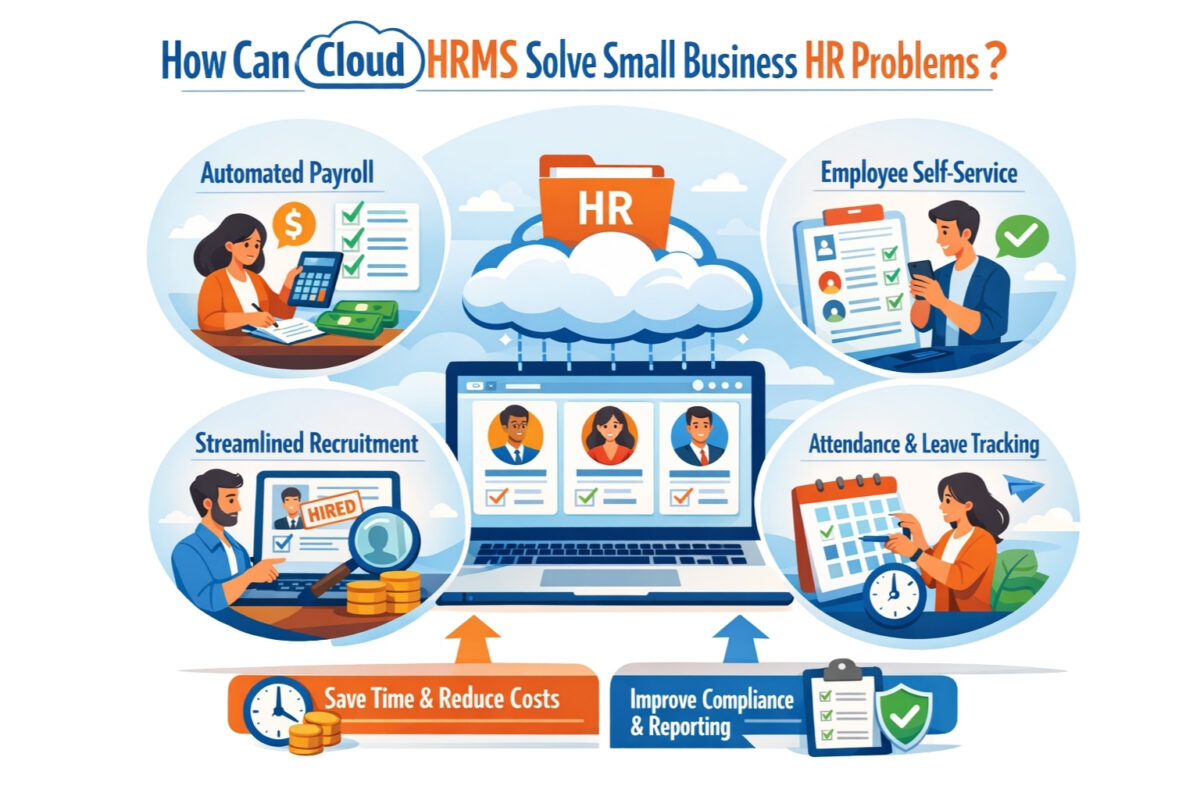
How Can Cloud HRMS Solve Small Business HR Problems?

Small and medium enterprises constitute the majority of India’s economy, but they face human resource management challenges as they expand. What starts as informal process management by the founder or an individual manager quickly becomes unmanageable when the team size exceeds 20-30 employees. Founders are trying to prioritise, recruit, run payroll, handle compliance filings, and answer employee questions while just trying to keep the business afloat.

This shift poses new HR challenges for small businesses. Manual processes are labor-intensive and error-prone, which introduces the risk of non-compliance that can harm business growth and reputation. The HR workload in small businesses increases, and one of two things happens: either the process slows down, or employees become dissatisfied.

Thankfully, cloud-based HRMS software offers a viable, adaptable solution. With these systems, routine work is automated and data are centralized, allowing small companies to elevate their HR function in a cost-effective and timely manner. In this article, we will review the top small business HR management challenges, the operational and financial impacts on business profitability, and how the latest HR systems can provide targeted relief.

Overview of HR Management for Small Business and SMEs

In big corporations, HR is a department with a talent acquisition team, a compensation team, a compliance team, and an employee relations team. By comparison, in most SMEs, HR duties are delegated to owners, operations managers, or administrators who work part-time and have little or no formal training or specialised tools.

Such a configuration often means that HR management issues in SMEs are underestimated until trouble blows up. Due to small staff and tight budgets, common HR problems in small companies like erratic record-keeping and reactive compliance have a habit of quietly piling up, leaving them vulnerable during audits, employee disputes, or periods of rapid growth.

The Hidden Costs of Doing Your Own HR in Small Business

Using spreadsheets, paper files, and email to perform HR functions incurs high hidden costs. The problems with manual HR management also steal time: payroll itself can be three or more days of manual work at month’s end. Managing employee records manually increases the risk of duplicate entries, stale information, and even data loss due to hardware failures or misfiling.

This is other than wasting time. Deductions or statutory filing mistakes can invite penalties, whereas late payslips or leave approvals lead to loss of employee trust. Over time, this translates into employee churn, lower employee productivity, and less focus on strategic business initiatives.

What are the Key HR Management Challenges Faced by Small Businesses?

1. Manual Management of Employee Records

Employee data joining letters, salary revisions, performance reviews, personal documents is stored in different folders across drives and spreadsheets. Accessing past records for appraisals or separations is error-prone and time-intensive.

This challenge ranks among the most persistent common HR problems in small companies, leading to inconsistencies that affect payroll accuracy, compliance reporting, and employee experience.

2. Compliance Challenges in HR for SME

Indian SMEs have to comply with a myriad of regulations, such as Provident Fund (PF), Employees’ State Insurance (ESI), Tax Deducted at Source (TDS), Professional Tax, gratuity, bonus, and certain state-level labour regulations. Manually monitoring due dates, calculations for contributions, and filing returns is error-prone and time-consuming.

The HR compliance challenges for SMEs face leave them vulnerable to financial penalties, legal notices, and harm to their reputation especially when scrutinized during audits or inspections.

3. The Challenge of Payroll Management in Small Businesses

Manual payroll processing has to calculate not only wages and salaries but also allowances, overtime, deductions, incentives, and taxes applicable to each employee. Variations such as late joiners, partial months, or variable pay further increase the complexity and the likelihood of errors.

Payroll management challenges in small businesses are common and can lead to late paychecks, inaccurate pay stubs, employee complaints, and a general lack of trust, all of which can disrupt business operations.

4. Issues of Employee Sign-in/out and Leave Management

Attendance management via registers, WhatsApp, or individual biometric machines can lead to discrepancies, particularly in hybrid or remote environments. Leave applications typically do not go through formal approval processes, leading to disputes over balances and entitlements.

Employee attendance and leave management issues lead to payroll errors, affect workforce planning, and compromise peace of mind.

5. Increasing HR Workloads With Very Little Resources

As the number of people you manage grows, so do your HR duties: recruiting, onboarding, enforcing policies, monitoring performance, conducting exit interviews, and handling grievances, all without additional resources.

An increasing HR workload in small businesses causes those responsible for completing these functions to burn out, service quality to decline, and strategic HR activities, such as talent development, to be overlooked.

6. Challenges Scaling HR Processes

What worked when your team needed only three people doesn’t work for nine people. Ad-hoc methodologies are harder to standardize, making it difficult to achieve uniformity across departments/branches.

Difficulties in scaling HR operations and digital HR management challenges limit expansion potential and increase operational risk during growth phases.

For an early adopters’ perspective on the benefits, see our related article: Why Small Businesses Need HR Management Software.

Why Traditional Approaches No Longer Work at Scale?

Spreadsheets and other disconnected tools lack the necessary framework to accommodate growing complexity. More employees mean more variables such as different leave policies, multi-state regulations, and varying payroll schedules. Digital HR management challenges multiply, increasing the risk of non-compliance, inaccurate data, and process failures.

How Cloud-Based HRMS Software Solves These Issues?

Today’s cloud-based HRMS software turns HR from a reactive, administrative drag into a streamlined, strategic function.

Centralized Employee Records

All employee data is stored in a single secure repository, along with version history, search capabilities, and role-based access. This removes redundancies and yields clean, accurate data throughout both processes.

Automated Payroll, Attendance, and Leave Control

Workflows enable these modules to automatically calculate payroll using live attendance and authorized leave. Self-service platforms like WeekMate empower employees to access their payslips, submit requests, and check their balances, making life easier for administrators.

Simplified Compliance Management

Statutory adherence, automated reminders, and pre-configured reports enable compliance with cycle filings, during audit, and on time. Regulatory changes are reflected in system updates, allowing manual processing to be avoided.

Reduced Workload and Enhanced Efficiency

Automation frees HR staff to focus on recruiting, engaging, and developing talent rather than performing tedious, repetitive work. Reporting dashboards provide actionable insights that tell you what to do. 

Scalable Operations for Growth

Cloud infrastructure is designed to support a growing workforce and expand across geographies without requiring infrastructure upgrades. Capabilities are designed for multi-location teams, remote access, and customizable workflows.

The table below are the comparison between manual processes and cloud HRMS:

Aspect Manual/Traditional Approach Cloud-Based HRMS Approach
Data Storage Scattered files and spreadsheets Centralized, secure database
Payroll Processing Manual calculations, high error risk Automated with statutory compliance
Compliance Tracking Manual reminders, prone to oversights Automated alerts and audit-ready reports
Attendance & Leave Inconsistent tracking, frequent disputes Real-time integration and self-service
Scalability Limited; breaks beyond 30–50 employees Seamless growth with no infrastructure cost
Monthly Time Savings Minimal 20–40+ hours per administrator

Key Things to Consider for Cloud HRMS Software Selection

  • Prioritize intuitive interfaces to ensure quick adoption by non-technical users
  • Ensure strong support for Indian statutory regulations (PF, ESI, TDS, Professional Tax, gratuity, bonus, etc.)
  • Consider modular integration, such as payroll, work schedule, leave management, and core HR modules
  • Evaluate scalability to ensure the business can grow without the need for a giant system upgrade.
  • Request mobile access for employees and managers who are out of the office.
  • Ensure robust data security, such as encryption, regular back-ups, and pertinent compliance certifications
  • Provide responsive support during Indian business hours.

How WeekMate HRMS Empowers Small Business HR functions?

  • Solves small business-specific HR challenges with an easy-to-use, India-centric application
  • Bring all your employee records under one roof, a centralized, secure, and accessible database
  • Streamlines payroll processing with statutory compliance.
  • enables real-time seamless attendance and leave monitoring
  • Offers easy-to-use self-service (payslips, leave applications, working documents) for employees and managers who administrate teams
  • It is scalable, specifically developed for SMEs, and designed to grow with you.
  • Offers economical service and speed of delivery to reduce the chance of disruption
  • Allows growing organizations to maintain control, ensure compliance, and support expansion without proportional increases in HR overhead

Conclusion: Transitioning from HR Chaos to Structured Control

WeekMate HRMS addresses the specific HR challenges outlined above for small businesses through a user-friendly, India-centric platform. Compliance regulations such as labor laws, the need to manually keep records, the risk of compliance breaches, payroll errors, pressure from doing too much work, and limits on growth: these are common problems, but they’re ones that can be solved. 

SMEs achieve precision, efficiency, transparency, and strategic capacity after implementing cloud-based HRMS software. Proactive investments in contemporary HR solutions ensure the business achieves more predictable outcomes and positions it for scalable growth. WeekMate provides a trusted path to simplified HR, empowering leaders to focus on people and performance – not paperwork!

FAQs

1. What are the key challenges in HR for small businesses in India?

Manual operations, statutory compliance, payroll accuracy, attendance monitoring, and fatigue-related workload are symptoms of understaffing. Increasingly, small businesses are burdened by spreadsheets or combinations of tools, which heighten the risk of miscalculations and missed deadlines. A small HR team can be pulled in many directions when it comes to tracking employee records, monitoring leave , and staying compliant with the government.

2. How does cloud-based HRMS software lessen the HR load in small businesses?

It eliminates the repetition and tedium of tasks like approving leave, payroll, and reporting, and can save 20–40 hours per month. HR teams can now break out of the cycle of repetitive work and manual calculations by consolidating employee data and workflows into a single platform. Automation also increases precision, allowing HR managers to focus on staff engagement and strategy development.

3. Is WeekMate HRMS suitable for fewer than 20 users?

Yes, flexible pricing and essential features make it a great choice for startups and small teams. WeekMate offers payroll, attendance, and employee record management tools that small businesses can scale up or down as needed, without having to purchase a complex enterprise system. You can add more features as your team grows, no need to switch platforms.

4. Does cloud-based HRMS guarantee automatic compliance with Indian laws?

Trusted platforms like WeekMate come with built-in modules for PF, ESI, TDS, gratuity, etc., with auto-updates. So, businesses can rest easy knowing they’re keeping pace with regulatory changes without having to monitor policy updates daily . Automatic compliance calculations also mitigate the risk of fines that may occur from reporting errors and/or filing penalties.

5. What is the biggest benefit of digital HR management?

Increased accuracy, happier employees, reduced risk of non-compliance and more time to work on growing the business. Digital HR solutions accelerate communication, provide clear employee records, and generate on-the-fly reports to support decision-making. Eventually, this translates into an efficient workforce and organizational management.

6. Is employee data secure in Cloud HR software?

Leading solutions leverage encryption, regular backups, access controls, and compliance with data protection regulations. Modern HRMS solutions also include role-based permissions that restrict who can view specific information. This approach to layered security secures employee data while making it easily accessible to HR teams.

7. What is the average time to implement a solution like WeekMate HRMS?

Most small businesses are fully up and running within 1-4 weeks, depending on whether you need to move data. During this time, you import and set up employee records, payroll information, and attendance rules. As soon as it’s installed, you and your team can begin managing HR processes from a single digital platform.

Why Most IT Companies Struggle With Operational Visibility and How to Fix It

Imagine this: It’s 9 PM in a busy IT firm in Ahmedabad. Your project manager is still refreshing three different applications to try and determine why the deadline for the client from the US has slipped yet again. The dev team is chatting in Slack, the ops lead is neck deep in Excel sheets, and leadership wants a status report “yesterday.” Sound familiar? It’s not just frustrating it’s costly. Indian IT firms are expanding at an unprecedented rate, but their infrastructure hasn’t kept pace. So what’s the result? Lost hours, missed opportunities, frustrated teams.

That’s why we’re seeing smart leaders turn to one simple concept: one platform, one source of truth. When everything projects, tasks, resources and reporting is housed in one place, magic happens. Transparency replaces guesswork. Speed replaces delays. And before you know it, your IT operations management software turns into the source of your company’s vitality, rather than the source of a headache.

In this blog, we will explore the visibility challenges that IT teams are struggling with day in and day out, how the lack of visibility silently inhibits growth, and how the right IT management software for companies can change everything. Keeping it practical and real-world, and no jargon. By the end, you’ll understand why making the jump to a software project management platform like WeekMate isn’t just a good move, it’s necessary for any expanding IT company in India.

What Is Operational Visibility in IT Operations?

Operational visibility simply means knowing exactly what’s happening across your teams, projects, and resources right now, not yesterday. It’s the difference between “I think the team is on track” and “Here is the live dashboard that tells us we’re 87% done with two blockers flagged.” In today’s hybrid work world, real-time insights are more valuable than ever. A postponed server migration in Hyderabad can trigger a client escalation in Mumbai within hours. When you don’t have transparency, working becomes guessing. Leaders can detect risks earlier, allocate resources immediately, and celebrate victories the moment they occur.

This is exactly when the software platform for managing IT operations and projects comes into its own. It consolidates all those disparate updates into one neat view, so no one will have to don a detective hat again.

What Are The Top Causes IT Companies Lack Operational Visibility?

Most IT companies don’t wake up to shattered processes one day the disruption sneaks up on them as the company scales.

Disconnected Tools and Fragmented Workflows

You’ve probably heard of this situation: you have one team using Jira, another one swearing by Trello, finance doing its thing with Excel, and HR managing leaves in Google Sheets. The result? Data silos everywhere Like information stored in Excel and email. Information is copied and pasted and lost. It’s no surprise that teams spend hours just trying to find the most up-to-date version of a document.

If this rings a bell, you’re not alone.

Our recent post on Why SaaS Is Replacing Spreadsheets dives deeper into how fragmented tools quietly drain productivity. A unified software management system eliminates this madness by connecting everything under one roof.

Poor Project Tracking and Resource Allocation

In the absence of oversight, projects drift. Resources get double-booked. Senior developers burn out, and juniors sit and wait. Deadlines slip quietly until the client is screaming.

The fix? A centralized project management system that shows real-time capacity, dependencies and progress in real-time. No more “where did that task go?” moments.

Reduced Team Sharing Between Departments

Testers, developers, account managers, and ops people often feel like they’re speaking different languages. One tiny miscommunication and a critical bug go unnoticed for days.

That’s why team collaboration software for IT companies is important. When you’re all editing the same live document, updates are seamless and accountability increases.

Lack of Real-Time Reporting and Dashboards

Weekly reports that arrive on Friday afternoon are nothing but history books. Leaders should know today whether a sprint is in trouble, not next week.

An enterprise software management platform, such as WeekMate, with live dashboards turn reactive firefighting into proactive leadership.

How Poor Operational Visibility Impacts IT Companies?

The costs aren’t just annoying they hit the bottom line hard.

Missed deadlines result in angry clients and penalties. Cost overruns nibble into already-thin margins. You waste talent if the best engineers spend more time updating tools than writing code. Worst of all, accountability disappears because no one can see the whole story.

These problems are scalability killers, particularly for fast-growing Indian IT companies. A 50-person team can manage with WhatsApp groups and shared drives, but a 150-person team can’t.

That’s why IT operations software India is witnessing huge growth businesses over here are looking for solutions that are compatible with local conditions, such as multi-city operations, limited budgets, and rapid expansion.

How IT Operations Management Software Increases Visibility?

Here’s the silver lining: the right tool not only fixes problems it stops them.

Centralized Oversight of Operations and Projects

From client updates to activities, resources, tasks, and projects, everything is under one roof with IT operations management software. You have one source of truth that updates in real time. Enough with those “Let me look into that and I’ll get back to you” emails.

Simplified Project Development and Management

A strong software project management platform makes planning a breeze. Drag-and-drop timelines, automated reminders, and smart resource allocation help keep projects on track without the need for constant manual chasing. Indian companies fondly recommend software project management tools for Indian companies because these tools cater to our unique blend of onsite, offshore and hybrid teams.

Improved Transparency and Collaboration

Live comments, @mentions, file sharing, full activity history, and live status updates make isolated departments work as one high-performing team. Everyone is looking at the same truth and that builds trust more quickly than any team-building offsite ever could.

Key Features of Today’s IT Management Software

Not all products are created equal. Look for these must-haves in any serious IT management software for companies:

Feature

What It Does

Real Benefit for IT Teams

Unified Dashboards

Live view of all projects & metrics Instant decisions instead of weekly reports

Workflow Automation

Auto-assign tasks, reminders, and approvals Saves 10–15 hours per person every month

Resource Planning

See who’s free, overloaded, or on leave No more double-booking top talent

Real-Time Reporting

Custom reports with one click Leadership gets answers in seconds

Mobile Access & Notifications

Work from anywhere Perfect for teams across multiple cities

Client Portals

Share progress without exposing internals Happier clients, fewer status calls

These capabilities transform a simple enterprise software management platform into the nervous system of your company.

Why Growing IT Companies Demand a Consolidated Software Platform?

Expansion is fantastic until your tools begin cracking under the stress. Suddenly, one unified software management system is a must-have. Early implementation of IT operations management software for growing IT firms helps companies avoid the painful “we’ve outgrown everything” situation many corporations encounter at the 80-150 employee mark.

Moving sooner to a single platform that can scale eases your path. You avoid migration nightmares down the road and you develop good habits from day one.

Choosing The Best IT Operations Software in India

Indian IT firms face only one challenge: meeting the unique demands of GST, multi-currency projects, data residency, and budget-friendly solutions. When you are comparing, ask yourself:

  • Does it scale without surprise price increases?
  • During Indian working hours, is support responsive?
  • Is it equipped for multinational, remote /distributed teams working from around the globe?
  • Is there room to grow over the next 3-5 years?

An all-in-one IT management software for enterprises that meets all those requirements isn’t a luxury; it’s survival gear in today’s cutthroat market.

Closing: How to Get Full Operational Visibility with the Appropriate Tools

Operational visibility isn’t about fancy dashboards or buzzwords. And it means every team member has clarity, every leader has confidence, and every client has peace of mind. The pain points we talked about, disjointed tools, poor tracking, and weak collaboration, are real, but they’re also 100% solvable.

By selecting a single-source-of-truth project management system that serves as your IT operations management software, you’ll scale with it as your company grows. You replace chaos with serenity. You make great teams, unbeatable ones.

At WeekMate, we made precisely this kind of platform because we know how it feels. Our software project management platform merges robust IT management software for companies with the simplicity that Indian teams actually enjoy. From real-time dashboards to seamless collaboration, WeekMate is helping growing IT firms across India move faster, deliver better, and sleep easier at night.

Ready to stop guessing and start knowing? Discover how WeekMate’s unified software management system can revolutionize your operations today. One platform. One truth. Endless growth.

FAQs

1. What is the key advantage of IT operations management software?

It lets you see every project and team member in real time, taking the guesswork and waiting out of it. With the help of centralized dashboards, automated alarms, and live performance monitoring, managers can identify bottlenecks immediately and re-dispatch resources. This results in faster delivery and improved accountability for IT teams.

2. What makes WeekMate special compared to other software project management tools?

WeekMate has been designed with the needs of Indian IT companies in mind. It is cost-effective, scalable, and brimming with homegrown features such as GST invoicing and multi-city team collaboration.

3. Is a small IT company capable of buying an enterprise software management platform?

Of course. Sophisticated solutions like WeekMate offer one-time pricing models that grow with you, rather than penalizing success too quickly. Startups and mid-sized IT firms can now access enterprise-class capabilities without incurring enterprise-class costs, as modern platforms are designed to scale. So, digital transformation is achievable even for lean teams.

4. Do IT operations software in India really understand local challenges?

The best ones do. Opt for platforms made in India, for India, that include compliance, support, and pricing relevant to India’s unique landscape. Such solutions usually include GST compliance, India-specific data hosting requirements, localized customer support services, and the business processes of Indian IT service providers doing business with global clients.

5. How long does it take to see results after switching to a unified software management system?

Most teams report increased visibility and a reduction in status meetings within a couple of weeks. Teams generally report faster communication, fewer missed deadlines, and more task ownership in the first month or so. The long-term efficiencies, such as better forecasting and resource utilization, become sharper after a quarter.

6. Is team collaboration software for IT companies really necessary?

Yes, especially when your team spans developers in Bangalore, testers in Pune, and clients in the US. Collaboration tools help eliminate communication gaps across time zones; they bring discussion threads into a centralized place and allow users to document them all. This allows for smoother sprint cycles and faster approvals, while keeping clients happier.

7. What if my team is reluctant to change tools?

Opt for a simple-to-use software solution to track IT work and projects, such as WeekMate. Clean design, fast onboarding, and overall user experience usually turn even the biggest skeptics within days.

Become A Partner