Spine HR vs WeekMate HRMS: Smart Choice for Growing Firms

HR‍‌ teams nowadays function in a vastly different scenario than they did 10 years ago. Companies are growing faster, workforces are more geographically distributed, and the concept of work is no longer limited to a single office or fixed hours. As enterprises grow, HR demands also change, with a focus on automation, an improved employee experience, and real-time access to people data.

With this transformation, numerous corporations periodically reevaluate their HR technologies. The tools that worked well in the early stages may now feel restrictive. This is the point where the debate of Spine HR vs WeekMate HRMS frequently arises. 

Businesses are not necessarily in a hurry to replace their systems; instead, they are evaluating platforms that better align with current workflows. To a great extent, WeekMate is a viable Spine HR alternative, specifically designed for the needs of growing teams.

Overview of Traditional HR Platforms Like Spine HR

Traditional HR platforms like Spine HR have long supported Indian businesses. They are dependable in payroll, statutory compliance, and other routine HR processes. Many enterprises use these tools as a starting point in their digital HR transformation, as they support the administrative groundwork.

Once the business requirements dramatically change over time. When teams are large or geographically dispersed, HR systems’ expectations extend beyond payroll accuracy. It is at this point that a Spine HR and WeekMate comparison is conducted, not for pointing out the failure of one, but rather because the company has evolved. In such instances, WeekMate often positions itself as a qualified Spine HR competitor, offering newer, operationally and employee-centric solutions.

The Shift Towards Modern, Cloud-Based HR Solutions

The adoption of cloud-first platforms is the primary factor driving changes in how HR departments operate. Being accessible from anywhere, receiving faster updates, and reduced dependence on infrastructure are now standard requirements in this context. When someone is comparing a traditional HR platform vs modern HR software, then mainly the differences refer to the quality of users’ experience rather than the number of features.

Today, employees want the ability to handle tasks independently, mobile access, and faster approvals. HR departments are seeking a dashboard rather than a spreadsheet, and executives need real-time data to support their decisions. This big change is the reason why more and more companies opt for cloud HRMS vs traditional HRMS, especially those that consider HR as a strategic rather than a merely operational function.

What Makes WeekMate HRMS a Preferred Choice for Growing Teams

From the outset, WeekMate’s design is intended to be user-friendly. HR employees, managers, and workers can navigate the system without extensive instructions. The difficulty is largely addressed here by shortening the time required for system acceptance and reducing change resistance, both of which are common concerns in any WeekMate HR software comparison exercise.

Unified HR, Attendance & Work Management

Not by using several tools, but through WeekMate, the issues of human resources, attendance, task tracking, and productivity are addressed in one place. This integration approach reduces data silos and enables teams to work from a single source of truth. For companies deciding between SpineHR vs WeekMate HRMS, consolidation is the primary focus.

Designed for Modern Work Models 

The use of hybrid work, remote teams, and flexible shifts is now considered socially acceptable rather than extraordinary. The WeekMate helps these facts with policy setting and workflow adaptability. As a Spine HR alternative, it is better tailored to a dynamic workforce structure, which is the most common today.

Strong Employee Self-Service Capabilities

Workers are allowed to submit a leave application, to record their attendance, and to change their personal data on their own. This openness increases trust while saving HR departments time. Such functionality often becomes a deciding factor during HR software features comparison discussions.

Real-Time Insights & Reporting

The real-time data visualizations provide HR executives with a clear, comprehensive view of attendance changes and patterns, workforce distribution, and productivity trends. This makes HRMS feature comparison less about static reports and more about actionable insights.

WeekMate HRMS vs Traditional HR Platforms (Neutral Comparison)

Traditional HR platforms continue to deliver strong results for businesses, especially when compliance and payroll stability are top priorities. They offer stable solutions for the basic HR needs and are a good fit for companies with relatively stable structures.

Conversely, the WeekMate HRMS Software is a solution that supports the modern way of working, is mobile, and scalable. In most Spine HR vs. WeekMate HRMS comparisons, the decision depends on the business’s maturity rather than a ‘better or worse ‘ verdict. Companies simply choose what fits their current and future needs when they compare HR software platforms.

To summarize:

Feature Traditional HR Platforms WeekMate HRMS
Primary Focus Stability, core payroll, and rigorous compliance. Agility, employee experience, and scalability.
Ideal User Established companies with fixed structures. Modern businesses and fast-growing teams.
Accessibility Often desktop-centric; stable interface. Mobile-first design; optimized for remote work.
System Flexibility Rigid but highly reliable for standard tasks. Dynamic and easily adaptable to changing workflows.
Implementation Usually longer, thorough setup processes. Faster deployment with scalable “plug-and-play” features.

The Typical Persona of WeekMate HRMS

Startups and fast-growing SMEs that require a flexible solution are the typical adopters of WeekMate. It also benefits teams that operate across different locations or shifts, as well as companies that prioritize employee experience. Businesses looking to combine HR and productivity tools often see value when reviewing traditional HR platform vs modern HR software options.

Getting to WeekMate HRMS: A Streamlined & Well-Planned Journey

Changing HR systems can be overwhelming, but WeekMate advocates a personalized approach. The switch is less disruptive because data transport, onboarding, and training are well coordinated. This hassle-free transition is the main feature praised by teams in WeekMate HR software comparison discussions, especially when they are moving from legacy systems.

Future-Ready HR Starts with the Right Platform

The decision to buy HR software goes beyond a mere technological decision. It is a significant business decision of long-term impact. The growth of an organization implies the need for its HR platform to both scale and change in line with it. For many modern teams, the debate is between Spine HR vs. WeekMate HRMS, raising the question of future readiness.

WeekMate HRMS positions itself as a scalable, adaptable solution that aligns HR operations with broader business goals.

Explore how WeekMate HRMS supports modern teams. Get a demo, initiate a free trial, or have a chat with a WeekMate HRMS expert today.

FAQs

  1. Is WeekMate HRMS a good fit for small teams and not just for expanding companies?

WeekMate is appropriate for small teams and can scale gently as a company grows, making it applicable across different stages.

  1. How challenging is the change from a conventional HR system to WeekMate?

The change is well-organized and well-led, with assistance provided for data transfer and training to minimize disruption.

  1. Does WeekMate facilitate remote and hybrid work policies?

Indeed, WeekMate is a work model designed for the future, which includes remote, hybrid, and multi-shift teams.

  1. What ways does WeekMate use to help HR teams save time daily?

By providing employee self-service, live dashboards, and integrated workflows, WeekMate significantly reduces the HR department’s manual tasks.

Next-Gen HRMS Transforming Workforce Management for Manufacturing

The manufacturing industry is riddled with workforce issues that old HR systems are incapable of solving. The manufacturing sector has a diverse workforce comprising permanent employees, contractors, and shop-floor workers who may work across multiple shifts and locations. Therefore, manufacturers require smarter solutions in handling their workforce. At this juncture, next-generation HRMS comes to the rescue by changing how manufacturing companies manage their most valuable resource—their people.

Understanding Workforce Management Challenges in Manufacturing

Manufacturing businesses face challenges that few industries can handle. The management of a workforce that is large and diverse, including the permanent staff, contractual workers, and vendor-based manpower that are spread across multiple units, is a task that requires accuracy and real-time coordination. The HRMS in the manufacturing industry must be up to the task of managing these dynamics without any interruptions.

Shift-based, 24×7 operations add to the complexity of the situation. Managing night shifts, overtime calculations, and rotating rosters requires tracking these activities with the highest accuracy. Most manual attendance systems are associated with errors, disputes, and payroll complications. Beyond operations, manufacturers must comply with labour laws, manage PF and ESI contributions, organize safety training sessions, and be audit-ready all while adhering to the core principles of human resource management.

What Makes HRMS “Next-Generation”?

A next-generation HRMS is a complete departure from legacy systems. Traditional HR software that only digitizes paperwork is quite different from modern manufacturing HR software, which is based on four main principles: cloud-based accessibility, mobile-first design, AI-powered automation, and data-centric decision-making.

These systems empower HR teams and workers alike with anytime, anywhere access. Whether you’re comparing top HRMS platforms in India or evaluating specific features, the difference becomes clear: smart HRMS systems don’t just record data; they provide actionable insights.

How Next-Generation HRMS Transforms Manufacturing Operations?

Smart Attendance and Workforce Tracking

The modern HRMS for manufacturing features the capability to integrate seamlessly with biometric technologies, geofencing, and facial recognition. As a result, attendance tracking is conducted in real time to ensure no buddy punches. Automated tracking of shifts and overtime minimizes conflicts and ensures accurate payroll processing.

Automated Payroll and Compliance Management

Errors in payroll may be the reason many employees lose trust in the company, and compliance issues are a nightmare for the company. An AI-powered HRMS is the solution to this issue, as it automates salary calculations, tax deductions, and statutory compliance for PF, ESI, and TDS. Audit records are prepared automatically, reducing manual work. For companies seeking additional support, outsourced payroll for manufacturing businesses remains a viable option.

Intelligent Shift Scheduling and Workforce Planning

Manufacturing workforce management software uses AI algorithms to optimize shift distribution based on production demands, employee availability, and skill sets. Thus, the predictive method in use reduces employee absences, ensures sufficient staffing, and improves overall productivity. The system learns patterns and can proactively suggest improvements through workforce planning rather than being reactive.

Digital Onboarding and Contractor Management

Digitally enabled onboarding can be a great help when mass hiring is coming up, as it does in government and other businesses experiencing peak season. The newly hired employee can complete KYC verification and upload documents via his mobile device before his official first day. Contractor and vendor workforce tracking is a guarantee of compliance and a means of tracking different employment categories.

The Role of AI and Analytics

Cloud HRMS for manufacturing leverages artificial intelligence to predict workforce trends. One way to do this is to forecast attrition and track absenteeism patterns. These systems provide the first alerts, enabling management to be on the front foot and take control.

Managers can easily observe the relationship between workforce analytics and production metrics through real-time dashboards. It implies they can make quality decisions without unnecessary time waste.

Smart alerts and automated approval workflows eliminate bottlenecks. Whether it’s leave approvals, overtime requests, or shift swaps, how HRMS helps manufacturing companies extends beyond basic administration to strategic workforce optimization.

Benefits of Next-Generation HRMS for Manufacturing Companies

The benefits of HRMS in manufacturing are tangible and measurable.HR teams experience relief from heavy workloads through paperless workflows and automation. 

Factory managers gain real-time visibility into headcounts and improved shift discipline, resulting in reduced production delays. Employees have access to self-service, transparent payroll calculations, and fast grievance resolution.

These benefits are significant for small and medium-sized enterprises. The right HR software for small manufacturing businesses is the one that provides equal opportunities, enabling smaller players to achieve operational excellence comparable to larger competitors.

Selecting the Proper HRMS Solution

Some of the first steps you should take when selecting the best software to manage the manufacturing workforce are to identify the features that make manufacturing unique. You must bear in mind systems capable of supporting functions across multiple sites, providing powerful mobile capabilities for shop-floor employees, and the ability to integrate with existing ERP and attendance systems. The ability to scale is crucial-your HRMS should be able to develop along with your company.

Manufacturing-focused HR challenges are often overlooked by generic systems; however, WeekMate HRMS, along with similar purpose-built solutions, is designed specifically for the manufacturing environment and deeply understands these unique workforce issues and their practical solutions.

Manufacturing​‍​‌‍​‍‌​‍​‌‍​‍‌ Industry Use Cases

  • HRMS for automobile manufacturing
  • HRMS for textile and garment units
  • HRMS for pharmaceutical plants
  • HRMS for electronics manufacturing
  • HRMS for food processing factories

Each segment demands strong HRMS in the manufacturing industry to manage complex workflows.

Challenges in Implementing HRMS in Manufacturing

  • Resistance to digital adoption
  • Migrating data from legacy systems
  • Training shop-floor teams
  • Ensuring data security in a Cloud HRMS for manufacturing environment 

How to Choose the Right HRMS for Manufacturing Businesses?

Consider industrial operations when selecting a system:

  • Manufacturing-specific HRMS features
  • Multi-plant scalability
  • Attendance & machinery integration
  • Mobile-first worker access
  • Payroll & statutory automation
  • Seamless ERP integration

Evaluation becomes simpler with the best HRMS software in ​‍​‌‍​‍‌​‍​‌‍​‍‌India.

The Path Forward

The manufacturing sector is transforming into Industry 4.0, and so is workforce management; it has to follow. The integration of IoT devices, predictive analytics, and skill-based production planning will define the future of manufacturing HR. Companies that embrace next-generation HRMS today position themselves for competitive advantage tomorrow.

Conclusion

The use of HRMS in manufacturing has shifted from an option to an absolute necessity. Efficient workforce management is the primary tool that manufacturing companies can use to achieve their target of slim margins and maximum productivity. By reducing administrative workload, ensuring compliance, and enabling better decision-making, next-generation HRMS is changing the way manufacturers do business—an impact that benefits both businesses and workers. WeekMate provides manufacturers with what they need in a comprehensive yet straightforward way.

FAQs


What features define a next-generation HRMS?

Essentially, a next-generation HRMS incorporates cloud accessibility, a mobile-first user interface, AI-driven automation, and real-time data analysis. Beyond simply saving employee data, it also provides forecasting models, intuitive alerts, automated processes, and seamless integration of biometric data to enable quick, intelligent workforce decisions.

Is HRMS beneficial to small manufacturing companies?

Definitely, yes. The typical payroll, attendance, and compliance issues that come with running a business equally apply to small manufacturers. In this case, the HRMS acts as an enabler by automating these processes, reducing manual effort, and offering MSME-friendly, lower-cost, scalable packages, thereby making business operations more effective and compliant.

Can HRMS handle contract and blue-collar workers?

Certainly. An advanced HRMS is equipped with features that enable it to manage permanent, contractual, vendor, and shop-floor workers through digital onboarding, KYC verification, contractor compliance tracking, and various payroll rules. In addition, the mobile attendance system and multilingual portals help blue-collar workers access and use the system.

In what ways does HRMS contribute to labor law compliance?

An HRMS automatically calculates employee contributions, including PF, ESI, PT, and TDS; records digital compliance; produces auditable reports; and reminds users of due dates and legal requirements. All of these help minimise errors, reduce the risk of penalties, and ensure that businesses in multiple states have no issues with audits.

How much does the HRMS cost for manufacturing units in India?

Most cloud HRMS solutions are priced between ₹50 and ₹300 per employee per month, with pricing dependent on features. This would mean a 200-employee facility would typically incur a monthly cost of ₹10,000–₹60,000. Several vendors provide packages specially designed for the manufacturing sector, along with demonstrations and free trials, enabling businesses to calculate return on investment (ROI) before purchase.

Top CRM Software 2026 Complete List & Comparison

Managing customers used to be simple. 

A few Excel sheets. A notebook on the desk. Maybe some follow-up reminders on WhatsApp.

But businesses in 2026 don’t operate that way anymore.

Today, sales teams handle leads from websites and social media. Then there are traditional calls and emails. After your business generates leads from campaigns, and marketplaces. All at the same time.  

Without a proper CRM system, things get messy very quickly. Leads get missed. Follow-ups get delayed. Customer conversations become impossible to track.

Startups, SMEs, or large enterprise teams need a CRM software. The right CRM can completely change how your business handles sales. Customer relationships, and team productivity improves. 

The problem?

There are too many CRM platforms available right now.

Some are packed with features but difficult to use. Some are affordable but limited. 

To make things easier, we compared some of the top CRM platforms businesses in India. We shortlisted the best options worth considering in 2026.

Searching for the best CRM software in India? This guide will help you make a practical decision.  

What is the Evaluation Criteria We Followed?

Not every CRM fits every business. 

A startup with a 5-member sales team has completely different needs compared to a large enterprise managing multiple departments and regions.   

So instead of simply listing popular names, we evaluated each CRM platform based on real business requirements. 

1. Ease of Use

A CRM should simplify work, not create more confusion.

We focused on platforms that are easy to navigate, simple to adopt, and don’t require weeks of training just to get started.

2. Automation Features

Modern businesses cannot afford to manage leads manually anymore.

We checked whether the CRM supports:

  • Automated follow-ups
  • Lead assignment
  • Workflow automation
  • Sales reminders
  • Pipeline tracking
  • Task management

3. Scalability

The CRM you choose today should still support your business two or three years later.

We evaluated whether these platforms can handle growing teams, advanced workflows, reporting, and multiple business functions.

4. Pricing & Overall Value

A CRM may look affordable initially but become expensive later through upgrades and add-ons.

We considered:

  • Feature availability
  • Per-user pricing
  • Upgrade flexibility
  • Long-term value

5. Integrations

Businesses use multiple tools daily.

A good CRM should connect smoothly with platforms like:

  • Email tools
  • WhatsApp
  • Marketing software
  • ERP systems
  • HR software
  • Customer support platforms

How to Choose the Right CRM Software in India? 

A  few practical things businesses should consider before investing in a CRM platform.

Understand Your Business Stage

  • Startups usually need simplicity and affordability.
  • Growing SMEs need automation and reporting.
  • Enterprises require customization, and multi-team workflows.

Choose accordingly.

Prioritize User Adoption

Even the best CRM becomes useless if your sales team avoids using it.

Always choose a platform with a clean interface and easy learning curve.

Focus on Automation

The right CRM should reduce manual work.

Look for features like:

  • Auto lead distribution
  • Workflow automation
  • Email reminders
  • Follow-up scheduling
  • Activity tracking

Check Mobile Accessibility

Sales teams work on the go.
Mobile access is no longer optional in 2026.

Compare Hidden Costs

Many CRM platforms increase pricing as teams grow.
Before finalizing, always check:

  • User limits
  • Automation limits
  • Storage caps
  • Premium support charges

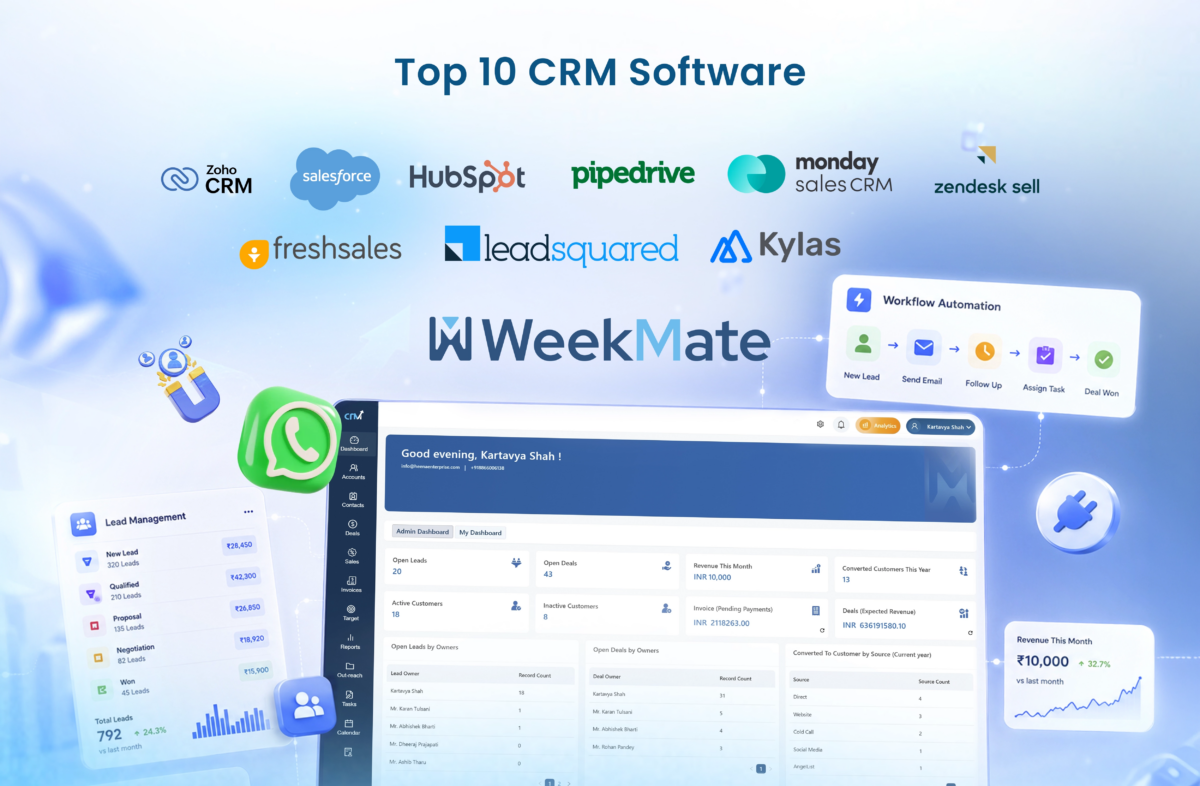
Top 10 CRM Software in India

1. WeekMate

Overview

WeekMate CRM is becoming a preferred CRM solution for Indian startups and growing businesses. The platform is practical and easy-to-manage.

It doesn’t overwhelm users with unnecessary complexity. WeekMate focuses on simplifying sales management and customer communication. It integrates follow-ups, task tracking, and team collaboration from one centralized system.

Businesses searching for the best CRM software in India are increasingly considering WeekMate. The platform balances affordability, automation, and usability.

Key Features

  • Smart lead and contact management
  • Sales pipeline tracking
  • Automated reminder management and follow-ups
  • Team collaboration tools
  • Custom workflows and reporting dashboards

User Rating

4.8/5

Best For

Startups, SMEs, and growing businesses.

2. Zoho CRM

Overview

Zoho CRM remains one of the most widely used CRM platforms in India.

It offers sales automation and omnichannel communication. It also presents detailed analytics, and integrations. Businesses already using Zoho products often prefer Zoho CRM because of the common ecosystem.

Key Features

  • Multi-channel customer communication
  • Workflow automation
  • AI-powered sales assistant
  • Advanced analytics
  • Extensive integrations

User Rating

4.5/5

Best For

SMEs and businesses are already using Zoho tools.

3. Salesforce Sales Cloud

Overview

Salesforce Sales Cloud is one of the most powerful enterprise CRM platforms. Services are available globally.

It is designed for businesses that need deep customization. You get advanced reporting, and AI-driven forecasting. The platform is ideal for large-scale workflow management.

Smaller teams may find it complex. But enterprises benefit heavily from its scalability.

Key Features

  • Advanced sales automation
  • AI-driven forecasting
  • Enterprise workflow customization
  • Detailed analytics
  • Large integration marketplace

User Rating

4.6/5

Best For

Large enterprises and enterprise sales teams.

4. HubSpot CRM

Overview

HubSpot CRM comes with a clean interface and beginner-friendly experience.

It combines CRM, marketing, and customer support tools under one ecosystem. This CRM tool  is a strong option for growing businesses.

Key Features

  • Contact management
  • Email tracking
  • Marketing automation
  • Reporting dashboards
  • Customer support integrations

User Rating

4.5/5

Best For

Growing businesses and marketing-focused teams.

5. Freshsales

Overview

Freshsales by Freshworks focuses heavily on sales productivity and customer engagement.

Its interface is simple and clean. The tool is suitable for businesses that want strong automation without excessive complexity.

Key Features

  • AI-powered lead scoring
  • Built-in email and calling
  • Workflow automation
  • Sales pipeline tracking
  • Activity monitoring

User Rating

4.4/5

Best For

SMEs and sales-focused businesses.

6. LeadSquared

Overview

LeadSquared is highly popular among businesses that manage high lead volumes.

It is widely used in sectors like education, healthcare, and financial services. The tool is beneficial where lead capture and follow-up speed matter significantly.

Key Features

  • Lead capture automation
  • Marketing automation
  • Field sales tracking
  • Sales workflows
  • Mobile CRM access

User Rating

4.3/5

Best For

High-volume sales and field sales teams.

7. Pipedrive

Overview

Pipedrive is designed primarily for sales teams that want a visually organized pipeline.

Its biggest strength is simplicity. Teams can quickly track deals, follow-ups, and sales stages. You don’t need to spend time learning complicated systems.

Key Features

  • Visual sales pipeline
  • Deal tracking
  • Workflow automation
  • Email integrations
  • Sales forecasting

User Rating

4.5/5

Best For

Sales-focused startups and SMEs.

8. Monday Sales CRM

Overview

Monday Sales CRM combines CRM functionality with workflow and collaboration management.

Monday Sales CRM offers customization flexibility. So, businesses that need visibility across departments often prefer this platform. 

Key Features

  • Workflow customization
  • Team collaboration
  • Lead management
  • Automation templates
  • Reporting dashboards

User Rating

4.4/5

Best For

Collaborative teams and workflow-heavy organizations.

9. Zendesk Sell

Overview

Zendesk Sell focuses on improving sales productivity while keeping customer communication organized.

It works particularly well for businesses already using Zendesk customer support products.

Key Features

  • Contact management
  • Pipeline visibility
  • Email and call tracking
  • Reporting tools
  • Sales engagement monitoring

User Rating

4.3/5

Best For

Customer service-driven businesses.

10. Kylas CRM

Overview

Kylas CRM is built specifically for growing Indian businesses.

It keeps things simple. The platform offers enough automation and sales management features for scaling teams.

Key Features

  • Lead management
  • Workflow automation
  • Pipeline tracking
  • Contact management
  • Sales reporting

User Rating

4.3/5

Best For

Indian startups and SMEs.

Comparative Summary Table

CRM Software

Best For Ease of Use Automation Scalability

User Rating

WeekMate

Startups & SMEs Excellent Excellent High 4.8/5
Zoho CRM SMEs High Excellent High

4.5/5

Salesforce Sales Cloud

Enterprises Moderate Excellent Enterprise-Level 4.6/5
HubSpot CRM Growing Businesses Excellent Strong High

4.5/5

Freshsales

Sales Teams High Strong Moderate 4.4/5
LeadSquared High-Volume Sales Moderate Strong High

4.3/5

Pipedrive

Small Sales Teams Excellent Moderate Moderate 4.5/5

Monday Sales CRM

Collaborative Teams High Strong High

4.4/5

Zendesk Sell Service Businesses Moderate Moderate High

4.3/5

Kylas CRM

Indian SMEs High Moderate Moderate

4.3/5

Final Verdict

There’s no “perfect” CRM for every business.

The right CRM depends on your team size, workflow complexity, sales process, and growth plans.

Here’s a simpler breakdown.

For Startups

WeekMate, Pipedrive, and Kylas CRM.

For SMEs

WeekMate, Zoho CRM, Freshsales, and Monday Sales CRM.

For Enterprises

Salesforce Sales Cloud 

However, businesses looking for a more practical and easy-to-manage solution are increasingly exploring WeekMate because of its simplicity, automation capabilities, and scalable approach.

FAQs

1. Which is the best CRM software in India for small businesses?

Top choices for small businesses include WeekMate, Zoho CRM, and Kylas CRM. These platforms offer affordability, automation, and ease of use.

2. Why do businesses need CRM software?

CRM software helps businesses manage leads and customer interactions. Automation helps with follow-ups and sales pipeline management. Team collaboration happens from one centralized platform.

3. Is CRM software suitable for startups?

Yes, CRM software helps startups organize customer data. Automate repetitive sales tasks. You can Improve follow-up consistency from the early stages of growth.

4. Which CRM is best for enterprises?

Weekmate and Salesforce Sales Cloud are widely considered. Both of them offer advanced customization and scalability.

5. Why are businesses choosing WeekMate CRM in 2026?

Businesses prefer WeekMate because it offers a clean interface. It has useful automation features and easy adoption. You get scalable CRM functionality without unnecessary complexity.

Common HRMS Modules & Features Guide for Modern Businesses

Effectively managing employees is the core of any successful organization. However, as the number of employees increases, the use of spreadsheets and manual management processes becomes increasingly challenging over time. This is the point at which a Human Resource Management System (HRMS) can be helpful a single platform that, on one hand, simplifies and, on the other hand, automates everything from payroll to performance reviews.

An HRMS is not just software; it is a strategic tool that changes how HR teams work. It eliminates repetitive text, reduces errors, and empowers employees to manage their own data. In case you operate a startup or are in charge of a big enterprise, exploring HRMS modules and HRMS features will help you make the right choice for your business.

In this article, we will introduce the basic HRMS modules, present their functionalities, and help you understand what an HRMS is. Upon completion, you will have a clear idea of what to look for when assessing HRMS software modules for your company.

Core HRMS Modules Explained

Employee Information Management (Core HR)

Every HRMS revolves around one idea: an employee information system. This module stores employees’ personal information, employment records, documentation, and job descriptions in a single, secure location. Role based access ensures that only authorized individuals get access to the most sensitive data. This means HR teams can save time and hassle by skipping cabinets or scattered folders; with a few clicks, they can access the information.

Payroll Management

Usually, the first and most significant reason for guilt is the payroll management system of the business. Payroll systems handle creating salary structures, generating payslips, deducting the correct taxes (TDS, PF, ESI), processing bonuses and incentives, and making allowances for deductions. In doing so, a robust HRMS payroll module ensures compliance with labor laws and reduces the risk of counting errors. Employees are receiving their salaries on time and in the correct amounts, while HR teams are free to focus on more productive, value adding work rather than performing manual calculations.

Attendance & Time Tracking

This module makes it easy to track employee attendance and absences, as well as any overtime work. The module can also connect to biometric systems and mobile apps, support multi shift and leave awareness, and flag late or early entries. Transparency in work and employee responsibility are the main benefits of this level of automation.

Leave Management System

The days when employees had to rely on a chain of emails and wait for leave approvals are now gone. Today’s leave management software provides a portal through which an employee can request casual, sick, earned, or work from home leave. The managers receive the alert immediately, grant the requests within a few seconds, and the system automatically updates the leave balances. In addition, holiday calendars help employees stay aligned with organizational schedules.

Recruitment & Applicant Tracking (ATS)

If you need to hire a specific talent, an organized process would make the process much easier. This module allows for creating a job post, parsing a resume, setting a meeting with the interviewee, and tracking every candidate all in one location. HR team members can work together without interruption; candidates are compared, and hiring decisions are made based on data driven insights.

Onboarding & Offboarding 

Nothing beats a good first impression. Digitized onboarding forms, document authentication, and task allocation help newbies feel they are in the right place and that the org is well prepared for their arrival from day one. Just as exit formalities and clearance procedures become streamlined and standardized, thereby safeguarding both the company and the employee, the employee turns away.

Advanced HRMS Functional Modules

Performance Management System (PMS)

If we want to talk about the essence of the setting for high performing teams, we should mention the need for at least two core components: a continuous feedback loop and a metric to measure the degree to which goals are met. A PMS module tracks KRAs, supports performance reviews, facilitates 360 degree feedback, and links appraisals to promotions. This results in a culture where continuous improvement and transparency prevail.

Training & Learning Management (LMS)

The need to develop employees is the primary driver of retention and productivity. An LMS module provides opportunities for skill based training, course tracking, managing certifications, and creating development pathways. In the end, employees become more productive, and the organization benefits from a growing, capable workforce.

Expense & Reimbursement Management

Whether it is travel or meal expenses, this module streamlines the reimbursement process. Employees can submit their invoices, managers can approve workflows, and payouts can be automated. Manual reconciliation and delayed payments are no longer necessary.

Shift & Workforce Scheduling

It is the module that can be a savior for a business with shifting employee schedules or 24/7 operations. This module manages shift rotations, tracks workforce availability, ensures compliance with night shift requirements, and supports manpower planning.

Compliance & Statutory Management

Compliance with labor laws is the primary condition without which the business cannot survive. This module manages gratuity, PF, and ESI, prepares audit ready reports, and streamlines government filings. In return, it saves your business from legal risks and fines.

Essential HRMS Features to Look For

Cloud Based Access

Modern HRMS systems feature access via the cloud, which gives an opportunity for both the HR team and the employees to log in wherever they are. The data is kept secure, backed up, and can scale with your business without issues.

Employee Self Service (ESS) Portal

By giving employees the ability to access their payslips, apply for leave, view their attendance, and update their profiles, the HR department reduces its workload and, at the same time, makes employees happier.

Automation & Workflow Management

Auto approvals, alerts, notifications, and reminders are automated, making the HR department very efficient. Without automation, these tasks would be very laborious and inefficient to perform.

Data Security & Access Control

Among the ways to protect employees’ sensitive information from unauthorized access are role based permissions, encryption, and secure document storage.

Custom Reports & Analytics

HR Indicators, payroll overviews, turnover rates, and employee engagement insights are data driven metrics that inform executive decision making.

Mobile App Support

Employees can mark their attendance, Managers can approve leave requests, and everyone can receive push notifications—all through their mobile devices.

Also Read: Free vs Paid SaaS Tools Difference

Industry Specific HRMS Features

Different kinds of businesses have different demands. For SMEs, affordability and ease of use may be priorities, while large companies may require integration and advanced analytics. The newly established businesses require a high degree of flexibility, whereas distributed teams may be better off with a mobile first platform. What are the modules in HRMS? The response varies by industry and organization size.

Benefits of Using an HRMS System

  • Reduces paperwork and minimizes repetitive manual tasks.
  • Improves accuracy in HR operations and employee records.
  • Enhances overall employee experience with better accessibility and transparency.
  • Saves time and operational costs through automation.
  • Enables smarter, data driven decision making.

Once you understand HRMS modules and their benefits, the value becomes undeniable.

How to Choose the Right HRMS Software?

  1. Assess your business size and future scalability needs.
  2. Define your budget and must have HRMS modules.
  3. Check whether the software allows customisation.
  4. Evaluate vendor reliability and post implementation support.

A platform like WeekMate HRMS Software offers a modern, flexible, and comprehensive environment for growing businesses.

Common Challenges Without an HRMS

  • Increased manual errors and data inconsistencies.
  • Payroll mismatches lead to employee frustration.
  • Noncompliance with statutory regulations.
  • Higher risk of employee dissatisfaction and turnover.
  • Vulnerability to data loss due to a lack of secure systems.

The advanced features of payroll management system alone can prevent costly mistakes and build long term trust.

Also Read: Top 7 HRMS Software in India

Parting Words

The first step in transforming your HR operations is to familiarize yourself with HRMS modules and features. It is possible to radically change how people are managed when you have the right HRMS software modules, ranging from core HRMS modules such as payroll and attendance to advanced ones like performance management and compliance tracking. The difference between HRMS and HR software, in most cases, comes down to integration, automation, and user experience. If you choose wisely, your team will be the ones to appreciate it.

Frequently Asked Questions

What are the basic modules in HRMS?

Basic modules include employee information management, payroll, attendance, leave management, and recruitment.

Is payroll included in HRMS?

Yes, in most HRMS platforms, payroll is a core module.

Can HRMS be customized?

Of course. Top notch HRMS solutions provide customization options to accommodate specific business needs and industry standards.

Modern Hospitality Management Platform for Seamless Service

Hospitality companies are currently operating in a highly demanding, highly competitive environment, making the delivery of excellent guest experiences more difficult than before. Apart from that, hotels, restaurants, and resorts also face challenges in managing their mostly unstable workforce, providing instant responses, maintaining service standards, and ensuring effective coordination among different units while simultaneously pursuing cost saving efforts.

Unfortunately, many hospitality brands still rely on disparate, unconnected systems for communication, HR, guest management, operations, and marketing. These isolated tools make it almost impossible to keep up with the pace of work, resulting in delays, poor workflow integration, and irregular guest experiences.

The problems of fragmented hospitality businesses and inefficient workflows can be solved with an all in one hospitality management software that integrates operational, human, and customer aspects into a single digital ecosystem.

Weekmate’s 360° unified hospitality operations system that integrates communication, CRM, marketing automation, HR, and task management in a single platform to help hospitality companies provide a seamless service experience from back office to guestroom.

The Challenge: Fragmented Systems and Inefficient Workflows

The hospitality industry is a complex one that depends on collaboration among different teams, changing work schedules, customer demands, and high standards of service available 24/7. Without proper integration, the whole operation is likely to turn into a mess very quickly.

Typically, the company struggles with:

  • The poor interconnectivity of HR, CRM, and communication tools
  • Slow response times internally
  • Using siloed data has led to inconsistencies in guest experiences.
  • High workforce turnover and challenging shift scheduling

Enterprises today are urging for a unified hospitality operations system that can eliminate fragmentation and consolidate everything in one place. This is where the integrated SaaS for hospitality truly becomes game changing.

The Weekmate Advantage: One Platform, Complete Control

Weekmate integrates five robust modules like HRMS, TaskHub, e-Connect, e-CRM, and email marketing tool into a single hospitality management software suite.

Its central idea: raise business process transparency, accelerate communication, automate daily tasks, and enhance guest service.

Managing People: HRMS for the Modern Hospitality Workforce

Handling staff in the hospitality industry is quite a challenge because it requires dealing with rotating shifts, casual workers, and multiple departments. The Weekmate program simplifies all these by providing a dedicated HRMS for hospitality industry operations module.

Some of the essential features are:

  • Fully automated attendance, leave, and payroll management
  • Shift scheduling and manpower planning for multiple locations
  • Employee performance management and compliance monitoring

Example:

With WeekMate HRMS, hotel managers can efficiently plan 24/7 staffing without manual spreadsheets or missed shift updates.”

This workforce management automation additionally facilitates workforce scheduling software for hotels, where the correct number of staff for each shift is always ensured.

Managing Operations: TaskHub for Efficient Daily Execution

TaskHub improves operational efficiency by automating task management.

Use cases include:

  • Housekeeping, maintenance, and F&B staff task assignments
  • Automation of service request and room inspection workflows
  • Progress and bottleneck tracking in real time

Example:

The problem with a guest room initiates an automatic TaskHub event, thereby informing the personnel through e-Connect so that no one is overlooked.”

In addition, WeekMate TaskHub is the proper instrument for task management for hotels, which really assures that all operations are done at the right ‍‌time.

Managing Communication: e-Connect for Seamless Coordination

Hospitality teams require instant coordination. Weekmate e-Connect brings together communication from all units so that each department is updated.

Main methods:

  • Direct and immediate communication between the front office, housekeeping, kitchen, and management
  • Abandonment of disjointed emails, chats, and calls
  • Faster escalation, updates, and announcements

Since it is well planned, it is one of the best internal communication tools for restaurants and hotels.

Managing Guests: e-CRM for Personalized Service and Relationship Building

Guest experience soars to new heights when staff have a single source of guest data. Weekmate e-CRM accomplishes this through its powerful guest engagement software features.

Main features:

  • Complete data of the client and his/her history of stay, preferences, and feedback
  • Reminder messages, loyalty communication, and follow up letters are all automated
  • Integration of operations for instant data flow

For instance:

“Staff is provided with guest preference data by WeekMate e-CRM when a repeat guest comes, enabling personalized service that drives loyalty.”

This strengthens guest relationship management, a major driver of repeat bookings.

Managing Engagement: Email Marketing for Loyalty and Retention

With the Weekmate Email Marketing tool, hospitality brands can keep their existing customers in continual contact.

Some of the functionalities are:

  • Automated pre arrival, in stay, and post stay emails
  • Focused advertisement campaigns
  • Segmentation of the guest list for the most successful campaigns

Regular communication leads to guest satisfaction and thus supports long term retention.

The Power of Integration: How Weekmate Connects It All

In contrast to traditional software, Weekmate links all the modules to form a seamless ecosystem:

  • HRMS clocks in workers
  • WeekMate TaskHub hands them duties
  • e-Connect brings the news to the teams without delay
  • e-CRM tracks customer interactions
  • Email Marketing renews relations

This serves as the core of hospitality automation software, acting as the digital command center for operations.

Benefits of a Unified SaaS Platform for Hospitality

The use of a unified hospitality operations system brings about several advantages that are pretty obvious:

  • Quicker Response Times: With shared visibility, teams can make instant reactions
  • Guest Experience Improvement: Personalized, regular, and on time
  • Cost Reduction: No need to have multiple software tools
  • Productivity Enhancement: Automation frees employees from routine tasks and errors
  • Scalable for Chains: Perfect for multi property hotel management

These advantages are the direct answer to the search phrase: benefits of unified hospitality ‍‌software.

Real-World Example: A Hotel Using Weekmate for 360° Operations

Here is how a standard hotel workflow runs with Weekmate:

  • HRMS responsible for scheduling teams across different shifts
  • TaskHub takes care of assigning the housekeeping and maintenance tasks
  • e-Connect coordinates the departments at the moment of the interaction
  • e-CRM records and communicates the customer preferences
  • Email Marketing sends out the automated thank you cards and offers

The result: More motivated employees, shorter wait times, and stronger customer loyalty.

The Future of Hospitality Management

The future belongs to hospitality digital transformation, where system continuity and intelligent automation are the main features.

Close to reality, we find these innovations:

  • AI-driven personalization
  • Predictive workforce planning
  • Automated guest lifecycle management
  • Unified analytics for better decision making

The long term plan is secured by a platform that not only connects but also integrates everything.

Why Weekmate Is the Ideal 360° Solution?

Weekmate stands out as the best SaaS for hotels and resorts because:

  • It combines all the necessary hospitality modules
  • It is internet based, roomy, and effortless to handle
  • It is made solely for hotels, restaurants, and resorts
  • By disclosing fragmented tools, it has saved the day
  • By elevating the speed, correctness, and guest happiness, it has won the crown

Weekmate is not merely software it is the interlinked framework that energizes every impeccable hospitality experience.

Conclusion: A Unified Platform for Hospitality Excellence

The best hospitality management software is the one that integrates the people, processes, and customer experiences into a single workflow and this is what Weekmate does. Instead of a patchwork of tools, hotels can now manage HR, operations, communication, CRM, and marketing through a single robust ecosystem.

Revamp your hospitality operations learn how Weekmate can make your work easy and efficient while helping you deliver incredible experiences day in and day out.

FAQs

What is WeekMate, and how does it help the hospitality industry?

WeekMate is an all in one SaaS platform built for the hospitality industry. It unifies HR, operations, communication, and guest engagement into a single ecosystem, enabling seamless workflows, better coordination, and a smooth, customized migration process.

How does WeekMate HRMS simplify workforce management for hotels and restaurants?

WeekMate HRMS automates attendance tracking, payroll processing, and shift scheduling while ensuring labor law compliance. It reduces manual effort and improves staff coordination across departments.

Can WeekMate TaskHub improve housekeeping and maintenance efficiency?

Yes. WeekMate TaskHub streamlines task delegation and real time monitoring for housekeeping and maintenance teams, ensuring faster execution, full transparency, and zero task miscommunication.

How does e-Connect enhance communication between hospitality teams?

e-Connect centralizes all real time communication in one place, enabling instant updates, alerts, and collaboration between departments without delays or information gaps.

What benefits does e-CRM offer for managing guest relationships?

WeekMate e-CRM builds complete guest profiles, automates communication, and enables personalized experiences, helping hospitality brands deliver consistent and memorable service at every touchpoint.

Manufacturing 360: One Platform for Workforce, Clients & Tasks

Today’s manufacturing is much more complex than it used to be. Complex supply chains, hybrid teams, changing compliance requirements, and demanding customers are among the challenges manufacturers must address simultaneously.

Despite that, the majority of factories continue to rely on disconnected tools such as multiple HR systems, standalone CRMs, manual spreadsheets, and unlinked communication channels.

This disintegration hampers workflow, narrows the scope for seeing things from a higher perspective, and causes errors that could be easily prevented.

The solution is integrated SaaS for manufacturing a 360° approach that connects the workforce, operations, tasks, clients, and communication in a single, digitally linked environment.

Weekmate offers manufacturers the power of a single, integrated platform that combines HRMS, e-CRM, e-Connect, and TaskHub to not only facilitate production but also business management.

The Problem: Disconnected Tools that Lead to Disjointed Operations

Manufacturers have a hard time when their systems are not compatible with each other:

  • HR systems operate independently of production and maintenance activities.
  • Communication is happening in parts through emails, spreadsheets, and chat apps.
  • CRM tools cannot access production schedules or delivery updates.
  • Supervisors use paper and pencil to keep track of attendance, tasks, and deadlines.
  • Teams do not have a merged view of operations and customer expectations.

This fragmentation results in miscommunication, slower decision making, and an increased manual workload.

A unified manufacturing platform eliminates these barriers by integrating HR, operations, CRM, and communication into a single digital ecosystem.

The Actual Meaning of “Manufacturing 360°”

Manufacturing 360 is a comprehensive, data centric approach that integrates people, processes, equipment, and customers into a single network. Unlike standalone manufacturing management software, this concept emphasizes:

  • Uninterrupted view
  • Instant collaboration
  • Integrated automation
  • Unbroken information flow

It is not just about supplementing the factory with manufacturing automation tools, but about building an interconnected space in which the software serves as the factory’s “nerve center.”

A proper 360° manufacturing solution brings clarity, efficiency, and accountability to every workflow.

The Four Pillars of Manufacturing 360° (Powered by Weekmate)

a) HRMS: The Fabric of Manufacturing Workforce

Workforce management is among the top problems in the manufacturing industry.

WeekMate HRMS is a manual labor saving tool for factories. It automates:

  • Attendance and biometric integration
  • Shift scheduling and multi shift rostering
  • Payroll accuracy and compliance
  • Workforce analytics and performance tracking

It serves as a single workforce management for manufacturing solution that is perfect for the management of contract labor, shop floor teams, and supervisory staff. Through automation, factories become more efficient and can eliminate errors caused by spreadsheet use.

b) TaskHub: Executing Manufacturing Strategies

TaskHub is the platform’s operational engine. With WeekMate TaskHub, manufacturers can:

  • Assign production, maintenance, and quality tasks
  • Track deadlines and progress through dashboards
  • Automate approvals and updates
  • Ensure uniform workflows across departments

TaskHub facilitates task automation for production teams; as a result, delays will be reduced and communication gaps will be avoided. Whether it is a maintenance request or a dispatch task, supervisors receive complete visibility.

c) e-Connect: Streamlining Internal Communication

Fast and reliable communication is a must for a modern factory.

WeekMate e-Connect serves as a central hub that helps consolidate fragmented email threads and scattered chat conversations.

It facilitates collaboration through:

  • Central messaging for operations, HR, and admin
  • Prompt notifications and alerts
  • Communication at the department level
  • Live communication for production and quality teams

It functions as a factory communication system that is very efficient in keeping employees aligned from the office to the shop floor.

d) e-CRM: Managing Client Relationships and Orders

In manufacturing, client management is the lifeline, especially in B2B environments.

WeekMate e-CRM brings together:

  • The client database and communication
  • Order details and delivery schedules
  • Invoices, feedback, and interaction history
  • Sales pipeline forecasting

This eliminates the distance between sales, operations, and dispatch. As robust manufacturing CRM software, it ensures both teams are on the same page from the first inquiry to the final delivery.

How Integration Creates Operational Synergy?

The main strength of WeekMate is its integration. The single workflow smoothly moves from one module to another in the following way:

  • e-CRM records the details of a new client
  • TaskHub creates the necessary tasks automatically
  • WeekMate HRMS figures out the available staff and their skills
  • e-Connect announces the updates and sends notifications
  • The progress is followed live

Such a system creates a connected manufacturing ecosystem that provides departments with a single source of truth, eliminating manual coordination, errors, and delays.

Benefits of a 360° Platform for Manufacturers

A single unified system delivers enormous value to the production line:

Realtime Visibility

The user gets instant access to workforce data, production tasks, and client updates.

Improved Collaboration

By using internal communication tools within factories, teams can share information seamlessly.

Increased Productivity

Teams share information seamlessly using internal communication tools for factories.

Error Reduction

By integrating the systems, there is no need to enter data twice, and inconsistencies are eliminated.

Scalability

It is very easy to add new team members, processes, or even new plants.

These advantages greatly enhance operational efficiency in factories and act as a catalyst for digital adoption.

Case Example: A Day in a Smart Factory Using Weekmate

Morning

HRMS automatically records attendance and assigns shifts. Supervisors open TaskHub to allocate morning production tasks.

Afternoon

Maintenance work is initiated, and e-Connect immediately sends the corresponding notification. The team is kept up to date on machine status via realtime communication.

Evening

Client delivery schedules stored in e-CRM are linked with dispatch activities. The team confirms readiness and communicates updates without delay.

Result: Fewer errors, quicker communication, higher productivity, and a connected workflow that is complete.

The Future of Integrated Manufacturing Systems

The shift in manufacturing to a new era of AI, IoT connectivity, and predictive analytics will see integrated SaaS platforms evolve into more advanced systems.

  • Factories will be heavily dependent on:
  • Condition monitoring of machines using IoT
  • Intelligent production scheduling software
  • Maintenance performed based on prediction
  • Automation of HR processes in connection with HR automation for manufacturing

This shift to a digital first approach marks the beginning of a complete manufacturing digital transformation; thus, factories will be future ready.

How Weekmate Delivers the Manufacturing 360 Vision

Weekmate is a single software that combines the power of automation, integration, and simplicity in one all in one software for factories. Its portfolio HRMS, e-Connect, TaskHub, and e-CRM gives the power to manufacturers to:

  • Control operations from start to finish
  • Enhance task transparency
  • Strengthen customer relationships
  • Improve labor management
  • Speed up decision making

The platform is a pretty flexible one in addition to being scalable and intuitive thus, it is among the best SaaS for manufacturing companies that are looking for digital modernization.

Conclusion: Building the Connected Factory of Tomorrow

Unified platforms are the new standard of operational excellence in an industry where every second and each workflow matters. A 360° manufacturing platform leads to better collaboration, higher accuracy, and seamless efficiency.

Moreover, it addresses crucial questions such as what a manufacturing management platform is, how to automate manufacturing operations, the benefits of integrated factory software, and how HR, CRM, and task systems improve production.

Put your factory in charge of a connected future learn how Weekmate can synchronize your workforce, clients, and communication into one formidable ‍‌system.

Frequently Asked Questions

1. What modules does WeekMate offer?

WeekMate is a complete suite that includes WeekMate HRMS, TaskHub, e-Connect, e-CRM, and an Email Marketing tool. These modules help you manage HR, tasks, internal communication, customer relationships, and marketing with seamless, custom migrations.

2. Does WeekMate charge per user or monthly?

WeekMate follows a one-time licence model and also offers HRMS & Payroll at ₹2,250 per month (up to 25 employees) + ₹90 per additional employee, with no hidden subscription costs, making it a highly cost-effective and scalable solution for growing businesses.

3. Is WeekMate suitable for manufacturing teams and factories?

Yes, WeekMate is an excellent fit for manufacturing enterprises. Its modular SaaS tools help streamline employee management, task operations, internal communication, and client management, making it ideal for production focused environments.

4. How secure is WeekMate, and what uptime can I expect?

WeekMate is built with enterprise grade security, including data encryption and role based access control. It delivers a 99.9% uptime SLA along with 24×7 technical support for uninterrupted operations.

Integrated Finance SaaS Suite: Payroll, Billing & Compliance

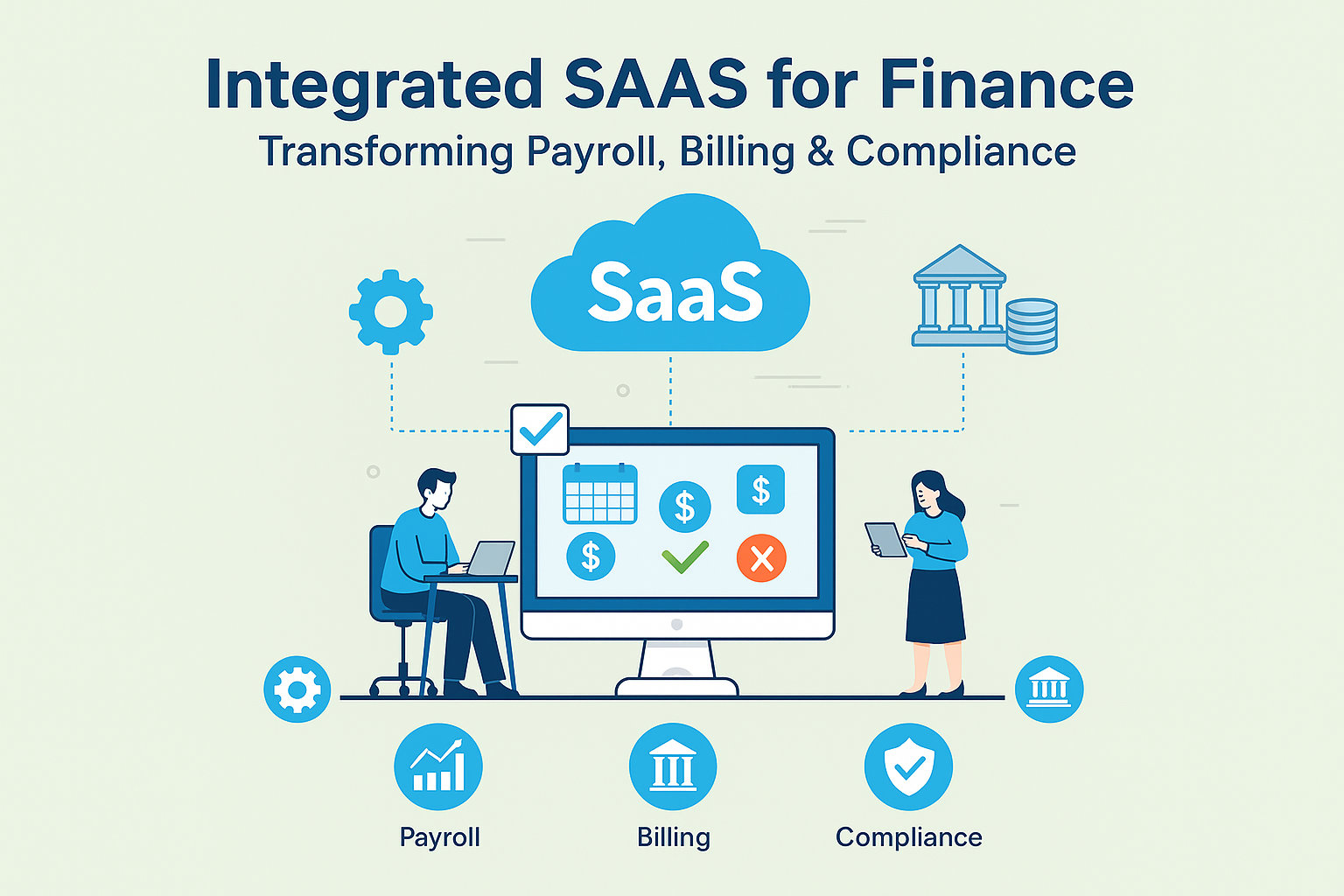
What is Integrated SaaS for Finance?

Integrated​‍​‌‍​‍‌​‍​‌‍​‍‌ SaaS for finance is essentially a harmonized, cloud-based software ecosystem that combines HR, CRM, task management, payroll, billing, reporting, and compliance into one centrally automated platform. An integrated SaaS suite syncs every finance workflow across the organization to keep data accurate, processes automated, and the organization fully visible, rather than using disconnected tools.

Why Do Finance Teams Need Unified Platforms?

Finance departments are increasingly seeking integrated systems that eliminate manual processes, reduce human errors, and ensure consistent compliance across HR, payroll, billing, and client management. A single integrated SaaS solution can enable real-time financial data flow, speed up approval processes, automate recurring tasks, and improve collaboration between HR, finance, and client-facing teams. As a result, final reports can be completed faster with greater accuracy, and overall business management becomes more efficient.

Integrated SaaS for finance is revolutionizing team operations nowadays. By integrating HR, CRM, task management, and workflow automation into a single system, companies are becoming more efficient while operating at lower operational risk.

Automation that unifies HR, CRM, and operations systems, such as WeekMate, increases efficiency, accuracy, and compliance and is the next step for finance.

The Problem: Fragmented Finance Technology Stacks

When finance technology is spread across various platforms, finance teams encounter multiple operational issues:

  • Separate HR software for accounting and invoicing
  • Unconnected billing or reporting for CRMs
  • Manual spreadsheets that cause both delays and errors
  • Repetitive data entry across tools
  • Low visibility of payroll, compliance, and client cycles
  • High risk of audit problems due to the poor synchronization of records

These issues not only slow down the workflow but also increase the necessity for manual interventions. The challenges of disconnected finance tools make it hard for teams to develop, generate new ideas, and keep up with regulations.

Fragmentation results in increased time, cost, and operational complexity, which, in turn, lead to lower accuracy and accountability levels.

WeekMate offers solutions, such as their WeekMate HRMS, that help automate HR, payroll, and compliance in one system.

Feature Fragmented Tools Integrated SaaS
Data Entry Manual, repeated Automated, unified
Compliance High risk Automated tracking
Payroll Disconnected Linked to HRMS
Billing Separate systems CRM-linked billing
Visibility Low Real-time dashboards
Cost High Optimized

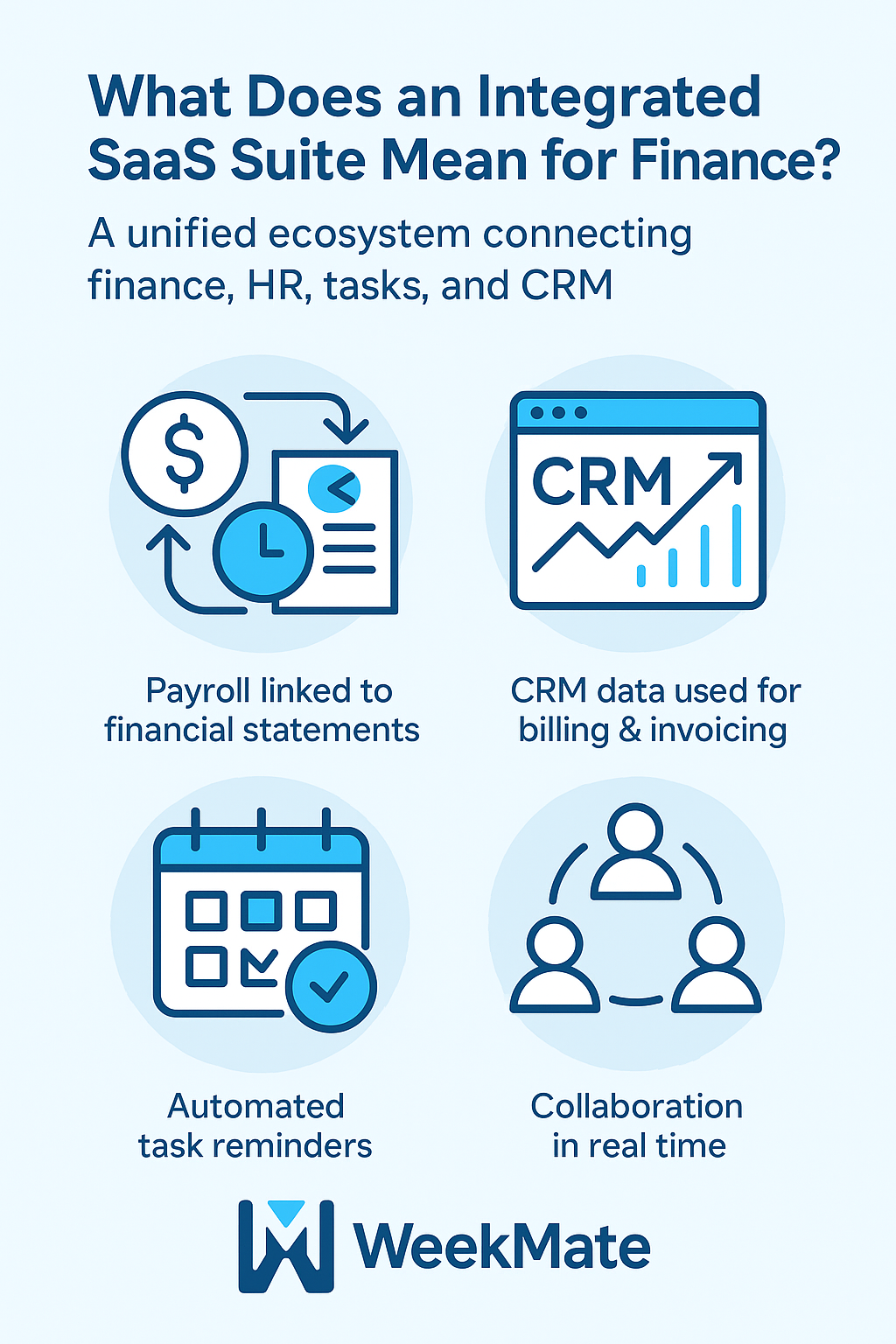
What Does an Integrated SaaS Suite Mean for Finance?

An integrated SaaS suite is a unified finance management software ecosystem that connects HR, CRM, tasks, communication, and finance workflows into one system.

For financial operations, such an integration implies:

  • Payroll and attendance are automatically linked to financial statements
  • CRM records are being directly utilized for billing, invoicing, and revenue forecasting
  • Completely automated task reminders for audit, taxation, and compliance deadlines
  • The cooperation of finance, HR, and client-facing teams in real-time

The platform delivers finance operations automation by eliminating manual data entry and ensuring that work is consistent. This kind of integration fosters transparency and helps control the entire financial lifecycle.

It is the solution to the question: What is an integrated SaaS for finance.

What Does an Integrated SaaS Suite Mean for Finance

Why the Shift Toward Unified Platforms Is Accelerating?

Several industry trends are guiding finance organizations towards integrated systems:

  • More complex regulations
  • A growing number of cloud-based finance solutions
  • Requirement for quicker reporting and real-time visibility
  • Implementation of fintech innovations
  • CFOs are under pressure to give accurate, connected insights
  • Savings achieved through software consolidation

Finance departments do not need only tools they require a unified business management suite capable of end-to-end workflow automation and compliance.

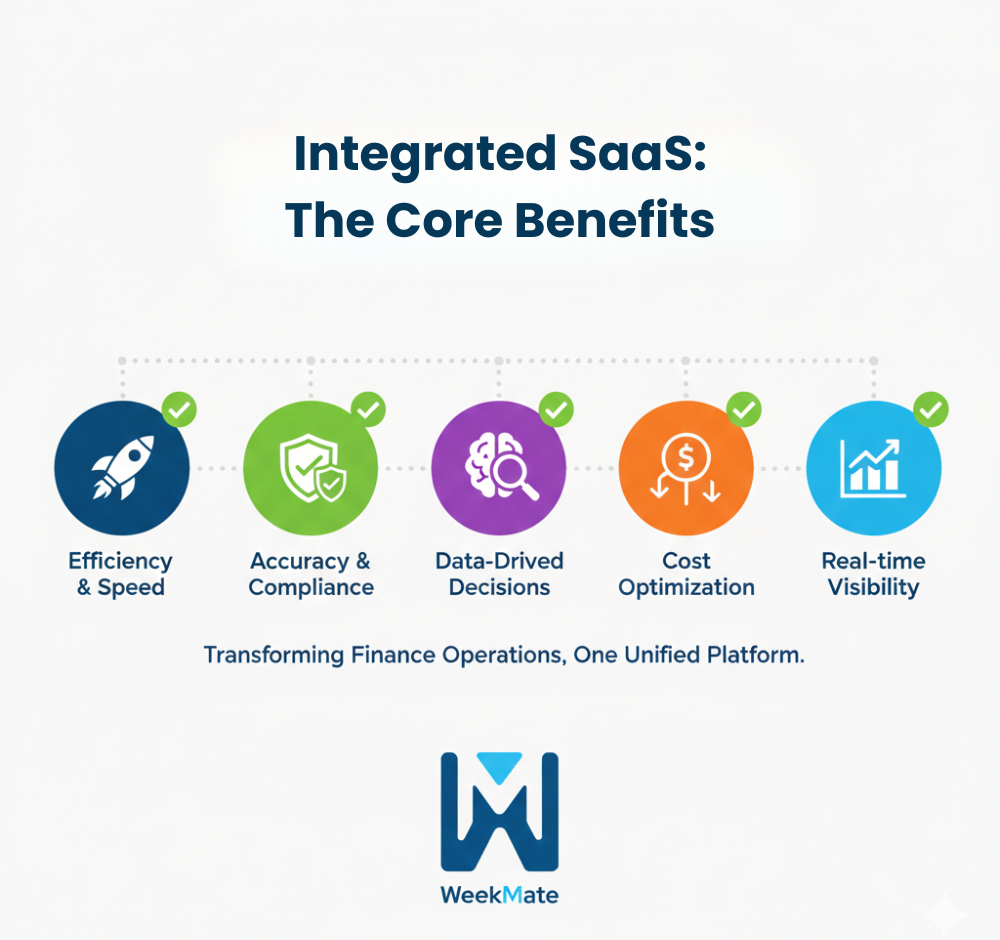
Key Benefits of Integrated SaaS for Finance Operations

Improved Accuracy

By linking data, human errors are reduced, and consistent numbers from HR, CRM, and finance are ensured.

Quicker Decision-Making

Unified dashboards such as WeekMate e-CRM provide immediate, real-time visibility into payroll, billing, tasks, and compliance.

Compliance Automation

The integration of a compliance management system eases audits, document tracking, and reporting.

Operational Efficiency

Thanks to finance workflow automation, employees spend less time switching tools and can devote more time to strategic analysis.

Cost Optimization

Using fewer tools reduces licensing costs and the administrative workload.

These benefits support data-driven financial operations at scale.

Integrated-SaaS-The-Core-Benefits

Practical Use Cases in Finance Departments

1. Payroll & HR Automation

With automated payroll processing, finance teams can check approvals, upload compliance documents, and meet deadlines.

2. Client Management & Billing

CRM-linked billing ensures invoices align with the services provided, which is the main factor in improving revenue accuracy. A great example of this is the WeekMate Email Marketing tool.

3. Auditing & Compliance

Task workflows enable finance teams to check approvals, upload compliance documents, and meet deadlines.

4. Financial Forecasting

Merged data sets enhance finance predictions, expense planning, and revenue modeling using finance analytics and dashboards.

The Future of Financial Automation

The finance department is undergoing an evolution that will eventually lead to the creation of intelligent and interconnected ecosystems.

Some of the most critical changes to expect are:

  • Automation of reconciliation and anomaly detection through AI
  • Use of predictive analytics for increased accuracy of forecasts
  • Centralized risk management within integrated platforms
  • Implementation of modern cloud-based finance solutions in place of legacy ERPs
  • Enhanced security and compliance frameworks
  • Collaboration across departments with HR, sales, and operations

This transformation to the digital world is a step towards complete digital finance transformation, which is beneficial not only for enterprises but also for accounting firms.

How WeekMate Enables Unified Finance Operations?

WeekMate is a robust SaaS platform for accounting firms and finance teams looking for complete operational control. Its linked modules are:

This network facilitates HR integration, CRM connectivity, and operations automation — thereby enabling seamless HR CRM integration for finance.

For example:

A finance team that uses WeekMate HRMS handles payroll, client billing, task assignments, and compliance tracking from a single dashboard. Thus, they save time each week and significantly reduce the chances of reporting errors.

WeekMate enables financial process management; thus, it is the unifier that synchronizes all departments into an automated flow.

This is exactly how to automate finance operations and how SaaS is transforming accounting firms today.

Conclusion: A Single Source of Truth for Financial Success

Modern finance teams can’t afford to use disconnected, manual methods. Integrated platforms provide the clarity, automation, and precision modern financial operations require.

The benefits of unified finance platforms are evident: up-to-the-minute insights, drastically reduced errors, highly improved compliance, and lower operational costs.

Unified SaaS technology is the way forward, and WeekMate is facilitating this transition with its complete suite.

Make an overhaul of your finance operations by implementing unified SaaS technology explore Weekmate’s integrated suite today.

Ecommerce Automation: HR, CRM & Tasks All-in-One Suite ProAI

Ecommerce has expanded substantially in the last ten years, mainly due to the increasing demand for online shopping, the rise of digital payments, and the development of global fulfillment networks. The growth of this business sector also deepens its complexity. To that effect, companies are not only expected to take care of customers but also to manage internal teams and run operations in an orderly manner, most of the time with scarce resources. It is at this point that ecommerce automation appears as a crucial winning factor.

The three major areas comprehended by modern ecommerce operations are:

  • HR‍‌ (Human Resources) – refers to the control and management of people, talents, and business operations.
  • CRM (Customer Relationship Management) – the management and control of customers, sales, and communication.
  • Task Management – scheduling of daily activities across the teams

An enterprise single, unified automation platform that combines the functional interactions of HR, CRM, and task management will make business operations more efficient. It will also scale it and prepare it for a future where AI-powered tools and automated technologies will dominate.

At present, leading brands are adopting an ecommerce management suite that combines HR, CRM, and task management features into a single, seamlessly integrated automation platform. The adoption of such a strategy is a step toward increased operating efficiency, higher accuracy, and long-term scalability.

The Growing Need for Ecommerce Automation

With the changes piling up fast in the e-commerce world, the company is facing numerous challenges, such as:

  • Customers’ increasing expectations for speedy delivery and customized experiences
  • A large number of orders calling for the establishment of scalable systems
  • The management of customer data on different platforms
  • The coordination of employee tasks in the fulfillment, support, and marketing departments

To overcome these hurdles, businesses are moving towards automated ecommerce operations equipped with advanced technologies such as AI in ecommerce, workflow automation, and integration dashboards.

Automation is a must for:

  • Decreasing common manual errors
  • Giving better speed and accuracy
  • Supporting ecommerce growth and scalability
  • Enabling data-driven decision-making

HR Automation in Ecommerce: Streamlining Talent Management

HR is at the very heart of e-commerce: from recruiting warehouse workers to managing the customer support team. Ecommerce HR automation enables businesses to execute HR processes quickly and effectively, even at scale.

Main HR activities facilitated by automation:

HR Function

How Automation Helps

Recruitment Automated filtering, scheduling, and applicant tracking
Onboarding Digital forms, instant training modules, and employee onboarding software
Payroll Error-free calculations and timely payments
Attendance Automated time tracking for remote and on-site staff

Automation helps HR teams by lightening their workload and enhancing the employee experience. Some of the benefits of HR automation in the ecommerce industry are that it leads to better compliance, quicker hiring, and more accurate data ‌management.

What Will Be The Future Trends In HR Automation?

  • Talent acquisition with AI support
  • Workforce management using the prediction model
  • Employee morale system

A tool such as WeekMate HRMS gives ecommerce businesses a great chance to make their HR work more efficient and gather workforce data in one place.

CRM Automation in Ecommerce: Enhancing Customer Relationships

What is CRM in ecommerce?

CRM software enables web-based businesses to track user actions, manage communication, segment audiences, and increase customer loyalty.

Keys CRM duties automated in ecommerce

  • Transforming targeted marketing through customer segmentation and lead scoring
  • Personalized and sequenced email marketing campaigns
  • Customer-support chatbots
  • AI-powered recommendations and responses

Customer data automation via integrated ecommerce + CRM workflows

By leveraging effective CRM automation, companies can elevate retention, drive more repeat purchases, and deliver personalized experiences that foster loyalty.

Where will CRM automation be in the future?

The implementation of AI in the ecommerce industry will go on and play an increasingly important role in predictive sales insights, behavior forecasting, and ultra-personalized communication.

WeekMate e-CRM, together with the WeekMate Email Marketing tool, is an excellent way for ecommerce brands to link their stores to customer data for a 360-degree customer view.

Task Management Automation: Boosting Productivity Across Teams

Task management is at the core of activities such as order processing, inventory management, packaging, and customer communication.

Ways in which automation enhances task management:

  • Auto-assign work based on free time, skill, or importance
  • Automate the repetitive workflows, like order updates or inventory alerts
  • Instant sync with HR and CRM systems
  • Real-time dashboards for tracking KPIs and performance

Having a great task management tool means easier work, quicker turnaround, and better collaboration.

WeekMate TaskHub and similar tools provide visual pipelines, automated task flows, and seamless collaboration.

Advantages of Integrating Three Modules: HR, CRM, and Task Management in a Single Suite

The primary advantages of a unified system, such as an ecommerce management suite are:

Main Benefits

Streamlined workflows

The need for different tools is eliminated; data sharing becomes effortless.

Improved accuracy

Data from CRM, HR, and tasks are harmonized throughout the company.

Enhanced insights

Access to up-to-the-minute analytics on the workforce, customers, and tasks.

Better employee and customer experiences

Quick responses, transparent communication, and process automation.

Lower costs

A single suite provides the functionality of 4–6 separate software subscriptions.

High scalability

Designed for the expansion of stable e-commerce brands.

A scope for such integration facilitates workflow optimization and aligns teams around shared goals.

For example, TaskHub and HR work seamlessly together. Employees punch in and out via TaskHub, and all working hours are instantly synced with HR for accurate tracking and payroll. If the working hours are not completed, a system-automated reminder will be mailed to complete the remaining hours.

The Future of Ecommerce Automation: What to Expect

The following wave of ecommerce technology innovations will be shaped ‍‌by:

Main Trends

  • Advanced machine learning for predictive analytics
  • AI-supported workforce and customer management
  • Extensive CRM and HR integration 
  • Tightening of data security and compliance requirements
  • Uninterrupted integration with marketing, logistics, and finance tools
  • Expansion of integrated business management software

As a result, the leaders who invest in the ecommerce business automation tools will be ahead of their rivals and build a stable, sustainable business model for the future.

Case Studies and Examples

Mid-Size Fashion Brand

  • Integration of HR, CRM, and task management
  • Onboarding time cut by 40%
  • Repeat customer rate increased by 22%
  • Marketing automation saved 15 hours per week

Electronics Retailer

  • Automated order workflows
  • Improved inventory updates through synced task management
  • Customer support response time improved by 35%

Beauty & Wellness Ecommerce Store

  • Automated segmentation and email campaigns
  • Staff productivity increased by 30%
  • Faster customer resolution through CRM-linked tasks

These case studies demonstrate what motivates the best ecommerce automation platforms to integrate various business functions into a single hub, such as WeekMate e-Connect for communication and collaboration.

Conclusion

The use of automation in HR, CRM, and task management is a key factor driving the momentum of change in ecommerce. The whole operation, from employee onboarding to customer engagement and daily task coordination, becomes more efficient with the help of ecommerce automation.

An ecommerce company looking to scale must consider an ecommerce management suite that combines workforce management, customer relations, and task workflows. Such a consolidated approach will not only streamline operations efficiently but also minimize errors and enable the company to grow further in the long term.

By the time automation reaches its next stage of development, those firms that decide to equip themselves with smart, connected solutions will find themselves in a much stronger position to expand and prosper in a fiercely competitive market. 

7 Key Principles of Effective Human Resource Management

Human‍‌ Resource Management (HRM) is the function that supports companies in handling their staff most efficiently. It covers everything from attracting the right talent to saving employees, solving issues, building a good workplace, and, overall, shaping organizational success. The basics of human resource management are about ensuring that people are valued, supported, and aligned with business objectives.

As companies grow, they cannot do without structured HR practices. Knowing the principles of human resource management helps leaders create workplaces that are fair, productive, and people-first. The employee principles guide how people are hired, trained, managed, and rewarded. As such, they act as a lever to the entire employee lifecycle.

Nowadays, with tools such as WeekMate HRMS, companies can implement these HR practices effectively and precisely.

What Are the Fundamentals of Human Resource Management?

The fundamentals of human resource management are the primary elements that define how the HR department functions. These HRM fundamentals cover the handling of the people in the company, which is divided into major areas, such as:

  • Talent acquisition
  • Training and development
  • Performance management
  • Compensation and benefits
  • Workforce planning
  • Employee relations and compliance

Particularly, these Core HRM concepts serve as the basis for institutions to recruit the best candidates, nurture them, assess their performance, and keep them engaged through the creation of effective employee policies. HR goes beyond administration and serves as a business growth engine.

The basics also serve as the platform for wider principles of HRM. Without a deep understanding of recruitment, employee development, and office relations, it would be tough to implement HR principles at the right level.

Core Principles of Human Resource Management

Recognition of the principles of human resource management is essential, as they underpin every HR decision. In line with the fundamentals of human resource management, these guidelines ensure that organizations establish solid, people-centred approaches.

The essential HRM principles that any company has to abide by:

1. Fairness and Equity

Each employee is entitled to equal treatment, opportunity for personal development, and, of course, respect. Fair HR practices are the main drivers of D&I and thus help to create trust.

2. Transparency and Communication

One of the keys to a successful organization is an open communication process between all involved parties. This makes everything clear, eliminating the chance for misunderstandings, and a collaborative culture results. All this has a direct impact on organizational culture, enhancing employee satisfaction.

3. Employee Development and Empowerment

Employee training and development programs serve as a platform for skill enhancement, which in turn facilitates employee growth. Empowerment gives employees a sense of ownership, which, in turn, increases overall productivity and motivation.

4. Performance and Accountability

Helping employees have a clear understanding of what is expected of them and providing constructive feedback is the way to keep them working towards organizational goals. An efficient performance management system is the primary vehicle for accountability and recognition.

5. Strategic Alignment

The functions of HR, its policies, and strategies must support the business goals. The reason companies get along well with a long-term strategy is that HR initiatives align with it. This allows businesses to build a strong talent pool that is ready for the future.

6. Legal and Ethical Compliance

The role of HR in this respect is to implement labor laws and workplace ethics, and to ensure compliance with safety regulations. Thus, it safeguards both the staff and the employer.

7. Employee Well-being

The promotion of work-life balance, employee health, and the provision of well-being programs all benefit employee engagement and retention, too.

By applying these principles of HRM, leaders can build transparent, ethical, and growth-oriented workplaces. One can implement these ideas with the help of instruments such as WeekMate HRMS, which automates procedures, supports performance reviews, and centralizes HR data.

Why the Principles and Fundamentals of HRM Matter?

The importance of HRM principles lies in their ability to create high-performing teams. Those organizations that follow these principles:

  • Become more productive
  • Clients of the company feel trust, and that is why the loyalty of employees also increases
  • Turnover goes down
  • Employee engagement improves
  • Working together becomes a natural way

In the real world, companies that emphasize HRM principles usually experience a positive organizational culture and stronger retention. For instance, through investments in training, feedback, and recognition programs, companies can boost not only employee morale but also overall results.

There is a very strong link between the fundamentals of human resource management and the principles: the fundamentals guide the processes, whereas the principles address behavior and approach. These two together lead to continuous workforce development.

Challenges in Applying the Principles of Human Resource Management

Situation with the best intentions in place, organizations may still have to deal with challenges such as:

  • Resource-strained by either a limited budget or a short-handed HR team
  • Highly traditional mindset and a reluctance to change
  • Lack of knowledge or training in this area
  • HR department with antiquated strategies and policies
  • Communication that is far from excellent or fragmented systems

In overcoming these obstacles, the management should be working towards tiny but continuous victories. One may take the example of digital innovations such as WeekMate HRMS: by investing in such a solution, the organization simplifies not only its compliance but also its processes, and at the same time ensures transparency, making it easier to apply the principles of HRM.

The Shift Toward Tech-Driven, People-Focused HR

The changes in workplaces today are a direct result of globalization, hybrid work, and digital transformation. Therefore, the basis of human resource management has changed significantly and now goes beyond administrative work.

Some of the new HRM fundamentals are:

  • HR decisions are now based on analytics
  • Digital onboarding and performance tools
  • Automated workflows
  • Employee-centric practices

Technology is a very important factor in this case. HR solutions such as WeekMate HRMS enable organizations to automate routine work, enhance accuracy, and make HR more strategic. With this digital shift, HR teams can focus more on people and less on manual work.

Conclusion: Creating a People-First Organization

Grasping the principles of human resource management and knowing the fundamentals of human resource management are the keys to having strong, healthy workplaces. The businesses that combine good ground with clear HRM principles foster an environment where workers recognize, encourage, and drive themselves.

The fundamentals of human resource management are still evolving, but the aim remains the same – to manage people effectively and appropriately while contributing to business growth. It doesn’t matter if your organization is big or small; it is the right moment to improve your HR practices and build a people-first culture.

Innovative solutions like WeekMate HRMS empower companies to simplify HR operations and maintain compliance with these principles.

FAQs

1. What are the main principles of Human Resource Management?

The main principles of HRM include inclusiveness, strong communication, strategic alignment, employee development, responsibility and accountability, legal compliance, and ensuring overall employee well-being.

2. Why are the principles of HRM important for organizations?

Implementing these principles leads to increased productivity, higher trust, enhanced employee engagement, better retention, and improved overall organizational effectiveness.

3. What are the fundamentals of Human Resource Management?

The fundamentals of HRM include recruitment and selection, employee training and development, performance management, compensation and benefits, workforce planning, and maintaining healthy employee relations.

4. How do the basics of Human Resource Management differ from HRM principles?

The basics describe the core functions that HR is responsible for, while HRM principles explain how HR should operate—ethically, strategically, transparently, and with a focus on people.

Become A Partner