Managing customers used to be simple.
A few Excel sheets. A notebook on the desk. Maybe some follow-up reminders on WhatsApp.
But businesses in 2026 don’t operate that way anymore.
Today, sales teams handle leads from websites and social media. Then there are traditional calls and emails. After your business generates leads from campaigns, and marketplaces. All at the same time.
Without a proper CRM system, things get messy very quickly. Leads get missed. Follow-ups get delayed. Customer conversations become impossible to track.
Startups, SMEs, or large enterprise teams need a CRM software. The right CRM can completely change how your business handles sales. Customer relationships, and team productivity improves.
The problem?
There are too many CRM platforms available right now.
Some are packed with features but difficult to use. Some are affordable but limited.
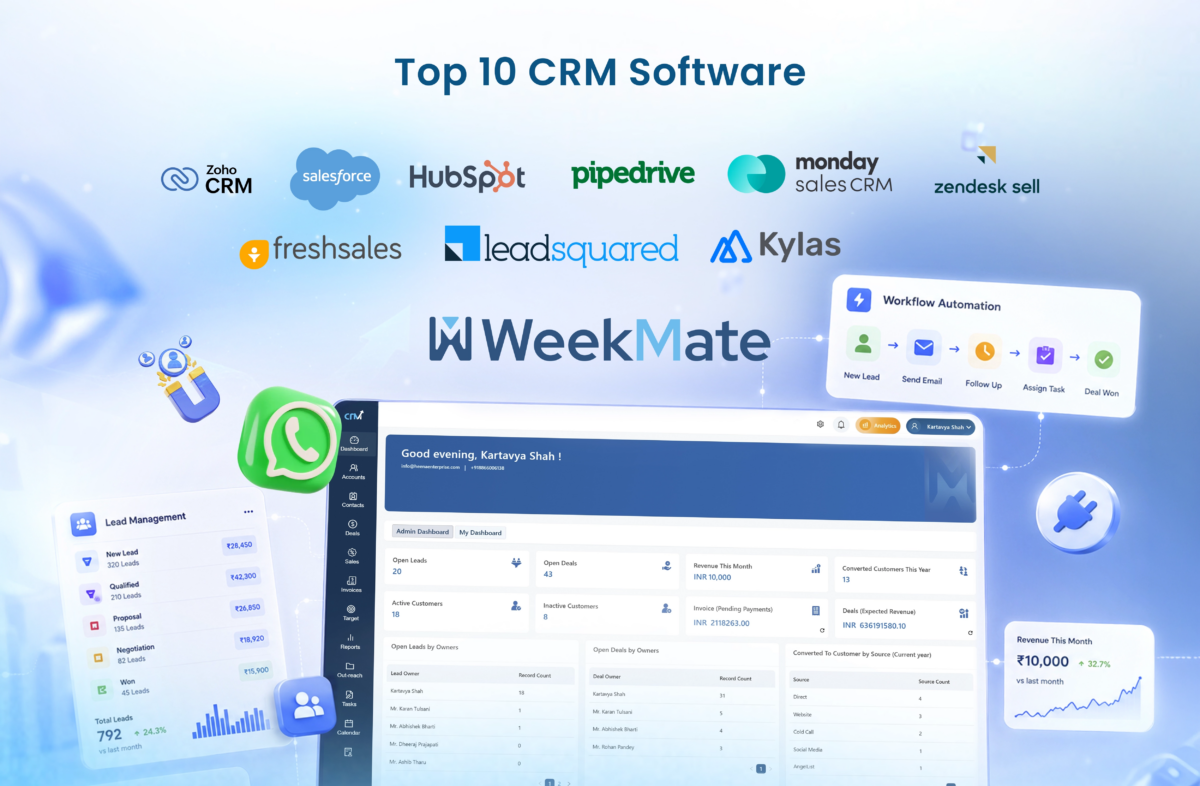
To make things easier, we compared some of the top CRM platforms businesses in India. We shortlisted the best options worth considering in 2026.
Searching for the best CRM software in India? This guide will help you make a practical decision.
What is the Evaluation Criteria We Followed?
Not every CRM fits every business.
A startup with a 5-member sales team has completely different needs compared to a large enterprise managing multiple departments and regions.
So instead of simply listing popular names, we evaluated each CRM platform based on real business requirements.
1. Ease of Use
A CRM should simplify work, not create more confusion.
We focused on platforms that are easy to navigate, simple to adopt, and don’t require weeks of training just to get started.
2. Automation Features
Modern businesses cannot afford to manage leads manually anymore.
We checked whether the CRM supports:
- Automated follow-ups
- Lead assignment
- Workflow automation
- Sales reminders
- Pipeline tracking
- Task management
Also Read: Why Custom CRM Software is the Future of Business Automation?
3. Scalability
The CRM you choose today should still support your business two or three years later.
We evaluated whether these platforms can handle growing teams, advanced workflows, reporting, and multiple business functions.
4. Pricing & Overall Value
A CRM may look affordable initially but become expensive later through upgrades and add-ons.
We considered:
- Feature availability
- Per-user pricing
- Upgrade flexibility
- Long-term value
5. Integrations
Businesses use multiple tools daily.
A good CRM should connect smoothly with platforms like:
- Email tools
- Marketing software
- ERP systems
- HR software
- Customer support platforms
How to Choose the Right CRM Software in India?
A few practical things businesses should consider before investing in a CRM platform.
1. Understand Your Business Stage
- Startups usually need simplicity and affordability.
- Growing SMEs need automation and reporting.
- Enterprises require customization, and multi-team workflows.
Choose accordingly.
2. Prioritize User Adoption
Even the best CRM becomes useless if your sales team avoids using it.
Always choose a platform with a clean interface and easy learning curve.
3. Focus on Automation
The right CRM should reduce manual work.
Look for features like:
- Auto lead distribution
- Workflow automation
- Email reminders
- Follow-up scheduling
- Activity tracking
4. Check Mobile Accessibility
Sales teams work on the go.
Mobile access is no longer optional in 2026.
5. Compare Hidden Costs
Many CRM platforms increase pricing as teams grow.
Before finalizing, always check:
- User limits
- Automation limits
- Storage caps
- Premium support charges
List of Top 10 CRM Software in India
|
CRM Software |
Best For | Ease of Use | Automation | Scalability |
User Rating |
|
WeekMate |
Startups & SMEs | Excellent | Excellent | High | 4.8/5 |
| Zoho CRM | SMEs | High | Excellent | High |
4.5/5 |
|
Salesforce Sales Cloud |
Enterprises | Moderate | Excellent | Enterprise-Level | 4.6/5 |
| HubSpot CRM | Growing Businesses | Excellent | Strong | High |
4.5/5 |
|
Freshsales |
Sales Teams | High | Strong | Moderate | 4.4/5 |
| LeadSquared | High-Volume Sales | Moderate | Strong | High |
4.3/5 |
|
Pipedrive |
Small Sales Teams | Excellent | Moderate | Moderate | 4.5/5 |
|
Monday Sales CRM |
Collaborative Teams | High | Strong | High |
4.4/5 |
| Zendesk Sell | Service Businesses | Moderate | Moderate | High |
4.3/5 |
|
Kylas CRM |
Indian SMEs | High | Moderate | Moderate |
4.3/5 |
1. WeekMate
WeekMate CRM is becoming a preferred CRM solution for Indian startups and growing businesses. The platform is practical and easy-to-manage.
It doesn’t overwhelm users with unnecessary complexity. WeekMate focuses on simplifying sales management and customer communication. It integrates follow-ups, task tracking, and team collaboration from one centralized system.
Businesses searching for the best CRM software in India are increasingly considering WeekMate. The platform balances affordability, automation, and usability.
Key Features
- Smart lead and contact management
- Sales pipeline tracking
- Automated reminder management and follow-ups
- Team collaboration tools
- Custom workflows and reporting dashboards
User Rating: 4.8/5
Best For: Startups, SMEs, and growing businesses.
2. Zoho CRM
Zoho CRM remains one of the most widely used CRM platforms in India.
It offers sales automation and omnichannel communication. It also presents detailed analytics, and integrations. Businesses already using Zoho products often prefer Zoho CRM because of the common ecosystem.
Key Features
- Multi-channel customer communication
- Workflow automation
- AI-powered sales assistant
- Advanced analytics
- Extensive integrations
User Rating: 4.5/5
Best For: SMEs and businesses are already using Zoho tools.
3. Salesforce Sales Cloud
Salesforce Sales Cloud is one of the most powerful enterprise CRM platforms. Services are available globally.
It is designed for businesses that need deep customization. You get advanced reporting, and AI-driven forecasting. The platform is ideal for large-scale workflow management.
Smaller teams may find it complex. But enterprises benefit heavily from its scalability.
Key Features
- Advanced sales automation
- AI-driven forecasting
- Enterprise workflow customization
- Detailed analytics
- Large integration marketplace
User Rating: 4.6/5
Best For: Large enterprises and enterprise sales teams.
4. HubSpot CRM
HubSpot CRM comes with a clean interface and beginner-friendly experience.
It combines CRM, marketing, and customer support tools under one ecosystem. This CRM tool is a strong option for growing businesses.
Key Features
- Contact management
- Email tracking
- Marketing automation
- Reporting dashboards
- Customer support integrations
User Rating: 4.5/5
Best For: Growing businesses and marketing-focused teams.
5. Freshsales
Freshsales by Freshworks focuses heavily on sales productivity and customer engagement.
Its interface is simple and clean. The tool is suitable for businesses that want strong automation without excessive complexity.
Key Features
- AI-powered lead scoring
- Built-in email and calling
- Workflow automation
- Sales pipeline tracking
- Activity monitoring
User Rating: 4.4/5
Best For: SMEs and sales-focused businesses.
6. LeadSquared
LeadSquared is highly popular among businesses that manage high lead volumes.
It is widely used in sectors like education, healthcare, and financial services. The tool is beneficial where lead capture and follow-up speed matter significantly.
Key Features
- Lead capture automation
- Marketing automation
- Field sales tracking
- Sales workflows
- Mobile CRM access
User Rating: 4.3/5
Best For: High-volume sales and field sales teams.
7. Pipedrive
Pipedrive is designed primarily for sales teams that want a visually organized pipeline.
Its biggest strength is simplicity. Teams can quickly track deals, follow-ups, and sales stages. You don’t need to spend time learning complicated systems.
Key Features
- Visual sales pipeline
- Deal tracking
- Workflow automation
- Email integrations
- Sales forecasting
User Rating: 4.5/5
Best For: Sales-focused startups and SMEs.
8. Monday Sales CRM
Monday Sales CRM combines CRM functionality with workflow and collaboration management.
Monday Sales CRM offers customization flexibility. So, businesses that need visibility across departments often prefer this platform.
Key Features
- Workflow customization
- Team collaboration
- Lead management
- Automation templates
- Reporting dashboards
User Rating: 4.4/5
Best For: Collaborative teams and workflow-heavy organizations.
9. Zendesk Sell
Zendesk Sell focuses on improving sales productivity while keeping customer communication organized.
It works particularly well for businesses already using Zendesk customer support products.
Key Features
- Contact management
- Pipeline visibility
- Email and call tracking
- Reporting tools
- Sales engagement monitoring
User Rating: 4.3/5
Best For: Customer service-driven businesses.
10. Kylas CRM
Kylas CRM is built specifically for growing Indian businesses.
It keeps things simple. The platform offers enough automation and sales management features for scaling teams.
Key Features
- Lead management
- Workflow automation
- Pipeline tracking
- Contact management
- Sales reporting
User Rating: 4.3/5
Best For: Indian startups and SMEs.
Must Read: Benefits of Custom CRM Software for Growing Businesses
Final Verdict
There’s no “perfect” CRM for every business.
The right CRM depends on your team size, workflow complexity, sales process, and growth plans.
Here’s a simpler breakdown.
1. For Startups
WeekMate, Pipedrive, and Kylas CRM.
2. For SMEs
WeekMate, Zoho CRM, Freshsales, and Monday Sales CRM.
3. For Enterprises
Salesforce Sales Cloud
However, businesses looking for a more practical and easy-to-manage solution are increasingly exploring WeekMate because of its simplicity, automation capabilities, and scalable approach.
FAQs
1. Which is the best CRM software in India for small businesses?
Top choices for small businesses include WeekMate, Zoho CRM, and Kylas CRM. These platforms offer affordability, automation, and ease of use.
2. Why do businesses need CRM software?
CRM software helps businesses manage leads and customer interactions. Automation helps with follow-ups and sales pipeline management. Team collaboration happens from one centralized platform.
3. Is CRM software suitable for startups?
Yes, CRM software helps startups organize customer data. Automate repetitive sales tasks. You can Improve follow-up consistency from the early stages of growth.
4. Which CRM is best for enterprises?
Weekmate and Salesforce Sales Cloud are widely considered. Both of them offer advanced customization and scalability.
5. Why are businesses choosing WeekMate CRM in 2026?
Businesses prefer WeekMate because it offers a clean interface. It has useful automation features and easy adoption. You get scalable CRM functionality without unnecessary complexity.