How Agentic AI in HRMS is Replacing Manual HR Workflows in 2026

HR was never exhausting. But somewhere along the way, it just became repetitive: screening resumes, chasing approvals, fixing payroll errors, answering the same employee questions over and over. Then gradually, automation came in. It certainly helped, but not much. Now in 2026, things are shifting in a very noticeable way.

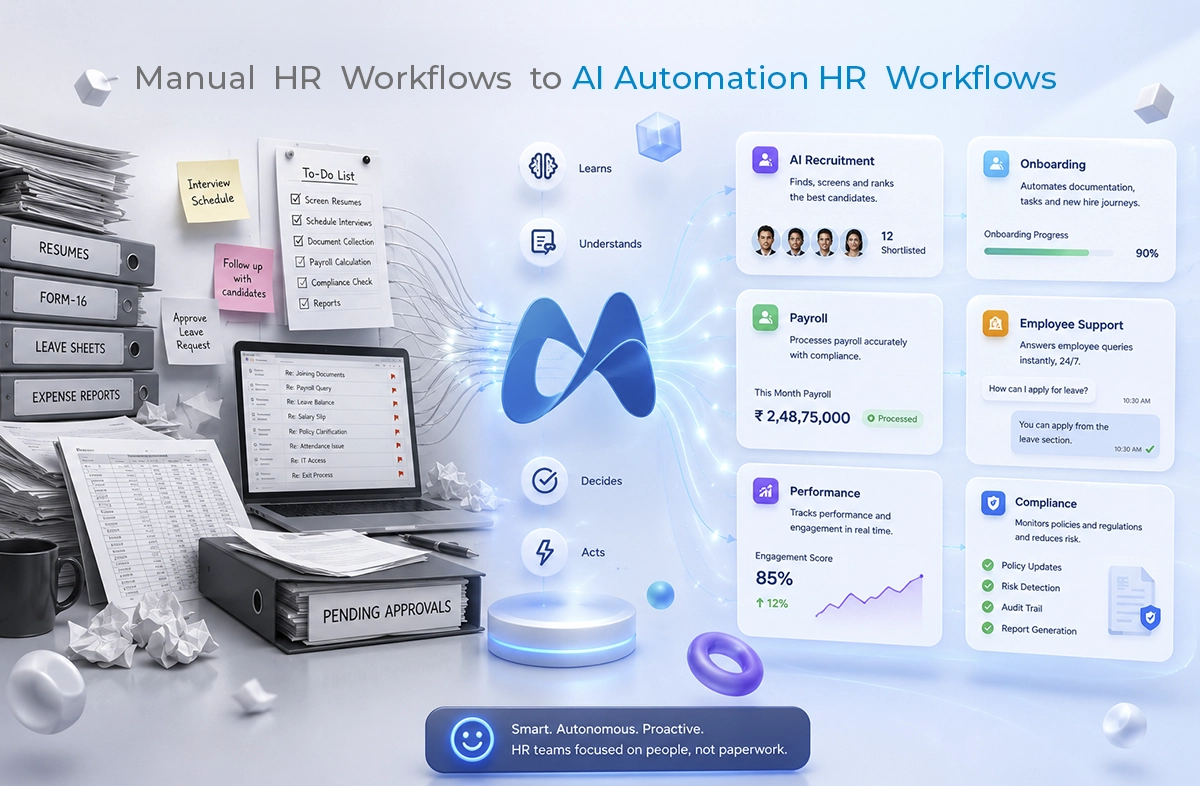
We’re moving from “automating HR” to something far more interesting. We’re building HR systems that can think, decide, and act on their own. And that’s where Agentic AI in HRMS comes into the picture.

Businesses today are not just worried about reducing the workload. They are working to make HR processes smarter. That’s because the best HR management software isn’t just tools anymore. They’re becoming partners.

What is Agentic AI in HRMS?

Defining Agentic AI

Agentic AI is an automated system that does not work on standard rule-based automation. So traditional AI follows instructions. But, agentic AI independently sets goals, makes decisions, and executes tasks. It almost works like a digital teammate.

So instead of saying, “Screen these resumes,” you’re saying, “Find the right candidate.” And the system figures out how to get there. It analyzes, decides, adjusts and then executes.

In HR, that means:

  • It can prioritize hiring needs without being told.
  • It can flag employee issues before they become problems.
  • It can even suggest decisions you didn’t realize needed to be made.

How Agentic AI Works Inside a Modern HRMS Platform

Inside a modern HRMS, agentic AI doesn’t sit in one corner doing one job. It connects everything.

Recruitment, payroll, attendance, and engagement are part of a continuous loop of data and decision-making. The AI agent continuously learns from patterns like employee behavior, team performance, and historical HR data. Based on all this, it starts predicting what might happen next. So instead of reacting to problems, it tries to prevent them.

Why This Shift Matters So Much in 2026

Work has changed a lot. Teams are no longer sitting in the same office. Hiring is global. Expectations are higher. And decisions must happen fast and sometimes instantly.

Manual HR processes just can’t keep up with that pace anymore. Even traditional automation struggles because it’s rigid. It doesn’t adapt well.

Agentic AI changes that. It brings flexibility, speed, and something HR systems have always lacked: awareness.

The Evolution of HR Automation

There was a time when HR automation felt something great. You could automate emails, schedule interviews, generate reports, and that was enough.

When you think about it, you realise that those systems were still dependent on humans to guide every step.

But now, in 2026, HR systems are becoming responsive in a much deeper way. Not just executing tasks, but shaping them.

From Rule-Based Systems to Something More Fluid

Earlier systems worked like this: “If X happens, do Y.” It was simple, predictable, but limited.

Because real-world HR isn’t that straightforward. Now, systems adjust based on context. They learn from outcomes. They improve with time. They now understand intent more than just following instructions.

Key Trends Driving HR Automation in 2026

When you notice closely, you will see a few patterns in those companies that are adopting advanced HR systems:

  • Conversational AI is replacing traditional HR helpdesks
  • Predictive analytics is guiding hiring and retention
  • AI-driven employee lifecycle management
  • Autonomous compliance tracking

Industries Rapidly Adopting Next-Gen HR Technology

Not surprisingly, industries dealing with complexity are moving first.

IT & SaaS: High hiring volume, remote team

Healthcare: Compliance-heavy operations

Manufacturing: Workforce scale and shift management

Startups: Need for scalable HR

Major Manual HR Tasks Being Replaced by Agentic AI

This is probably the most visible change. Tasks that once took hours are now handled in the background. They are not completely removed; just redefined.

Recruitment and Candidate Screening

Resume screening used to be very time-consuming. Now, it happens almost instantly.

It’s not just about speed. AI systems are matching candidates based on skills, behavior patterns, and even cultural alignment. Interviews get scheduled automatically, and follow-ups happen without reminders.

Employee Onboarding and Documentation

New employees often feel overwhelmed on day one. Too many forms, too many policies, not enough clarity. Agentic AI changes that.

It creates structured onboarding paths, explains policies in simple language, and ensures nothing gets missed.

Payroll and Attendance Management

Payroll errors used to be stressful. But now, systems handle calculations, deductions, and compliance all in real time with their payroll automation systems.

Further, attendance tracking adapts to hybrid work models and leave management becomes seamless.

Employee Support and HR Helpdesks

Instead of waiting for HR responses, employees now interact with AI assistants. They ask questions, get answers and move on.

And over time, these systems get more accurate, more helpful and more human-like.

Performance Management and Engagement

Annual reviews feel outdated now. Systems track performance continuously. Feedback is generated in real time. Patterns are analyzed quietly in the background.

Managers no longer have to rely on memory.

Compliance and Policy Management

Regulations change. Policies evolve. Risks appear unexpectedly.

Earlier, HR teams reacted to these changes. Now, systems continuously monitor HR statutory compliance. They flag risks early, suggest actions and even generate audit reports.

Benefits of Reducing Manual HR Tasks Using AI

This is where things come together. Because it’s not just about replacing tasks. It’s about changing outcomes.

Efficiency Gains

Tasks have become faster. But more importantly, they’re lighter. HR teams aren’t overloaded anymore. They have space to think, plan, and focus on people instead of processes.

A Better Employee Experience

When systems respond instantly and accurately, employees feel supported. Not because someone is constantly checking on them. But because the experience just works.

Data Accuracy and Compliance

Mistakes are reduced, and reports become cleaner. Hence, the decisions become more reliable.

Cost Savings and Scalability

Less manual work means fewer resources spent on repetitive tasks. And scaling has become easy.

HR Becomes Strategic

This is probably the biggest shift. HR isn’t just executing anymore. It’s guiding decisions, shaping culture, influencing growth. And that changes how businesses operate at a deeper level.

The Future of HRMS with Agentic AI

Autonomous HR Departments

Not fully autonomous, but close. Systems handle operations. Humans focus on strategy. It’s a balance, and when done right, it works beautifully.

Employee Experiences That Feel Personal

Every employee gets a different journey. Learning paths, benefits, engagement strategies—all tailored. It doesn’t feel generic anymore.

Ethical AI Becomes Non-Negotiable

With power comes responsibility. And this is where companies need to be careful. Bias needs to be addressed. Decisions need to be transparent, and data needs to be protected.

Humans + AI, Working Together

This isn’t about replacement. It’s about collaboration. AI handles repetition. Humans handle judgment, empathy, and leadership. And together they create something far more effective.

Choosing the Best HR Management Software for Agentic AI

Important Features to Look For

  • Workflow automation
  • Predictive analytics
  • Employee self-service tools
  • Seamless integrations

Questions You Should Ask Vendors

  • Can the AI be customized?
  • How secure is the data?
  • Will this scale with our growth?

Common Mistakes to Avoid

Some things to watch out for:

  • Ignoring integration challenges
  • Overlooking employee adoption
  • Choosing outdated systems

It’s not just about features, it’s about fit.

Challenges of Implementing Agentic AI in HRMS

Let’s not ignore this. Implementing agentic AI isn’t frictionless.

  • Data quality can slow things down.
  • Employees might resist change.
  • Too much automation can feel impersonal.
  • Regulations still need careful handling.

But with the right approach, these are manageable.

Final Thoughts

One thing is clear in 2026, that HR is no longer just a support function. It’s becoming a strategic driver and decision-making force.

And Agentic AI in HRMS is playing a big role in that transformation. From reducing manual work to enabling intelligent workflows, the shift is real. And businesses that embrace it early? They’re not just keeping up. They’re moving ahead.

So if you’re exploring ways to modernize your HR operations, it might be time to look into the best HR management software built for this new reality.

FAQs

1. What is Agentic AI in HRMS?

Agentic AI is an automated system that does not work on standard rule-based automation. It lets systems make decisions, handle HR tasks, and improve workflows independently.

2. How is it different from traditional automation?

Traditional automation only works by following a set of rules. Whereas Agentic AI can adapt, learn from experience, and respond to different situations by itself.

3. Is it suitable for growing businesses?

Yes. Agentic AI is especially helpful for companies that want to grow without adding more work for their HR teams.

4. Does it replace HR teams?

No, it does not replace humans. It actually helps by automating repetitive tasks so people can focus on more strategic work.

5. Is Agentic AI safe to implement?

Yes, Agentic AI is safe to use when companies make data security, transparency, and responsible AI practices a priority.
Top AI Features Every Modern HR Management Software Must Have

Modern organisations are changing in every way because of artificial intelligence. Finance teams are forecasting smarter, marketing is completely personalised, and operations are in sync like never before. So here is a fair question: why should the HR department be left behind? The truth is, it should not be left behind, and the best companies are making sure it is not.

This is where HR management software comes in. To be honest, the way we handle human resources has changed more in the last five years than it did over the previous two decades. The reason for this change is simple: ‘artificial intelligence’. AI is changing how companies take care of their people, processes, and performance.

So if you are still using the simple HR software, you are probably missing out on great advantages. The best platforms that we have today come with intelligent features that learn, adapt, and help the team on a daily basis.

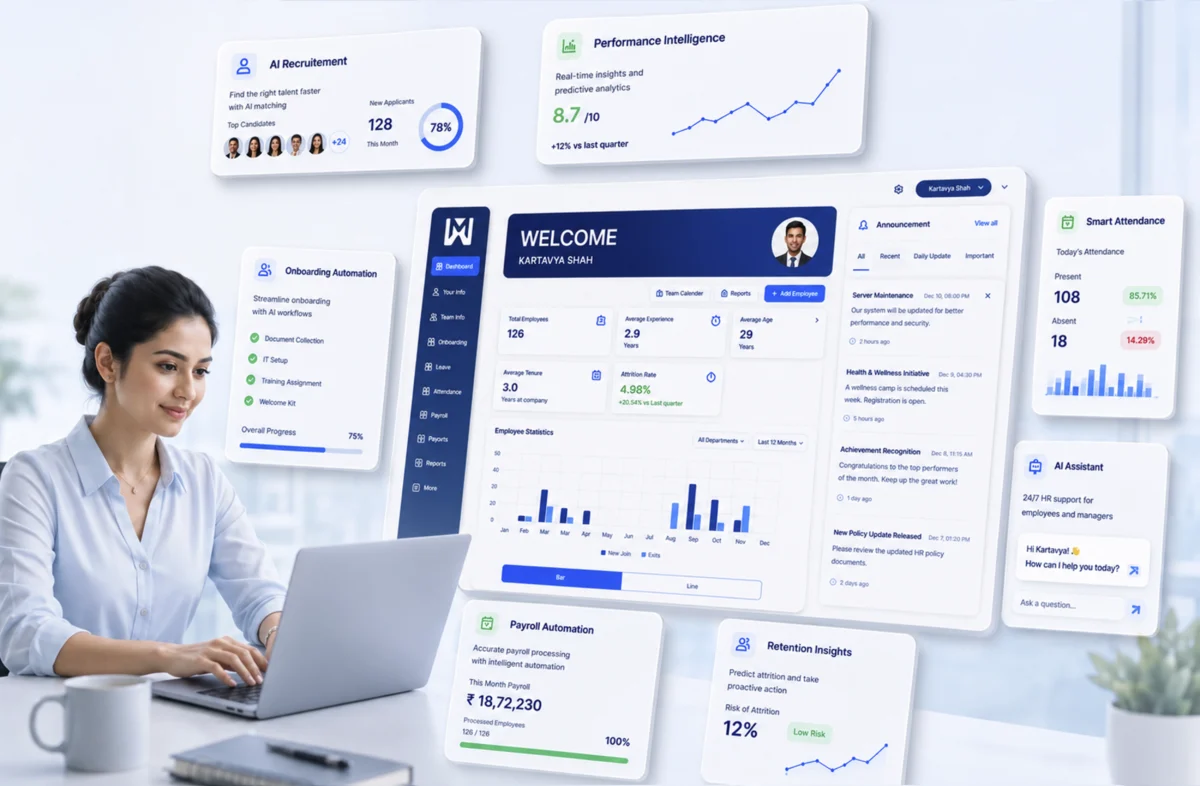
Choosing appropriate HR management software features can change the way your company hires new people, retains existing employees, or develops its team. From automating repetitive daily tasks to enabling predictive decision-making, AI is reshaping what HR can do across every sector of work.

10 AI Features To Look For In A Modern HR Management Software

Let’s take a look at the most important AI features that any modern HR platform should have. If you are an HR manager at a growing startup or a CHRO at a large company, this list will help you know what to look for:

1. AI-Powered Recruitment and Hiring Tools

Hiring today is not only about manually filtering the candidate resumes. It is about selecting the right people accurately and consistently. And we all know that this process is lengthy and very time-consuming. But we have a key. In these scenarios, AI solutions for hiring and recruitment can really help you. Here’s how they do it:

Instead of going through individual resumes manually, AI tools help you to quickly scan, rank, and shortlist candidates from vast databases based on their skills, experience, and how well they fit the role. It is further enhanced by the use of machine learning models that match candidates based on successful past hiring decisions and outcomes.

In addition, AI-powered chatbots can carry on initial conversations, answer basic questions, and schedule interviews in real time. This relieves teams and also enhances the candidate experience.

Further, AI takes into consideration only skills and qualifications, which removes bias or the influence of other factors that sometimes unintentionally occur.

Here’s an example. An AI-powered HRMS can significantly reduce the time to hire. This gives an edge to the companies. Since top candidates often get several offers in a week, moving quickly can be a crucial factor for hiring a standout or losing them to another company.

2. Intelligent Performance Tracking Systems

Traditional performance reviews are often irregular and slow. Modern HR software for performance tracking with AI focuses on ongoing, real-time feedback throughout the year.

AI-enabled systems provide live performance dashboards that allow managers to track progress and fix issues as and when they occur. Also, predictive analytics can help identify trends in future performance, making it easier to recognise top performers and support those who may need help.

A key benefit is personalised feedback. Employees are assessed based on their actual performance rather than standard or generic comments, leading to greater engagement and motivation. Goals are also automatically assigned to align individual KPIs with team and company goals.

Another often ignored benefit is fairness. Human managers may unintentionally bring hidden biases into reviews. AI can show clear performance data along with personal feedback, giving everyone a balanced view. It does not replace the manager’s judgement, but it helps make discussions more focused on facts.

In the end, using AI for productivity tracking creates a culture of transparency, accountability, and continuous improvement.

3. Smart Attendance and Workforce Monitoring

Most people don’t like to track attendance, but it’s a necessary part of work. Traditional methods like punch cards, sign-in sheets, and simple biometrics often miss key details, especially in today’s hybrid and remote work environment.

A modern AI attendance tracking system offers a simple, accurate and efficient process with real-time updates. It uses tools like facial recognition and biometrics to verify who is present. Further, GPS-based attendance makes remote and field teams more flexible and reliable.

These systems also reduce admin work by automating shift scheduling and leave management. HR teams can now easily identify attendance patterns and know who is present.

4. Predictive Analytics for Employee Retention

Nowadays, retaining employees has become difficult for modern workplaces. These days, smart companies don’t just wait for people to quit; they try to predict when they might leave.

There are AI-driven retention tools that use predictive analytics and large data to detect early signs of disengagement. Some of these signs are:

  • Less participation in team meetings or chat platforms.
  • A sudden decrease in performance metrics.
  • Decreased use of paid time off.
  • Less participation in internal training or development opportunities.

It further allows organisations to implement targeted retention strategies such as personalised engagement programmes, career growth options, and better compensation.

5. Automated Employee Onboarding

Onboarding is the first actual experience employees have in an organisation. This phase greatly affects what follows in their professional journey.

From the moment documents are checked, processes move faster because machines handle setup tasks one after another. New joiners receive guided steps, automated reminders, and an onboarding procedure dedicated to their specific roles. Each stage adjusts quietly behind the scenes, ensuring relevance without manual input.

This reduces chaos and helps employees become familiar and productive faster. But more than that, it creates a positive first impression.

It also lightens the workload for HR teams, thereby improving the overall employee experience. A well-executed onboarding process leads to higher engagement, faster productivity, and less attrition.

6. Conversational AI and HR Chatbots

Much of an HR team’s day is often spent answering the same questions over and over. This can result in slow progress while staff wait for answers. Efficiency improves when automated conversations handle routine requests instead. As a result, dependence on HR decreases.

AI chatbots provide quick, 24/7 support to employees. It promptly answers standard questions on leave, salary details or company policies. They are connected thoughtfully to human resources platforms and pull information from policy documents and employee records. It leads to accurate replies since it comes from live data rather than guesswork.

There’s another benefit: chatbots keep track of the most common employee questions. Patterns begin emerging when multiple queries cluster around one topic.

For example, a lot of people might ask about remote work policies in a single week. This repetition suggests either unclear guidelines or weak message delivery from management. Insight grows as data accumulates across weeks. Clarity gaps become visible only after repeated concerns surface. A shift in internal communication could follow such observations.

7. Learning and Development Recommendations

Generic training programmes now feel dull, failing to engage. In a dynamic work environment, growth continues without pause. Thanks to artificial intelligence, skill-building adapts closely to individual needs, gaining stronger results.

Through analysis of worker abilities, artificial intelligence detects missing competencies while guiding suitable education plans based on personal needs. Learning routes shaped by these insights follow professional ambitions instead of standard course packages meant for broad groups.

This method enhances efficiency while shaping a team prepared for what comes next. It creates a genuine culture of continuous learning and not a compliance-driven programme.

8. Payroll Automation and Compliance Management

Dealing with payroll often brings challenges that require careful attention. Where manual methods are used, mistakes tend to appear more frequently, along with compliance issues.

With automation through artificial intelligence, number handling becomes smoother, and everything is in line with the rules.

It calculates salaries without any manual inputs; deductions and taxes are identified using the current rules and employee data. It also stays up to date with changing regulations, ensuring compliance across different regions.

9. Integration with Digital HR Transformation Tools

A major difficulty in HR is fragmented systems failing to communicate together. When different software handles individual functions, information often becomes isolated, reducing overall effectiveness.

Here, digital HR transformation tools play a critical role.

Data moves freely across various departments, as modern HR platforms can be connected easily with ERP, CRM and other systems. This creates a single hub for managing employee information.

Because information flows without interruption, decisions are quicker yet hold greater precision. Leaders get a complete picture instead of scattered reports across multiple tools.

10. Advanced Data Security and Privacy Features

Because HR systems manage confidential staff information, security matters most. Examples include social security numbers, salary figures, medical records, performance reviews, etc. One incident involving unauthorised access may damage confidence while leading to significant regulatory penalties. Thus, modern HR platforms use artificial intelligence to strengthen their security.

Below are the key features you should consider:

  • Unusual access behaviours are identified instantly through artificial intelligence systems.
  • Fraud prevention tools that spot manipulated payrolls or fake employee records.
  • Secure employee information through full encryption pathways
  • GDPR, CCPA, HIPAA, and other relevant compliances.
  • Role-based access controls.

Why WeekMate Stands Out

True artificial intelligence tools are rare among systems that claim to have them. Yet actual usefulness often depends on alignment with daily human resources workflows. WeekMate was built to fill this gap.

It brings together every function described earlier. Not only recruitment, but also performance tracking, along with daily attendance controls. Onboarding processes link directly to training modules, while learning records update automatically. Payroll calculations integrate seamlessly, supported by consistent data flow. Security measures apply throughout, embedded within each section. Artificial intelligence operates quietly inside all components, enhancing tasks without disruption.

Is your organisation seeking a constructive shift in digital HR practices? You are at the right place. WeekMate offers an initial step that can evolve as your needs change.

Final Thoughts

AI is not a future concept in HR anymore. It forms part of everyday human resources tasks. What matters most is selecting the right HR management software features, which are not just limited to basic automation but offer support in making better judgments.

AI in HRMS is quietly reshaping HR tasks like hiring, growth tracking, retention, and more. A noticeable change is occurring as we move from manual work to intelligent systems and from waiting for issues to arise to planning in advance.

And for organisations that aim to stay ahead, choosing the right HR management software has become a necessity, not a choice.

Here’s something worth noting: replacing every system immediately isn’t required. Start instead with a single function, recruitment or tracking attendance, and build slowly over time. Tools such as WeekMate turn gradual shifts into smooth progress without strain.

Now might be the moment to consider changes in how human resources work, especially when technology can reshape processes. Shifting towards AI-driven solutions could support stronger adaptability within company structures.

FAQs

1. Is AI in HR software replacing HR professionals?

Not quite. Artificial intelligence does not remove human resources staff from their roles. Rather, duties across these teams begin evolving quietly. Application filtering becomes automated. Payroll documentation updates itself without intervention. Simple employee questions receive instant replies through AI. This turns the attention towards meaningful work: shaping long-term plans, strengthening team bonding, and building the work culture.

2. How long does it take to implement AI-powered HR software?

Implementation duration varies by system complexity. Usually, it can happen within several weeks. But in some cases, it can extend beyond a month. Factors like data readiness affect timing. Custom features could also slow deployment. WeekMate and similar tools offer guided onboarding to speed this up.

3. Is AI-driven HR software safe for sensitive employee data?

Yes, provided the platform you choose has proven credibility. Security is not compromised if the application uses full encryption, complies with regulations such as GDPR or HIPAA, and implements access controls based on user roles. It should also integrate artificial intelligence for spotting risks. However, human supervision cannot be removed, despite high-level defences.

4. Can small businesses benefit from AI HR features?

Absolutely. Small businesses, indeed, tend to benefit the most. With limited staff handling personnel matters, minor shifts, like streamlining routine steps, can free up significant effort.

5. What is the difference between an HRMS and an AI-powered HR platform?

A traditional HRMS is used to store and manage employee data. Beyond storage, AI-powered platforms interpret data to forecast outcomes and guide choices. What defines such tools is their ability to process rather than just hold facts. Simple databases lack these dynamic functions found in advanced setups.

Why Every Hybrid Company Needs a Cloud HRMS System

The way we work is now forever changed. In India and around the world, hybrid work models are no longer a trend, but they’ve become the way of working. Teams divide their time among office desks, home setups, and, occasionally, co-working spaces in different cities. That flexibility is great for morale and recruiting, but it also introduces real headaches for HR and leadership: fragmented attendance records, payroll confusion, communication gaps, and the ever-present nagging worry about compliance.

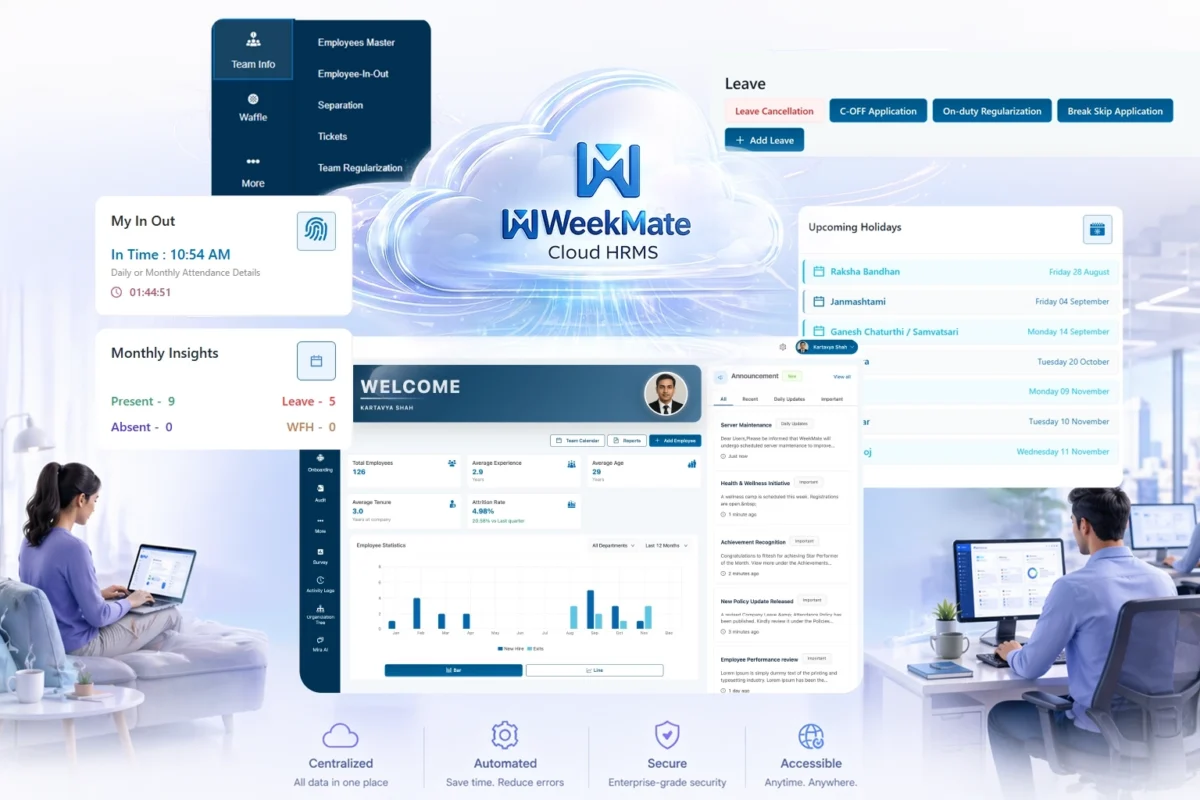
This is where the modern cloud-based HRMS software solution becomes the game-changer. It consolidates everything you need to manage a hybrid workforce into a single, secure, and accessible platform. Whether you are leading a growing IT services company in Bengaluru, a manufacturing business with field staff, or a startup with remote developers, digital HR solutions such as WeekMate HRMS can help you maintain organization and compliance, and grow your business without dealing with daily firefighting.

What is a Cloud HRMS System?

A cloud-based HRMS software is a web-hosted human resource management system that provides comprehensive functionalities for end to end management of human resource activities, and you can use it at any time from anywhere on your computer or mobile device.

Unlike the old HR systems, where documents were kept on Excel sheets or on desktops, and even physical files were stored in on-premises facilities, digital HR solutions are much more dynamic and automated.

Core modules typically include:

  • Centralized employee records
  • Automated payroll management system
  • Performance tracking and appraisals
  • Leave and attendance management
  • Recruitment and onboarding tools

For instance, WeekMate HRMS integrates these with AI-powered automation, along with the flexibility of cloud and on-premises deployment, which is ideal for Indian enterprises cautious about data privacy and compliance.

Understanding Hybrid Workforce Management

A hybrid work environment offers employees the option to work in the office, remotely, or a combination of both. Companies in India are embracing this to improve work-life balance, access wider talent pools (especially from Tier-2 and Tier-3 cities), and save on real estate costs. However, hybrid workforce management comes with unique challenges:

  • Communication gaffes between on-site and remote teammates.
  • Hard to track productivity without micromanaging.
  • Managing attendance, leaves, and shifts for employees in different locations and time zones
  • Ensuring fair performance evaluation across varied work setups.

Without the proper resources, these problems could swiftly lead to disengagement, mistakes, and even compliance risks under Indian labor regulations.

Key Challenges Without an HRMS in Hybrid Workplaces

Many businesses are still using unintegrated tools or manual processes. The result?

  • Endless back-and-forth for attendance and leave approvals.
  • Mismatched timesheets and holiday calendars lead to payroll mistakes.
  • Compliance shambles with PF, ESI, TDS, and state labor laws. 
  • The unavailability of centralized data makes it difficult to generate reports with ease or forecast workforce needs.

Leave and attendance management gets difficult, especially with some employees clocking in via biometric scans at the office and others working remotely. These inefficiencies consume HR time and disappoint employees.

Advantages of Cloud-Based HRMS for Hybrid Business

Migration to cloud HRMS software brings immediate and long-term benefits.

Employee Management in a Central Location

You have a unified database that serves as your powerful employee management software. HR, managers, and employees can all get up-to-date, accurate information from anywhere, whether in Mumbai or a hill station. No more searching through email or shared drives.

Streamlined Payroll Processing

An automated payroll management system computes salaries, deductions, taxes and produces payslips within minutes. It remains compliant with the latest Indian statutory requirements and helps avoid errors and payment delays that break employees’ trust.

Leave and Attendance Tracking 

Real-time leave and attendance management system supporting multiple modes. This includes biometrics for office staff, GPS/selfie-based for field force, and web login for remote workers. Approvals are faster through self-service portals, and WFH or comp-off tracking becomes effortless.

Enhanced Collaboration & Communication

Employees access self-service portals to view their records, request leave, or obtain payslips. Integrated engagement features and notifications ensure everyone is on the same page and minimize miscommunication in hybrid setups.

Improved Efficiency for the Organization

With cloud-based HRMS software eliminating manual work, HR teams are now free to focus on strategic activities. Data-driven insights using organizational efficiency tools help leaders make smarter decisions on hiring, promotions, and resource allocation.

The result of WeekMate HRMS is happier teams, fewer compliance risks, and tangible productivity gains. Many Indian SMEs claim to save 15-30 hours a month on routine HR tasks.

Features to Look for in the Best HRMS for Hybrid Workforce Management

There are several features to consider when searching for the best HRMS for hybrid workforce management:

When evaluating solutions for your needs, consider obtaining (or looking for) the following capabilities to help identify the best HRMS for hybrid workforce management:

  • Full cloud-based with excellent mobile access.
  • Automation of routine tasks such as paying employees and sending reminders.
  • Seamless integration with current software (time and attendance devices, accounting software, etc.).
  • Customizable dashboards and reports.
  • Data security at multiple levels, compliance, and role-based access.

WeekMate HRMS excels in this domain with its AI-based automation, support for remote/hybrid/office teams, and diverse configuration options.

Here’s a quick comparison table:

Feature

Traditional HR Systems

Cloud-Based HRMS (e.g., WeekMate)

Accessibility

Office-bound, desktop only Anytime, anywhere via cloud & mobile
Payroll Automation Manual calculations, high errors

Automated payroll management system with compliance

Leave & Attendance

Spreadsheets & registers Real-time tracking with multiple punch options
Scalability Limited, expensive upgrades

Grows easily with your team

Data Security & Compliance

Risk-prone Enterprise-grade with audit trails
Hybrid Workforce Support Poor

Excellent for remote + office teams

How Cloud HRMS Can Help You Grow Your Business?

And when your business grows, your cloud-based HRMS software grows with you. It enables advanced workforce planning, detects skill gaps using performance data, and enhances the overall employee experience, which is key to retaining employees in high-demand Indian markets.

When organizations adopt digital HR solutions like WeekMate, they advance their digital transformation. Instead of being a purely administrative function, HR today is a strategic partner in organizational productivity.

Real-World Use Cases

Remote Hiring: On the first day of work, a new employee in a different city or state can complete paperwork, sign documents online, and gain access to the system, all without ever setting foot in a physical office.

Multi-Office Payroll Processing: An organization with offices in Delhi and Hyderabad, along with remote teams, processes salaries smoothly in a single run, managing different state compliances like a breeze.

Distributed Teams Performance: Managers monitor goals and provide real-time feedback, ensuring that appraisals are fair whether an employee works from home or on the factory floor.

Such scenarios are all too familiar to Indian enterprises making the move to hybrid models after the pandemic.

Tips For Finding The Right HRMS

Assess your existing challenges and what you aim to accomplish in the future.

  1. Compare features, including hybrid workforce management and leave and attendance management.
  2. Review pricing and opt for clear models that don’t punish growth.
  3. Review user comments, the quality of support, and how easy it is to implement.
  4. Make sure the system meets Indian statutory requirements and provides a high level of data security.
  5. A brief demo or trial can say a lot about how easy the platform really is.

For more details, refer to this blog on How Cloud HRMS solves HR problems.

Final Thoughts

In today’s hybrid work world, old-school ways of working just aren’t cutting it. Good cloud-based HRMS software, such as WeekMate, is crucial for managing hybrid workforces, keeping operations running smoothly, and ensuring your employees are happy. It gives strength to a digital HR solution that automates payroll management, simplifies complex employee management tasks, and provides a framework for organizational efficiency tools to any business looking to grow.

By selecting the right system to invest in today, Indian companies can reduce risk, save time and money, and cultivate a workforce that is more engaged and productive, preparing them to meet the challenges of tomorrow. The benefits in terms of compliance, efficiency, and employee satisfaction are well and truly worth it. If your company is trying to figure out how to manage hybrid work, this is a great time to look into how a modern HRMS can revolutionize your people operations.

FAQs

1. What is cloud-based HRMS software, and why is it suitable for hybrid teams?

Cloud-based HRMS is software that can be accessed securely from anywhere via the internet. It’s perfect for hybrid businesses because it allows remote attendance, provides real-time updates, and keeps data centralized without the need for physical infrastructure.

2. How does an HRMS payroll management system comply with Indian regulations?

An automated payroll system accurately deducts PF, ESI, TDS, professional tax, and other statutory deductions. It produces compliant reports and payslips, minimizing errors and Audit risks for businesses across states.

3. Can cloud HRMS track leave and attendance for in-house & work-from-home employees?

Yes. Today’s solutions come with flexible leave and attendance management features, such as biometric on-site tracking, GPS/selfie for field workers, and web login for WFH, to ensure tracking is fair and accurate.

4. Is WeekMate HRMS the best HRMS for hybrid workforce management?

WeekMate HRMS is tailor-made for hybrid, remote, and in-office configurations. It includes AI automation, payroll, attendance, and employee lifecycle management, with adaptable cloud- and on-premises deployment, ideal for Indian SMEs and expanding organizations.

5. What are the advantages of digital HR solutions in hybrid work models?

Digital HR solutions lead to enhanced efficiency, reduced manual errors, improved employee experience through self-service, and actionable, data-led insights for stronger decision-making and organizational efficiency tools.

6. What is the time frame to deploy a cloud-based HRMS?

All but the earliest type of modern platform, including WeekMate, offer fast onboarding in the order of days to a few weeks, thanks to user-friendly interfaces, data import utilities, and dedicated customer support.

7. Can cloud HRMS boost employee engagement in hybrid working models?

Definitely. Self-service portals, transparent leave and payroll policies, and real-time communication tools make for more engaged and appreciated employees, even when they are dispersed geographically.

WeekMate HRMS vs PagarBook: Workforce Digitization Platforms Compared

In the fast-growing business environment of India, workforce digitization platforms India have become a need of the hour for boosting operational efficiency. The shift from manual to automated HR processes mitigates compliance-related challenges and administrative burdens, enabling organizations to focus on strategic initiatives. This transition is especially relevant for small and medium enterprises (“SMEs”) that are struggling with labor laws and workforce dynamics.

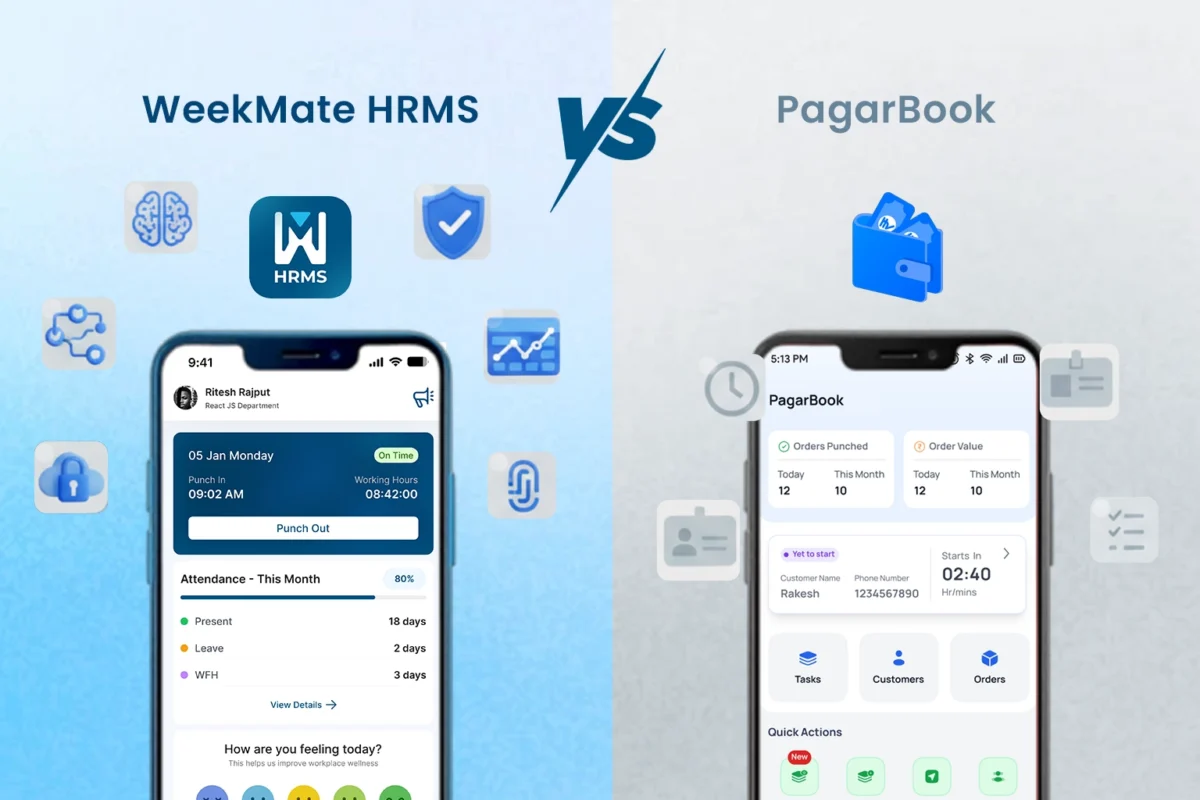
This WeekMate HRMS vs PagarBook is an HR software comparison India companies should consider. The analysis of these two software products is intended to help SMEs find the best employee management software in India by evaluating their features, UI, and usability. Finally, the comparison shows that one solution offers much greater scalability and a deeper feature set in this payroll and attendance software comparison.

Highlights of Workforce Digitization in India

Workforce digitization platforms India include a set of digital software and tools that covers end to end human resource functions like hiring, payroll, and performance management via SaaS and mobile-enabled platforms. This is driven by several factors from the Indian perspective.

The rise of remote and hybrid work means there needs to be a robust system in place to monitor employees in other locations. Also, the confusing maze of compliances, such as provident fund and tax deductions, must be accurately automated, or penalties may result. The growing adoption of digital tools among SMEs contributes another layer to this trend, along with national programmes encouraging technological integration.

Payroll and attendance software play an important role in this system by providing automation that can reduce errors by as much as 90%. The Indian HRMS market is anticipated to reach a value of USD 870.46 million by 2025 and is expected to grow at a CAGR of 17.34% to around USD 1.2 billion by 2027 from 2020. In a country having more than 74.7 million MSMEs that provide jobs to over 328 million people, these platforms are crucial for growth that is not just rapid but sustainable.

Platform Overview
WeekMate HRMS – Company & Product Snapshot

WeekMate HRMS is designed for SMEs and startups and is also relevant for large enterprises in need of customizable HR solutions. It is cloud platform-based software with Web and Mobile Interfaces, offering on-the-go accessibility. As powerful employee lifecycle management software, it processes everything from talent acquisition to separation, applying artificial intelligence along the way for smarter decision-making.

PagarBook – Company & Product Snapshot

PagarBook caters to the needs of micro, small and medium enterprises primarily in the retail and on-site business. Its emphasis on mobile accessibility facilitates quick management for dispersed teams. It has found favor with industries that benefit from simple worker oversight and payroll management, though it is more concentrated on basic functions.

Feature-by-Feature Comparison

Employee Database & Lifecycle Management

Having records centralized digitally makes it easier to search for data, and securely storing important documents keeps them safe. Onboarding and offboarding automation to reduce paperwork.

In this HR software comparison India, WeekMate exceeds PagarBook in terms of intelligent automation-based employee lifecycle management software.

Feature

WeekMate HRMS

PagarBook

Digital Records Advanced database with customizable attributes and deep employee history. Standard profiles with basic contact and identity options.
Document Storage Encrypted cloud with versioning, role-based access, and tracking history. Elementary file uploads for basic compliance and ID proofing.
Onboarding/Exit Streamlined automation including digital signatures and asset tracking. Primarily manual procedures with minimal checklist support.
Depth of Utility Complete cycle coverage: Recruitment, payroll, performance, and offboarding. Limited scope: Focused primarily on attendance and wage calculations.

Attendance and Timesheet Management

Options such as biometric, location-based, or app-based tracking ensure accuracy, while roster management and overtime control promote equal treatment.

WeekMate offers more features in terms of timesheet and productivity tracking with analytics tools, while PagarBook is basic in its functionalities.

Feature

WeekMate HRMS

PagarBook

Attendance Methods Multiple, including facial recognition and geolocation Photo and position-based basics
Shift Scheduling Intelligent, adaptive planning Standard manual setup
Overtime Tracking Rule-based automation Hands-on computations
Productivity Tracking Interactive visuals and metrics Minimal overviews

Leave Management System Comparison

Flexible policy configurations, automatic balance updates, and unified calendars make administration effortless. Approval processes and self-initiated requests enhance efficiency.

The leave management system comparison shows that WeekMate is more advanced than PagarBook.

Feature

WeekMate HRMS

PagarBook

Policy Configuration Extensive tailoring for various scenarios Preset formats
Accrual Automation Dynamic, adjusted calculations Fundamental tracking
Approvals/Requests App-enabled reviews and submissions Limited application features
Integration Linked to compensation and insights Independent operation

Payroll Processing Automation

Dynamic salary components, real-time computations, and transaction processing ensure accurate disbursements and error-free documents.

WeekMate’s payroll processing automation is also more reliable thanks to native validations.

Feature

WeekMate HRMS

PagarBook

Structures Versatile element designs Fixed patterns
Calculations Smart batch handling Guideline-driven, less agile
Deductions/Reimbursements Dedicated modules for claims Essential management
Payslips Tailored distributions Uniform layouts

Compliance & Statutory Payroll

Contributions management (e.g., ESI) and Taxes Compliance, Localization, and Reports.

WeekMate proved to be superior in compliance and statutory payroll consistency.

Feature

WeekMate HRMS

PagarBook

Statutory Handling Thorough automatic support Selective, often manual
State Support Nationwide, with updates Core coverage
Filings/Reports Direct submission links Exportable formats

Employee Self-Service Portal

Access securely using your phone, check your records, download your documents, update your details, and get in touch internally.

WeekMate’s employee self-service portal offers broader functionality.

Feature

WeekMate HRMS

PagarBook

Mobile Access Extensive application tools Core utilities
Views/Downloads Detailed interfaces Restricted displays
Updates/Communication Editable info and messaging Simple modifications

HR Analytics & Reporting

Ready-made reports, your own views and trends, and actionable workforce insights.

WeekMate delivers more advanced HR analytics and reporting.

Feature

WeekMate HRMS

PagarBook

Reports/Dashboards Bespoke, intelligence-enhanced Conventional summaries
Insights/Analytics Forward-looking evaluations Elementary data

User Experience & Interface

WeekMate features a user-friendly design, multilingual support, and fast setup, and is accessible on all devices with equal ease. PagarBook robs the desktop of any bells and whistles you could ask for, instead focusing on convenience and features that would fit minimal needs.

Integrations & Ecosystem

WeekMate is easily integrated with financial systems, verification hardware and open APIs for custom applications. PagarBook is not as integratable with other products, though it does have some very narrow connections to transaction services.

Customer Support & Implementation

WeekMate comes with a guided, intuitive, educational setup process, and you will also receive our friendly, active support across multiple channels. PagarBook offers in-app support, but answers to complex issues might take longer.

Security & Data Privacy

Both subscribe to industry standards, but WeekMate introduced enhanced security, access control and recovery measures to keep data protection on a higher level.

Use-Case Suitability

When selecting an employee management software India, the scale and vision of an organization generally matter. WeekMate is great for growing businesses.

  • Best for micro & small businesses: PagarBook does basic monitoring. 
  • Best for scaling SMEs: WeekMate provides comprehensive automation.

Industry fit:

  • Software & IT: WeekMate’s metrics.
  • Manufacturing: WeekMate’s scheduling.
  • BPO: WeekMate’s compliance tools.
  • Pharmacy: The full management of WeekMate.
  • Accounting: WeekMate’s integrations.

Which Platform is Better for SMEs?

WeekMate is favoured in the WeekMate HRMS vs PagarBook comparison for its cost-effectiveness, support for growing teams, compliance requirements, and process complexity. For a growing company with 50 employees looking to get productive, WeekMate offers end-to-end support; PagarBook accommodates smaller, mobile businesses.

Final Thoughts

This HR software comparison India focuses on highlighting the pros of WeekMate in workforce digitization platforms India. Go with WeekMate HRMS for holistic, futuristic offerings; go with PagarBook for bare-bones, basic needs. The development of payroll and attendance software comparison indicates futuristic, AI-powered systems such as WeekMate will drive the evolution of HR solutions in India.

FAQs

1. Why is WeekMate HRMS better suited for SMEs as compared to PagarBook?

WeekMate HRMS is better suited for SMEs, as it provides a comprehensive platform for handling all aspects of HR, payroll, attendance, and productivity management. Whereas PagarBook is more appropriate for small businesses that want to manage payroll and staff records with basic functionality.

2. Do WeekMate HRMS and PagarBook provide statutory payroll compliance in India?

Yes, Indian Statutory compliances such as PF, ESI, TDS, and professional tax calculations are supported on both platforms. While WeekMate includes more automated compliance updates, comprehensive audit trails, and multi-layered reporting that help reduce errors.

3. How do their attendance and leave management systems compare?

WeekMate offers advanced attendance features, including biometric integration and shift scheduling, as well as more detailed timesheets and productivity reports. PagarBook does have basic attendance and leave management, but no advanced workforce analytics.

4. Is there an employee self-service portal for both platforms?

Both provide employee self-service portals that allow employees to view payslips and leave balances. WeekMate has a more comprehensive portal that includes features such as document management, performance insight, and real-time notifications.

5. Can WeekMate HRMS and PagarBook be integrated with other business apps?

WeekMate offers a number of third-party and API integrations to sync with your accounting, CRM, and productivity applications. The complexity of integration in PagarBook is higher, so growing companies may find it more challenging to automate their business.

6. What are the benefits of WeekMate?

WeekMate is simplifying the complex HR processes by bringing payroll, attendance, compliance and performance management under one roof. It eliminates manual errors, increases productivity, enables monitoring, and boosts employee experience with self-service and automation solutions.

Become A Partner